Strontium atomic clock demonstrates super-fine 'ticks'
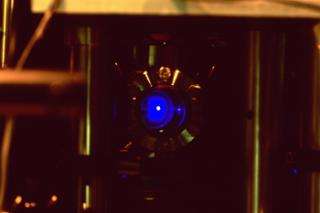
Using an ultra-stable laser to manipulate strontium atoms trapped in a "lattice" made of light, scientists at JILA have demonstrated the capability to produce the most precise "ticks" ever recorded in an optical atomic clock—techniques that may be useful in time keeping, precision measurements of high frequencies, and quantum computers using neutral atoms as bits of information.
The JILA strontium lattice design, described in the December 1 issue of Science, is a leading candidate for next-generation atomic clocks that operate at optical frequencies, which are much higher than the microwaves used in today's standard atomic clocks and thus divide time into smaller, more precise units. JILA is a joint institution of the Commerce Department's National Institute of Standards and Technology and the University of Colorado at Boulder.
The JILA group, led by NIST Fellow Jun Ye, achieved the highest "resonance quality factor"—indicating strong, stable signals when a very specific frequency of laser light excites the atoms—ever recorded in coherent spectroscopy, or studies of interactions between matter and light. "We can define the center, or peak, of this resonance with a precision comparable to measuring the distance from the Earth to the Sun with an uncertainty the size of a human hair," says first author Martin Boyd, a CU-Boulder graduate student. This enabled observation of very subtle sublevels of the atoms' electronic energy states created by the magnetic "spin" of their nuclei.
The new strontium clock is among the best optical atomic clocks described to date in the published literature. It is currently less accurate overall than NIST's mercury ion (charged atom) clock. Although the strontium clock operates at a lower optical frequency, with fewer than half as many ticks per time period, the JILA clock produces much stronger signals, and its "resonant" frequency—the exact wavelength of laser light that causes the atoms to switch back and forth between energy levels—was measured with higher resolution than in the mercury clock. The result is a frequency "ruler" with finer hash marks.
Improved time and frequency standards have many applications. For instance, ultra-precise clocks can be used to improve synchronization in navigation and positioning systems, telecommunications networks, and wireless and deep-space communications. Better frequency standards can be used to improve probes of magnetic and gravitational fields for security and medical applications, and to measure whether "fundamental constants" used in scientific research might be varying over time—a question that has enormous implications for understanding the origins and ultimate fate of the universe.
One of JILA's major innovations enabling the new level of precision is a customized probe laser that is highly resistant to "noise" caused by vibration and gravity, based on a compact, inexpensive design originally developed by 2005 Nobel Laureate Jan Hall, a Fellow and senior research associate at JILA.
The laser can be locked reliably on a single atomic frequency, 430 trillion cycles per second (terahertz) with a "linewidth" or uncertainty of under 2 Hertz, 100 times narrower (or more precise) than the Ye group's previously published measurements of the strontium lattice clock.
The lattice consists of a single line of 100 pancake-shaped wells — created by an intense near-infrared laser beam — each containing about 100 atoms of the heavy metal strontium. The lattice is loaded by first slowing down the atoms with blue laser light and then using red laser light to further cool the atoms so that they can be captured. Scientists detect the atoms' "ticks" (430 trillion per second) by bathing them in very stable red light at slightly different frequencies until they find the exact frequency that the atoms absorb best.
Optical lattices constrain atom motion and thereby reduce systematic errors that need to be managed in today’s standard atomic clocks, such as NIST-F1, that use moving balls of cold atoms. Lattices containing dozens of atoms also produce stronger signals than clocks relying on a single ion, such as mercury. In addition, the JILA clock ensures signal stability—a particular challenge with large numbers of atoms—by using a carefully calibrated lattice design to separate control of internal and external atom motions. Similar work is under way at a number of standards labs across the globe, including the NIST ytterbium atoms work.
The JILA work may enable quantum information to be processed and stored in the nuclear spins of neutral atoms, and enable logic operations to proceed for longer periods of time. The enhanced measurement precision also could make it easier for scientists to use optical lattices to engineer condensed matter systems for massively parallel quantum measurements.
Citation: M.M. Boyd, T. Zelevinsky, A.D. Ludlow, S.M. Foreman, S. Blatt, T. Ido, and J. Ye. Optical atomic coherence at one second time scale. Science. Dec. 1, 2006.
Source: NIST


