New Horizons Gets First Glimpse of Pluto
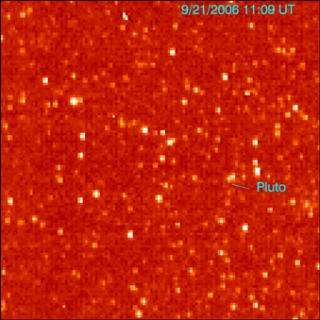
The New Horizons team got a faint glimpse of the mission's distant, main planetary target when one of the spacecraft's telescopic cameras spotted Pluto for the first time.
The Long Range Reconnaissance Imager (LORRI) took the pictures during an optical navigation test on Sept. 21-24, and stored them on the spacecraft's data recorder until their recent transmission back to Earth. Seen at a distance of about 4.2 billion kilometers (2.6 billion miles) from the spacecraft, Pluto is little more than a faint point of light among a dense field of stars. But the images prove that the spacecraft can find and track long-range targets, a critical capability the team will use to navigate New Horizons toward 2,500-kilometer wide Pluto and, later, one or more 50-kilometer sized Kuiper Belt objects.
Mission scientists knew they had Pluto in their sights when LORRI detected an unresolved "point" in Pluto's predicted position, moving at the planet's expected rate of motion across the constellation of Sagittarius near the plane of the Milky Way galaxy. Pluto appears in all three images of that region of space LORRI photographed on Sept. 21 and Sept. 24, confirming that it was "real" and not a cosmic ray or other object. For further confirmation, the object moving along Pluto's predicted path in the sky has a visual magnitude (brightness) a little brighter than 14, just what could be expected from Pluto at that time and that distance from New Horizons.
To analyze the images for their moving target, the team actually pulled a page out of Clyde Tombaugh's Pluto discovery book, stroboscopically switching between multiple images of the same area taken days apart. Using this technique, objects such as stars appear stationary, but moving targets, such as a planet, are easily seen jumping between positions against the star field.
"Finding Pluto in this dense star field really was like trying to find a needle in a haystack," says New Horizons Principal Investigator Alan Stern, of the Southwest Research Institute. "Clyde Tombaugh would have been proud because the LORRI team had to use the same technique that served him so well in discovering Pluto, but because LORRI produces digital images, they could avoid all the messy chemicals Clyde needed to develop the photographic plates!"
LORRI, designed and built by the Johns Hopkins University Applied Physics Laboratory (APL), is crafted to obtain images at the highest possible resolution from the longest possible distance. This latest optical navigation test simulated the conditions under which LORRI will be required to find a Kuiper Belt object (and potential flyby target) as New Horizons approaches Pluto.
"LORRI passed this test with flying colors, because Pluto's signal was clearly detected at 30 to 40 times the noise level in the images," says New Horizons Project Scientist Hal Weaver of APL.
"Those of us who calibrated LORRI on the ground and in flight are not surprised to see what it can do, but we are mighty grateful that LORRI has survived launch and its first several months in space without any loss of performance," says LORRI Principal Investigator Andy Cheng, of APL. "We'll have to wait until early 2015 for LORRI to return better views of Pluto than have ever been seen before. In the meantime, we're looking forward to viewing the marvels of the Jupiter system this coming January and February."
Just beyond the Jupiter encounter, Stern says, the team will use LORRI to begin collecting valuable data on Pluto itself.
"We won't get useful science out of these first detections of Pluto," he says. "But during the next several years of approach, we'll use LORRI to study Pluto's brightness variation with our angle to the Sun to build a 'phase curve' we could never get from Earth or Earth orbit. This will allow us to derive new information about Pluto's surface properties even while we are still far away.
Source: NASA


