Genetically engineered blood protein can be used to split water into oxygen and hydrogen
December 1, 2006 Genetically engineered blood protein can be used to split water into oxygen and hydrogen

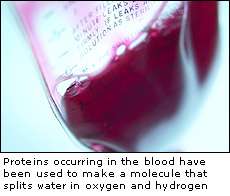
Scientists have combined two molecules that occur naturally in blood to engineer a molecular complex that uses solar energy to split water into hydrogen and oxygen, says research published today in the Journal of the American Chemical Society.

This molecular complex can use energy from the sun to create hydrogen gas, providing an alternative to electrolysis, the method typically used to split water into its constituent parts. The breakthrough may pave the way for the development of novel ways of creating hydrogen gas for use as fuel in the future.

Professors Tsuchida and Komatsu from Waseda University, Japan, in collaboration with Imperial College London, synthesised a large molecular complex from albumin, a protein molecule that is found at high levels in blood serum, and porphyrin, a molecule which is used to carry oxygen around the body and gives blood its deep red colour. Porphyrin molecules are normally found combined with metals, and in their natural state in the blood they have an iron atom at their centre. The scientists modified the porphyrin molecule to swap the iron for a zinc atom in the middle, which completely changed the chemistry and characteristics of the molecule.

This modified porphyrin molecule was then combined with albumin; with the albumin molecule itself being modified by genetic engineering to enhance the efficiency of the process. The resulting molecular complex was proven to be sensitive to light, and can capture light energy in a way that allows water molecules to be split into molecules of hydrogen and oxygen.

Dr Stephen Curry, a structural biologist from Imperial College London's Division of Cell and Molecular Biology who participated in the research explains: "This work has shown that it is possible to manipulate molecules and proteins that occur naturally in the human body by changing one small detail of their make-up, such as the type of metal at the heart of a porphyrin molecule, as we did in this study.

"It's very exciting to prove that we can use these biological structures as a conduit to harness solar energy to separate water out into hydrogen and oxygen. In the long term, these synthetic molecules may provide a more environmentally friendly way of producing hydrogen, which can be used as a 'green' fuel."

Source: Imperial College London


print this article email this article download pdf blog this article bookmark this article     Stumble it Digg this share on Facebook retweet share on Reddit add to delicious
Rate this story - 4.8 /5 (167 votes)


December 1, 2006 all stories

Comments: 0

4.8 /5 (167 votes)
  • Stumble this up

  • Digg this

  • share this

  • hide
  • Related Stories


Other News

Accidental discovery produces durable new blue pigment for multiple applications

Accidental discovery produces durable new blue pigment for multiple applications

Chemistry / Biochemistry

created Nov 16, 2009 | popularity 4.5 / 5 (30) | comments 6

An accidental discovery in a laboratory at Oregon State University has apparently solved a quest that over thousands of years has absorbed the energies of ancient Egyptians, the Han dynasty in China, Mayan ...


One word: bioplastics

One word: bioplastics

Chemistry / Materials Science

created Nov 17, 2009 | popularity 4.5 / 5 (11) | comments 4

(PhysOrg.com) -- Every year, more than 250 billion pounds of plastic are produced worldwide. Much of it ends up in the world's oceans, a fact that troubles MIT biology professor Anthony Sinskey.


New on-off 'switch' triggers and reverses paralysis in animals with a beam of light

New on-off 'switch' triggers and reverses paralysis in animals with a beam of light (w/ Video)

Chemistry / Biochemistry

created Nov 18, 2009 | popularity 4.8 / 5 (5) | comments 3

In an advance with overtones of Star Trek phasers and other sci-fi ray guns, scientists in Canada are reporting development of an internal on-off "switch" that paralyzes animals when exposed to a beam of ultraviolet ...


New research provides blueprint for molecular basis of global warming

New research provides blueprint for molecular basis of global warming

Chemistry / Materials Science

created Nov 17, 2009 | popularity 4 / 5 (4) | comments 3

A new study indicates that major chemicals most often cited as leading causes of climate change, such as carbon dioxide and methane, are outclassed in their warming potential by compounds receiving less attention.


Ethanol

Microbes to Take Over Ethanol Production?

Chemistry / Biochemistry

created Nov 20, 2009 | popularity 3.5 / 5 (6) | comments 0

(PhysOrg.com) -- Not too long ago, it seemed that ethanol production was the wave of the future. The use of trash, wood chips or different types of plants -- usually grass or corn -- to make ethanol was considered ...