A Giant Among Minnows: Giant Danio Can Keep Growing
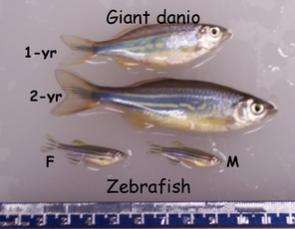
Two fish that share much in common genetically appear to have markedly different abilities to grow, a finding that could provide a new way to research such disparate areas as muscle wasting disease and fish farming, a new study shows.
The study in the November issue of the American Journal of Physiology-Regulatory, Integrative and Comparative Physiology, finds that the giant danio, unlike its cousin the zebrafish, appears to have the ability to recruit new muscle throughout its life. Humans have the same ability before birth, but mostly lose it after birth.
Because the zebrafish and giant danio are closely related, and the zebrafish’s genome has already been mapped, scientists hope they can more easily identify the genetic keys to the difference in growth potential between them. According to co-author Peggy R. Biga, “I don’t think there will be a major genomic difference between them. I believe it will be easy to define the difference.”
The study “Zebrafish and giant danio as models for muscle growth: Determinate versus indeterminate growth as determined by morphometric analysis,” was carried out by Biga and Frederick W. Goetz, both of the University of Wisconsin-Milwaukee and the Great Lakes Wisconsin Aquatic Technology and Environmental Research (WATER) Institute, Milwaukee. The American Physiological Society published the study.
Zebrafish versus Giant Danio
Zebrafish and giant danios, members of the minnow family, are easy to raise and are popular inhabitants of home aquariums. They are native to the warm waters around India and some other areas of southern Asia. Although both are small, the danio is a giant among minnows, growing to a maximum of six inches. The zebrafish, in contrast, grows to about two inches.
The zebrafish has been a staple of genetic research because it is easy to raise and maintain. But the fish is too tiny for physiological research. So the researchers were interested in finding a close zebrafish relative to allow them to do physiological research while drawing on the knowledge base of the zebrafish genome.
The researchers saw the giant danio as the physiological model and began a series of experiments on differences in muscle growth between the fish. In this two-phased experiment, they discovered that the giant danio can keep growing even into adulthood, but the zebrafish stops growing. The giant danio can get bigger because it exhibits a type of muscle growth that is different from the zebrafish.
“One of these species either lost or gained the ability to continuously grow, but most likely, the zebrafish lost it” Biga explained. Because genes are the key, the zebrafish’s mapped genome will be invaluable in finding what is different about the danio’s genetic pathways that allow it to keep growing.
Study: Phase I - First four weeks of life
In the first phase of the study, the researchers tracked the size of the fish from the time they hatched through the first four weeks of their larval stage. They found that the two species were the same size at hatch. By the end of week one, the giant danio was significantly larger and remained so. This result was not surprising, since the giant danio is so much larger at adulthood, about twice as large. But the study was the first to report the early larval growth of these species, the authors said.
The researchers also documented muscle changes over the first four weeks in the fleshy portion of the fish’s midsection, known as the myotome. They measured growth in length and width and tracked the number and size of muscle fibers, and found that the fish employ different methods of growth.
“Muscle growth in vertebrates is defined as being either determinate or indeterminate,” the authors wrote. “Animals such as mammals exhibit determinate growth, in which there is a finite size. In contrast, many fish species growth is indeterminate, in which there is no fixed size and some growth may continue throughout the life of the fish.”
Indeterminate growers increase muscle mass both by recruiting new muscle fibers (hyperplasia) and by increasing the size of the existing muscle fibers (hypertrophy). Many fish species exhibit indeterminate (hyperplastic) growth.
In this first phase of the study, the researchers found that hyperplasia accounts for 67 percent of the giant danio’s muscle growth, compared to the zebrafish in which hyperplasia accounts for only 47 percent of the growth.
Study: Phase II - Adult growth
In the study’s second phase, the researchers applied growth hormone once every three weeks for 17 weeks to adults of both species. The adult danio continued to grow during the 17-week trial and analysis of muscle fibers showed hyperplastic muscle growth.
Adult zebrafish did not exhibit increased growth or hyperplasia in response to growth hormone, suggesting that zebrafish reach a growth plateau similar to mammals and hence exhibit determinate growth. The zebrafish exhibited little hyperplastic growth after the juvenile phase.
Next step
This model can be used to investigate muscle wasting diseases such as muscular dystrophy. Other studies have already shown that a condition similar to muscular dystrophy can be experimentally induced in zebrafish. One of the next steps for the researchers is to induce the condition in the giant danio.
“We anticipate that the giant danio will be able to handle the muscular dystrophy better because of their ability to increase muscle,” Biga said. What makes this intriguing is that human embryos exhibit hyperplasia, but then lose that ability after birth, with one exception. When humans injure a muscle, the muscle sends a signal to special cells attached to the muscle fibers, telling these cells to grow and join to adjacent muscle fiber to repair the injury.
There is also an application to fish farming. “If we understood how fish grow, we could figure out strategies for enhancing the growth of farmed fish such as Atlantic salmon and decrease the time to get to market size. “The more we understand about growth, the more likely we can come up with acceptable ways to enhance it,” she said.
Source: American Physiological Society


