Negative Vibes From Space
December 1, 2006 Negative Vibes From Space

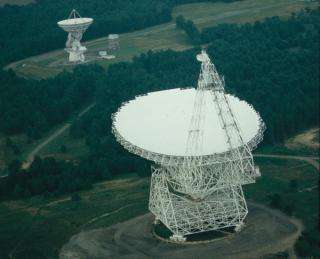
Green Bank Telescope. Credit: NRAO

Astronomers have discovered the first negatively charged molecule in space, identifying it from radio signals that were a mystery until now. While about 130 neutral and 14 positively charged molecules are known to exist in interstellar space, this is the first negative molecule, or anion, to be found.

"We've spotted a rare and exotic species, like the white tiger of space," said astronomer Michael McCarthy of the Harvard-Smithsonian Center for Astrophysics (CfA).

By learning more about the rich broth of chemicals found in interstellar space, astronomers hope to explain how the young Earth converted these basic ingredients into the essential chemicals for life. This new finding helps to advance scientists' understanding of the chemistry of the interstellar medium, and hence the birthplaces of planets.

McCarthy worked with CfA colleagues Carl Gottlieb, Harshal Gupta (also from the Univ. of Texas), and Patrick Thaddeus to identify the molecular anion known as C6H-: a linear chain of six carbon atoms with one hydrogen atom at the end and an "extra" electron. Such molecules were thought to be extremely rare because ultraviolet light that suffuses space easily knocks electrons off molecules. The large size of C6H-, larger than most neutral and all positive molecules known in space, may increase its stability in the harsh cosmic environment.

"The discovery of C6H- resolves a long-standing enigma in astrochemistry: the apparent lack of negatively charged molecules in space," stated Thaddeus.

The team first conducted laboratory experiments to determine exactly what radio frequencies to use in their search. Then, they used the National Science Foundation's Robert C. Byrd Green Bank Telescope to hunt for C6H- in celestial objects. In particular, they targeted locations in which previous searches had spotted unidentified radio signals at the appropriate frequencies.

They found C6H- in two very different locations-a shell of gas surrounding the evolved red giant star IRC +10216 in the constellation Leo, and the cold molecular cloud TMC-1 in Taurus. The presence of the anion in both regions shows that the chemical processes that form C6H- are ubiquitous. It also suggests that other molecular anions are present and will be found in the near future.

"This finding is dramatic evidence that our understanding of interstellar chemistry is still quite rudimentary. It also implies that more molecular anions, perhaps many, may now be found in the laboratory and in space," said McCarthy.

This research will appear in the December 1 issue of The Astrophysical Journal Letters.

Source: Harvard-Smithsonian Center for Astrophysics


print this article email this article download pdf blog this article bookmark this article     Stumble it Digg this share on Facebook retweet share on Reddit add to delicious
Rate this story - 4.5 /5 (75 votes)


December 1, 2006 all stories

Comments: 0

4.5 /5 (75 votes)
  • Stumble this up

  • Digg this

  • share this

  • hide
  • Related Stories

  • Scientists Reproduce a Building Block of Life in Laboratory
    created Nov 06, 2009 | popularity not rated yet | comments 0
  • NRL sensor provides critical space weather observations
    created Nov 03, 2009 | popularity not rated yet | comments 0
  • Fantastic Voyage
    created Nov 02, 2009 | popularity not rated yet | comments 0
  • Interactions with Aerosols Boost Warming Potential of Some Gases
    created Oct 29, 2009 | popularity not rated yet | comments 0
  • The Sun's Sneaky Variability
    created Oct 28, 2009 | popularity not rated yet | comments 0


  • hide
  • Relevant PhysicsForums posts

  • The shape of our solar system's orbits.
    created Nov 07, 2009
  • Above or Below the Line of Nodes
    created Nov 07, 2009
  • Supernova vs. Nova?
    created Nov 07, 2009
  • Supernova's Gamma Rays and Comets
    created Nov 06, 2009
  • More from Physics Forums - General Astronomy

Other News

The GOES-12 satellite sees Large Hurricane Ida nearing landfall

The GOES-12 satellite sees Large Hurricane Ida nearing landfall

Space & Earth / Earth Sciences

created 3 minutes ago | popularity not rated yet | comments 0

Residents of the U.S. Gulf coast thought they were getting a break this hurricane season until Ida showed up. Today, November 9, Ida is a hurricane and is headed for a landfall in the western Florida Panhandle ...


Scientists seek safe carbon dioxide storage for 'greener' power generation (w/ Video)

Space & Earth / Environment

created 19 minutes ago | popularity not rated yet | comments 0

The U.S. Department of Energy (DOE) has announced plans to fund research at the University of Alabama at Birmingham (UAB) School of Engineering on technologies that would help reduce greenhouse gas emissions through the capture ...


Antarctica glacier retreat creates new carbon dioxide store

Antarctica glacier retreat creates new carbon dioxide store

Space & Earth / Earth Sciences

created 3 hours ago | popularity 5 / 5 (1) | comments 1

Large blooms of tiny marine plants called phytoplankton are flourishing in areas of open water left exposed by the recent and rapid melting of ice shelves and glaciers around the Antarctic Peninsula. This ...


Success in 'space elevator' competition (AP)

Success in 'space elevator' competition (Update 3)

Space & Earth / Space Exploration

created Nov 05, 2009 | popularity 4.3 / 5 (33) | comments 53

(AP) -- A robot powered by a ground-based laser beam climbed a long cable dangling from a helicopter on Wednesday to qualify for prize money in a $2 million competition to test the potential reality of the ...


In a Galaxy Far, Far Away...

In a Galaxy Far, Far Away...

Space & Earth / Astronomy

created Nov 06, 2009 | popularity 4.8 / 5 (5) | comments 15

(PhysOrg.com) -- Astronomers have published the discovery of the farthest known object in the cosmos: a star that exploded when the universe was only 630 million years old -- only 4.6% of its current age. ...