A New Paradigm for Lunar Orbits
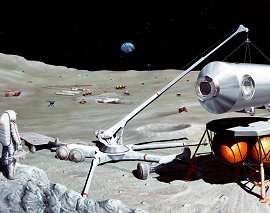
It's 2015. You're NASA's chief engineer designing a moonbase for Shackleton Crater at the Moon's south pole. You're also designing a com-system that will allow astronauts constant radio contact with Earth.
But you know that direct transmissions won't work--not always. As seen from Shackleton Crater, Earth is below the horizon for two to three weeks each month (depending on the base's location). This blocks all radio signals, which travel line of sight.
The solution seems obvious. Simply place a satellite in a high, circular orbit going almost over the Moon's poles. Better yet, place three satellites into the same orbit 120 degrees apart. Two would always be above the lunar horizon to relay messages to and from Earth.
There's just one problem.
"High-altitude circular orbits around the Moon are unstable," says Todd A. Ely, senior engineer for guidance, navigation, and control at NASA's Jet Propulsion Laboratory. "Put a satellite into a circular lunar orbit above an altitude of about 430 miles and it'll either crash into the lunar surface or it'll be flung away from the Moon altogether in a hyperbolic orbit." Depending on the specific orbit, this can happen fast: within tens of days.
Why? Earth is responsible. The gravity of massive Earth only 240,000 miles from the Moon constantly tugs on lunar satellites. For a lunar orbit higher than 430 miles, Earth's pull is actually strong enough to whisk a spacecraft out of the game.
Satellites in Earth orbit don't experience this sort of interference from the Moon. The Moon has just 1/80th Earth's mass—scarcely more than 1%. Relatively speaking, the Moon is a gravitational pipsqueak. Indeed, to any satellite in Earth orbit, the gravitational pull of the Sun is 160 times stronger than any lunar influence.
Any satellite in orbit around the Moon higher than about 430 miles, however, finds itself in a kind of celestial tug-of-war between Moon and Earth. Earth's pull can actually change the shape of an orbit from a circle to an elongated ellipse.
Stable circular lunar orbits do exist below an inclination of 39.6º, says Ely, but they spend so much time near the equator that "they are terrible orbits for covering the poles."
NASA wants to explore the Moon's polar regions for many reasons--not least is that deep polar craters may contain ice, which astronauts could harvest and melt for drinking or split into hydrogen and oxygen for rocket fuel and other uses. The instability of polar orbits poses a real problem for exploration.
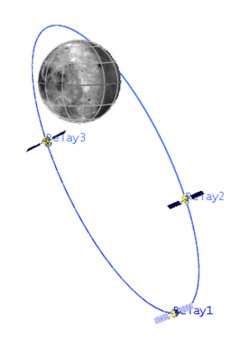
Now for the good news. Ely and several colleagues have discovered a whole new class of "frozen" or stable high-altitude lunar orbits. Pictured right, they are all inclined at steep angles to the Moon's equatorial plane so they get far above the horizon at the lunar poles, and--surprise--they are all also quite elliptical.
"For better South Pole coverage, you want an ellipse with an eccentricity of about 0.6, which is pretty oval," Ely says. An eccentricity of 0 is a circle, along which a satellite travels at a constant speed around a primary body (say, the Moon) at its center. With Earth nearby, that's out of the question: "An inclined circular orbit is kind of a blank canvas where Earth can quickly work its will," Ely says.
In contrast, an eccentricity of 0.6 is an ellipse about as oval as an American football minus the pointed ends; the Moon would be at one focus of the ellipse. "The ellipse effectively 'locks in' the satellite's behavior to make it tougher for Earth to change," Ely explains. [See the appendix below for details.] How stable are they? Ely and his colleagues calculate that certain elliptical, high-inclination, high-altitude lunar orbits may remain stable for periods of at least a century. Indeed, Ely hypothesizes the orbits could last indefinitely.
For lunar communications and navigation, Ely recommends spacing three satellites 120º apart in the same elliptical orbit at an inclination of 51º. Each satellite in turn would go screaming down past periapsis (closest approach to the lunar surface) only 320 miles above the north lunar pole, but would each linger fully 8 hours of its 12-hour orbit at 4,800 miles (8,000 km) above the horizon over the south lunar pole. In this configuration, two of the three satellites would always be in radio line-of-sight from a South Pole moonbase.
High-inclination, highly elliptical orbits being cheapest and most stable for communications satellites around the Moon? To Earth-centered satellite engineers used to thinking in terms of circular equatorial orbits, "it's a new paradigm," Ely declares.
Source: Science@NASA, by Trudy E. Bell


