Purveyors of the Cosmic 'Occult'
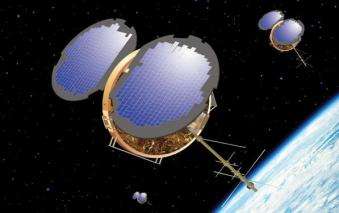
To a non-scientist, the words 'radio occultation' might sound a little spooky. But this relatively simple NASA-developed technology at the heart of a new satellite network named Cosmic is proving to be a powerful new tool for weather and climate forecasting.
Launched April 14, 2006, the six spacecraft of the Constellation Observing System for Meteorology, Ionosphere and Climate measure the bending and slowing of microwave radio signals as they pass through Earth's atmosphere. The signals are transmitted from U.S. global positioning system (GPS) satellites to Cosmic's GPS science receivers, which were designed by NASA's Jet Propulsion Laboratory. These bending and slowing events, referred to as occultations, occur when the GPS satellite signals are interrupted as the satellites rise or set on Earth's horizon, blocking their transmission.
By precisely measuring -- to a few trillionths of a second -- the time delay from this bending, scientists can infer information on atmospheric conditions such as air density, temperature, moisture, refractivity, pressure and electron density. This makes GPS radio occultation a powerful new tool for weather and climate forecasting and space weather research. Now, with Cosmic, the technology appears poised to take off.
A joint endeavor between several U.S. and Taiwanese agencies and institutions, Cosmic is currently feeding real-time, weather balloon-quality data on Earth's atmosphere every day, over thousands of points on Earth. Temperature and water vapor profiles derived from Cosmic will help meteorologists improve many areas of weather prediction and observe, research and forecast hurricanes, typhoons and other storm patterns over the oceans. Over time, the mission should be a boon to scientists studying long-term climate change trends. Cosmic data will also help improve forecasting of space weather -- the geomagnetic storms in Earth's ionosphere (the part of our atmosphere filled with electrically charged particles). Those storms can disrupt communications around the world and affect electrical power grids.
Cosmic blends with existing observing systems, filling in major gaps and enhancing computer-generated forecast models. "Through Cosmic, radio occultation is at last emerging from the laboratory and is being embraced by the worldwide weather and climate community," said Tom Yunck, a researcher in JPL's Instruments and Data Systems Division and a key member of the JPL team behind Cosmic's radio occultation technology. "Nearly all developed countries and major weather services are researching these data and learning how to ingest them into forecasts."
A Technology Whose Time Has Come
GPS occultation has many advantages. It can probe Earth's atmosphere from the top of the stratosphere (50 kilometers, or 30 miles up) directly to Earth's surface with extreme precision. It can operate in all weather conditions, penetrating the thickest clouds. And it is relatively inexpensive. GPS receivers, comparable in size and complexity to notebook computers, can be built for a fraction of the cost of traditional spaceborne sensors and placed unobtrusively on many low-orbiting spacecraft.
Since most Earth satellites already carry such devices for timing and navigation, upgrading those instruments for science purposes might ignite a revolution in Earth remote sensing. A single GPS receiver in low Earth orbit can acquire more than 500 measurements of atmospheric conditions at various heights every day, spread nearly uniformly across the globe. This is comparable to the number of weather balloons launched worldwide every 12 hours.
Unlike other remote sensing techniques, occultation measurements don't require calibration as the instruments age. This means measurements made today can be compared to measurements 20 to 30 years from now without any concern about measurement drifts and errors.
"There's an urgent need for very accurate, stable climate records that can be relied on for decades to come," said Tony Mannucci, supervisor of JPL's Ionospheric and Atmospheric Remote Sensing Group. "We expect constellations such as Cosmic will continue to be deployed and that we can establish a long-term, stable and accurate atmospheric temperature record that the scientific community wants and needs."
Cosmic Status
Seven months after launch, all six Cosmic spacecraft and their payloads are healthy. Maneuvers continue to move the satellites into their final orbits 800 kilometers (500 miles) above Earth, in six different orbital planes. The satellites are averaging about 1,200 soundings a day, in a nearly uniform global distribution, providing independent data over vast stretches of ocean and ice where there are no weather balloons. As the satellites approach their final positions, they will increase their output to about 2,500 soundings a day.
Cosmic data became available to the public on July 28. JPL and its partners have begun processing Cosmic data into temperature and water vapor profiles of the atmosphere and measurements of the electron content of the ionosphere.
The capability of GPS to deliver high-quality measurements despite thick cloud cover is proving to be a major advantage. Preliminary results suggest Cosmic data will improve prediction of hurricane tracks, including where and when they will hit land.
It's too soon to say exactly how much impact Cosmic will have on daily weather forecasting, but the early evidence is that it will be large. "Even a one-percent improvement would be considered a big impact," said George Hajj, supervisor of JPL's Orbiter and Radio Metric Systems Group. "It's expected that Cosmic-like data will become one of the main data streams for weather centers worldwide.” In fact, the U.S. National Oceanic and Atmospheric Administration will begin using Cosmic data in their operational forecasts in January 2007, and Canada will follow next spring.
NASA has announced the availability of grants to advance GPS remote sensing science through the analysis of Cosmic and related data sets. JPL has also begun developing a third-generation Global Navigation Satellite System receiver that will use the vastly expanded signals expected in the next 10 years from the next-generation GPS satellites; the rejuvenated Russian Global Navigation Satellite System satellites, known as GLONASS; and the European Galileo system.
For more information on Cosmic on the Internet, visit: www.cosmic.ucar.edu . For information on GPS occultation remote sensing, visit: genesis.jpl.nasa.gov .
Source: by Alan Buis, Jet Propulsion Laboratory, Pasadena, Calif.


