Inside a Quantum Dot: Tracking Electrons at Trillionths of a Second
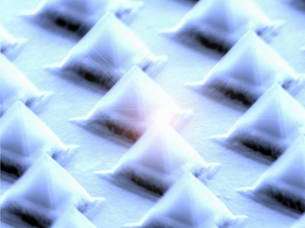
November 23rd, 2005 Nanopyramids of Gallium Arsenide

Researchers at the EPFL (Ecole Polytechnique Federale de Lausanne) have developed a new machine that can reveal how electrons behave inside a single nano-object. The results from initial tests on pyramidal gallium-arsenide quantum dots are presented in an article in the November 24 issue of Nature.

Image: Nanopyramids of Gallium Arsenide.

Hiding in the lab behind a dramatic black curtain, the hardware setup is not particularly imposing. It doesn’t look expensive. Nonetheless, this machine in EPFL’s Laboratory of quantum optoelectronics took four years to perfect and represents an equipment investment of more than a million Swiss francs.

It is an ingenious combination of technologies onto a single powerful platform. It will improve our understanding of the dynamics that rule the nanoscale world, perhaps opening doors to exploiting the physics of nanoscale phenomena for practical ends.

Even the most sophisticated methods used to explore material properties and dynamics run into limits when applied at the nanoscale. Current techniques either have good spatial resolution (down to tens of nanometers or below) or an ultrafast time resolution (down to picoseconds), but not both.

At least not until now. The machine developed by Professor Benoit Deveaud-Pledran and his EPFL colleagues is the first tool that can track the passage of an electron in a nanostructure – at a time scale of ten picoseconds and a spatial resolution of 50 nanometers.

The EPFL researchers replaced the standard electron gun filament on an off-the-shelf electron microscope with a 20 nanometer-thick gold photocathode. The gold is illuminated by an ultraviolet mode-locked laser, generating an electron beam that pulses 80 million times per second. Each pulse contains fewer than 10 electrons. The electrons excite the sample, causing it to emit light. The spectroscopic information is collected and analyzed to recreate the surface morphology and to trace the path the electrons follow through the sample.

Deveaud-Pledran and his colleagues tested their new machine on pyramidal quantum dots. These 2-micron-high nano-objects, specially synthesized in the lab of EPFL professor Eli Kapon, contain several different nanostructures, making them ideal test objects. When the electron beam impacts the pyramid, the electrons diffuse towards the closest nanostructure. From there, the diffusion continues until the point of lowest energy is reached -- the quantum dot at the tip of the pyramid. The time traces corresponding to each of these nanostructures reveal just how critical that 10- picosecond time resolution is; with even a 100-picosecond resolution, important information would be lost.

The machine will not only give us a glimpse into nanoscale dynamics, but because it will work on any semiconductor, it will also allow researchers to study previously intractable materials. The wide energy range of the electrons in the beam can excite materials that won’t luminesce with laser techniques, explains Deveaud-Pledran. “With a laser, you can’t get a short enough wavelength to excite diamond or silicon, for example. This machine will.”

Nanotechnology is widely heralded as the key to the technology of the future -- everything from quantum computing to ultra-dense data storage to quantum cryptography depends on the behavior and control of materials at the nanoscale.

“Remember the first portable CD-players?” says Deveaud. “They consumed 4 AA batteries reading a single disk. We improved our understanding of the physics of materials, and now they consume 50 times less energy. As far as the nanoworld is concerned, we still don’t understand the dynamics of materials at the nanoscale. I can’t tell you exactly what this machine will lead to because that depends on who uses it and what we find. But there’s no question that it will help us make progress, and that the potential applications are exciting.”

Source: EPFL (Ecole Polytechnique Federale de Lausanne)


print this article email this article download pdf blog this article bookmark this article     Digg this Stumble it share on Facebook share on Reddit add to delicious save to Yahoo! bookmarks
4.8/5 after 6 votes


November 23rd, 2005 all stories
Nanotechnology /

Comments: 0
Rank: 4.8/5 after 6 votes

  • Stumble this up

  • Digg this

  • Share it:
  • share on Facebook
  • share on MySpace
  • share on Slashdot
  • rss-newsfeed
  • share on Google
  • share on Reddit
  • add to delicious
  • save to Yahoo! bookmarks
  • share on Windows Live
  • Add to Mixx!
Rating: 4.8/5 after 6 votes

  • Related Stories

  • New DNA sensors could identify cancer using graphene
    created Apr 13, 2009 | popularity not rated yet | comments 0
  • The Day the World Didn't End
    created Oct 14, 2008 | popularity not rated yet | comments 0
  • Exciton-based circuits eliminate a 'speed trap' between computing and communication signals
    created Jun 19, 2008 | popularity not rated yet | comments 0
  • Researchers developed a quantum 'light switch'
    created Dec 10, 2007 | popularity not rated yet | comments 0
  • Physicists establish 'spooky' quantum communication
    created Sep 05, 2007 | popularity not rated yet | comments 0

Tags


  • Physicists Demonstrate Quantum Memory with Matter Qubits
    Physicists Demonstrate Quantum Memory with Matter Qubits
    Physics / General Physics
    created Jul 03, 2009 | popularity 4.4 / 5 (17) | comments 1
  • 'Holey' Nanosheets for Wastewater Dye Removal
    Nanotechnology / Nanomaterials
    created Jul 01, 2009 | popularity 5 / 5 (5) | comments 1
  • Jellyfish Robot Swims Like its Biological Counterpart
    Jellyfish Robot Swims Like its Biological Counterpart
    Electronics / Robotics
    created Jun 26, 2009 | popularity 4.4 / 5 (8) | comments 1
  • Could Maxwell's Demon Exist in Nanoscale Systems?
    Could Maxwell's Demon Exist in Nanoscale Systems?
    Physics / General Physics
    created Jun 24, 2009 | popularity 4.4 / 5 (18) | comments 29
  • Living Safely with Robots, Beyond Asimov's Laws
    Living Safely with Robots, Beyond Asimov's Laws
    Electronics / Robotics
    created Jun 22, 2009 | popularity 4.6 / 5 (53) | comments 40
  • Other News

    Nano Measurement in the 3rd Dimension

    Nano Measurement in the 3rd Dimension

    Nanotechnology / Nanophysics

    created 1hour ago | popularity 3 / 5 (1) | comments 0

    From the motion sensor to the computer chip - in many products of daily life components are used whose functioning is based on smallest structures of the size of thousandths - or even millionths - of millimetres. ...


    A 'quantum of sol' -- how nanotechnology could hold the key to a solar-powered future

    A 'quantum of sol' -- how nanotechnology could hold the key to a solar-powered future

    Nanotechnology / Nanomaterials

    created Jun 30, 2009 | popularity 3.9 / 5 (16) | comments 17

    (PhysOrg.com) -- A new generation of 'nano-structured' millimetre-sized solar cells that could convert the sun's energy to electricity more than twice as efficiently as current technology, is the subject of ...


    Australian researchers are set to begin human trials of a tiny nano-cell that acts as a "Trojan horse" against cancer

    Hi-tech 'Trojan horse' can kill cancer cells: researchers

    Nanotechnology / Bio & Medicine

    created Jun 29, 2009 | popularity 4.7 / 5 (12) | comments 7

    Australian researchers are set to begin human trials of a tiny nano-cell that acts as a "Trojan horse" against cancer cells, a breakthrough they say may curb the need for debilitating chemotherapy.


    'Holey' Nanosheets for Wastewater Dye Removal

    Nanotechnology / Nanomaterials

    created Jul 01, 2009 | popularity 5 / 5 (5) | comments 1

    (PhysOrg.com) -- Researchers have discovered that extremely thin sheets of nickel oxide with hexagonally shaped holes can absorb hazardous dyes from wastewater nearly as well as the best traditional methods, but are recyclable. ...


    Harnessing Nanoparticles To Track Cancer Cell Changes

    Nanotechnology / Bio & Medicine

    created Jul 03, 2009 | popularity not rated yet | comments 1

    The more dots there are, the more accurate a picture you get when you connect them. Cancer researchers adopting that philosophy have developed a new imaging technology that could give scientists the ability to simultaneously ...