November 23, 2005 feature
Manned vs. Unmanned Space Exploration (Part 1)

Watching the Apollo landings on the moon as a child I could hardly have imagined I was seeing the end of an era – that of manned exploration of space. Shuttle trips to low earth orbit not withstanding; the human race has stopped reaching for the stars – with manned missions, of course. Now, the new explorers are robots. Will they be the ultimate space traveler? Or will man, with all faults and flexibility, take back this role?
This article explores the pros and cons of both types of space exploration and hopefully will spark more discussion of this complex and highly political issue.
Unmanned Missions – going where no man has gone before - and maybe never will
Robotic space exploration has become the heavy lifter for serious space science. While shuttle launches and the International Space Station get all the media coverage, these small, relatively inexpensive unmanned missions are doing important science in the background.
Most scientists agree: both the shuttle (STS – Space Transport System) and the International Space Station are expensive and unproductive means to do space science.
NASA has long touted the space station as the perfect platform to study space and the shuttle a perfect vehicle to build it. However, as early as 1990, 13 different science groups rejected the space station citing huge expenses for small gains.
Shuttle disasters, first the Challenger followed by Columbia’s catastrophic reentry in February, 2003, have forced NASA to keep mum about crewed space exploration and the International Space Station is on hold.
The last important media event promoting manned flight was Senator John Glenn’s ride in 1998 – ostensibly to do research on the effects of spaceflight on the human body, but widely seen by scientists as nothing but a publicity stunt.
Since each obiter launch cost $420 million dollars in 1998, it was the world’s most expensive publicity campaign to date. Proponents say the publicity is needed to support space program funding. Scientific groups assert the same money could have paid for two unmanned missions that do new science - not repeat similar experiments already performed by earlier missions.
Indeed, why do tests on the effects of zero gravity on humans anyway when they can sit comfortably behind consoles directing robotic probes from Earth?
Space is a hostile place for humans. All their needs must be met by bringing a hospitable environment up from a steep gravity well, the cost of which is enormous. The missions must be planned to avoid stressing our fragile organisms. We need food, water and air requiring complicated and heavy equipment. All this machinery needs to be monitored, reducing an astronaut’s available time to carry out experiments. Its shear weight alone reduces substantially the useful payload.
The space shuttle is a hopelessly limited vehicle. It’s only capable of reaching low earth orbit. Worse, the space station it services is placed in the same orbit – one that is not ideal for any type of space science. Being so close to the Earth, gravity constantly tugs at the station making it unstable for fabrication of large crystals – part of NASA’s original plans but later nixed by the American Crystallographic Association.
To date, more than 20 scientific organizations worldwide have come out against the space station and are recommending the funds be used for more important unmanned missions.
NASA has gone so far as to create myths about economic spin-offs from manned spaceflight - the general idea being the enormous expense later results in useful technology that improves our lives. Items like Velcro, Tang and Teflon – popularly believed to have come from the space program or invented by NASA. There is only one problem: they did not.
Shuttle launches are expensive: very expensive. Francis Slakey, a PhD physicist who writes for Scientific American about space said, “The shuttle’s cargo bay can carry 23,000 kilos (51,000 lbs) of payload and can return 14,500 kilos back to earth. Suppose that NASA loaded the Shuttle’s cargo bay with confetti to be launched into space. If every kilo of confetti miraculously turned into gold during the return trip, the mission would still lose $270 million.” This was written in 1999 when a shuttle flight cost $420 million.
Currently, it’s estimated that just the shuttle program average cost per flight has been about $1.3 billion over lifetime and about $750 million per launch over its most recent five years of operations. This total includes development costs and numerous safety modifications. That means each shuttle launch could pay for 2 to 3 unmanned missions.
While recent failures have more than quadrupled success rates for unmanned missions, they still have managed to keep space programs alive – not just for the US, but Russia, Japan and China as well.
Mars Pathfinder and Mar Exploration Rovers have succeeded beyond the expectations of their designers and continue to deliver important data to earthbound scientists.
When the successful Deep Impact mission smashed into comet Temple 1 in July, 2005 it released a cloud of debris that may help understand comet formation and composition.
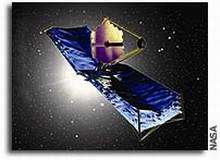
Image: Jack Web Space Telescope
Future robotic missions promise to deliver even more crucial data to widely divergent fields. TRW is now building Hubble’s successor, the Jack Web Space Telescope (formally the Next Generation Space Telescope). Slated for launch in 2010, it will be placed in L2 orbit – a much better position to study the stars. At L2, or Lagrange Point 2, it needs only one simple shield instead of the complicated cooling system required by Hubble because of its nearness to earth. It will also be out of range of the space shuttle should anything go wrong as did on the Hubble mission.
As computers become more capable and reliable, robots of greater complexity will be built to handle even the most challenging assignments. The time for humans to explore space may have come…. And, indeed, may have gone forever.
Probably the best example of a possible future for human space flight is the recent Russian policy of taking on paying guests – the first space tourists. Already 2 people have paid the $20 million dollar price tag to visit the International Space Station. So instead of a laboratory for cutting edge science, it may become a multibillion dollar Ramada Inn.
What is plainly obvious is robotic space explorers are here to stay. Humans may have to look for different roles to play in space.
To be continued... Read Part 2
by Chuck Rahls, Copyright 2005 PhysOrg.com


