Transplanted brain cells hold promise for Parkinson's disease
December 4th, 2006 Transplanted brain cells hold promise for Parkinson's disease

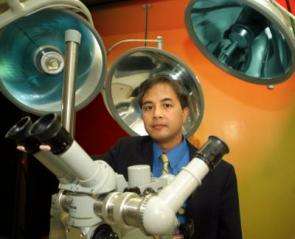
Dr. Cesario V. Borlongan, neuroscientist at the Medical College of Georgia. Credit: Medical College of Georgia

Transplanted neural stem cells hold promise for reducing the destruction of dopaminergic cells that occurs in Parkinson's disease and for replacing cells lost to the disease, scientists say.

Research published in the current issue of The Journal of Neuroscience shows a human neural stem cell transplant essentially enables an animal model for Parkinson’s to continue functioning normally rather than displaying the progressive loss of movement control that characterizes the disease.

"We are very cautious but to us, it’s an indication that stem cells have promise for Parkinson’s disease," says Dr. Cesario V. Borlongan, neuroscientist at the Medical College of Georgia and corresponding author of the study.

Transplants were done shortly after a neurotoxin was used to destroy neurons that make dopamine, a neurotransmitter key to movement control, Dr. Borlongan notes. This would be equivalent to a patient getting treatment very early in the disease process, which rarely happens since there is no screening test to catch it early.

"Right now we are saying if you are able to identify Parkinson’s in the early stage, we think this therapy will work. An important question that remains is, ‘Can we rescue neurons that are dying from Parkinson’s"’ This would more accurately mimic what patients need." The researchers already have begun studies that delay the transplants until weeks after injury.

For this study, researchers compared animals that received placebo treatment with those that received only protective neurotrophic factors secreted by stem cells and those that had a transplant.

Animals that received transplants essentially regained control of their movement, placebo-treated animals did not recover and those that received neurotrophic factors, called stem cell factors, recovered partially.

When researchers examined the brains one month after transplant – a long time in the two-year life of a rat - researchers found endogenous dopaminergic cells and transplanted neural stem cells had both survived. Also, transplanted neural cells had formed synapses to communicate with each other and ultimately the striatum, the portion of the brain dopaminergic cells act on to control movement.

"When we looked at the transplanted stem cells, they had survived, had differentiated into neurons and showed some connection with the host tissue," says Dr. Borlongan.

They did additional studies in test tubes, taking commercially available rat and human dopaminergic cells, exposing them to neurotoxins and then to stem cell factors. Stem cell factor protected cells in a dose-dependent fashion. "The more stem cell factor, the better the protection," Dr. Borlongan says. When the cells were co-cultured with stem cells, protection was further increased. When they used an antibody to block the stem cell factor, neuro-protection was significantly reduced. "This again shows a combination of factors at work," says Dr. Borlongan. "It’s a synergistic effect."

He’s now following rats with transplants for six months to see if the early protection/recovery holds up; he’s already past the three-month mark and to date, recovery is stable. While the rats needed immunosuppression because they received human cells, Dr. Borlongan says humans would not.

About a half-million Americans have Parkinson’s disease. Typically the disease does a lot of damage to dopaminergic cells before it becomes symptomatic. Although Parkinson’s is associated with abnormal movement, such as tremors, loss of these cells actually makes it difficult for people to move and, once they move, they can’t control the movement, Dr. Borlongan says. The standard treatment is L-dopa, a synthetic dopamine that tends to minimize symptoms for three to five years. As the disease progresses and the drug becomes less effective, doses are increased and can produce more dyskinesia, loss of controlled movement. Centers such as MCG are exploring new ways to slow disease progression, diagnose it earlier and more accurately monitor its progression.

Source: Medical College of Georgia


print this article email this article download pdf blog this article bookmark this article     Digg this Stumble it share on Facebook share on Reddit add to delicious save to Yahoo! bookmarks
4.3/5 after 7 votes


December 4th, 2006 all stories
Medicine & Health / Research

Comments: 0
Rank: 4.3/5 after 7 votes

  • Stumble this up

  • Digg this

  • Share it:
  • share on Facebook
  • share on MySpace
  • share on Slashdot
  • rss-newsfeed
  • share on Google
  • share on Reddit
  • add to delicious
  • save to Yahoo! bookmarks
  • share on Windows Live
  • Add to Mixx!
Rating: 4.3/5 after 7 votes

  • Related Stories

  • MicroRNAs hold promise for treating diseases in blood vessels
    created 3 hours ago | popularity not rated yet | comments 0
  • Bioethicists lead call for public debates on future uses of stem cells
    created Jul 02, 2009 | popularity not rated yet | comments 0
  • Blood stem cell growth factor reverses memory decline in mice
    created Jul 01, 2009 | popularity not rated yet | comments 0
  • Human cardiac master stem cells identified
    created Jul 01, 2009 | popularity not rated yet | comments 0
  • Discovery pinpoints new connection between cancer cells, stem cells
    created Jul 01, 2009 | popularity not rated yet | comments 0

Tags


  • Physicists Demonstrate Quantum Memory with Matter Qubits
    Physicists Demonstrate Quantum Memory with Matter Qubits
    Physics / General Physics
    created Jul 03, 2009 | popularity 4.4 / 5 (17) | comments 1
  • 'Holey' Nanosheets for Wastewater Dye Removal
    Nanotechnology / Nanomaterials
    created Jul 01, 2009 | popularity 5 / 5 (5) | comments 1
  • Jellyfish Robot Swims Like its Biological Counterpart
    Jellyfish Robot Swims Like its Biological Counterpart
    Electronics / Robotics
    created Jun 26, 2009 | popularity 4.4 / 5 (8) | comments 1
  • Could Maxwell's Demon Exist in Nanoscale Systems?
    Could Maxwell's Demon Exist in Nanoscale Systems?
    Physics / General Physics
    created Jun 24, 2009 | popularity 4.4 / 5 (18) | comments 29
  • Living Safely with Robots, Beyond Asimov's Laws
    Living Safely with Robots, Beyond Asimov's Laws
    Electronics / Robotics
    created Jun 22, 2009 | popularity 4.6 / 5 (52) | comments 40
  • Other News

    Researchers highlight new direction for drug discovery

    Medicine & Health / Research

    created 1hour ago | popularity not rated yet | comments 0

    In a discovery that rebuffs conventional scientific thinking, researchers at Georgetown University Medical Center (GUMC) have discovered a novel way to block the activity of the fusion protein responsible for Ewing's sarcoma, ...


    Variations in 5 genes raise risk for most common brain tumors

    Medicine & Health / Genetics

    created 3 hours ago | popularity not rated yet | comments 1

    Common genetic variations spread across five genes raise a person's risk of developing the most frequent type of brain tumor, an international research team reports online in Nature Genetics.


    MicroRNAs hold promise for treating diseases in blood vessels

    Medicine & Health / Research

    created 3 hours ago | popularity not rated yet | comments 0

    A newly discovered mechanism controls whether muscle cells in blood vessels hasten the development of both atherosclerosis and Alzheimer's disease, according to an article published online today in the journal Nature.


    Malaysian authorities seize 'Viagra coffee' : report

    Medicine & Health / Health

    created 6 hours ago | popularity not rated yet | comments 1

    Malaysia's health authorities have seized over 20,000 dollars worth of coffee mixed with sildenafil, the main ingredient in erectile dysfunction drug Viagra, a report said Sunday.


    Wind power may have its own environmental problems

    Medicine & Health / Health

    created 3 hours ago | popularity 2 / 5 (2) | comments 0

    Wind power generation is expected to be a clean and environmentally friendly natural energy source, but a new kind of environmental problem has surfaced as infrasonic waves caused by windmills are suspected of causing health ...