Lunar Leonid Strikes
December 4, 2006
Lunar Leonid Strikes

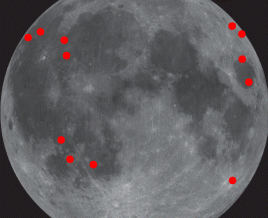
Each red dot denotes a meteoroid impact observed since Nov. 2005 by members of the NASA Meteoroid Environment Office. Credit: NASA

Meteoroids are smashing into the Moon a lot more often than anyone expected. That's the tentative conclusion of Bill Cooke, head of NASA's Meteoroid Environment Office, after his team observed two Leonids hitting the Moon on Nov. 17, 2006. "We've now seen 11 and possibly 12 lunar impacts since we started monitoring the Moon one year ago," says Cooke. "That's about four times more hits than our computer models predicted."

If correct, this conclusion could influence planning for future moon missions. But first, the Leonids:

Last month, Earth passed through a "minefield" of debris from Comet 55P/Tempel-Tuttle. This happens every year in mid-November and results in the annual Leonid meteor shower. From Nov. 17th to Nov. 19th both Earth and the Moon were peppered with meteoroids.

Meteoroids that hit Earth disintegrate harmlessly (and beautifully) in the atmosphere. But the Moon has no atmosphere to protect it, so meteoroids don't stop in the sky. They hit the ground. The vast majority of these meteoroids are dust-sized, and their impacts are hardly felt. But bigger debris can gouge a crater in the lunar surface and explode in a flash of heat and light. Some flashes can be seen from Earth.

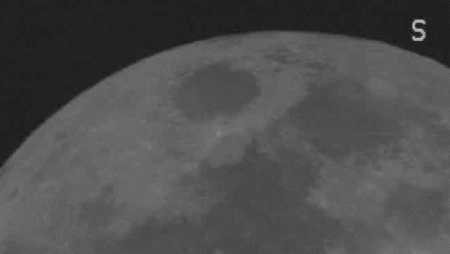
During the passage through Tempel-Tuttle's debris field, Cooke's team trained their telescopes (two 14-inch reflectors located at the Marshall Space Flight Center) on the dark surface of the Moon. On Nov. 17th, after less than four hours of watching, they video-recorded two impacts: a 9th magnitude flash in Oceanus Procellarum (the Ocean of Storms) and a brighter 8th magnitude flash in the lunar highlands near crater Gauss.
Lunar Leonid Strikes
Enlarge

An 8th-magnitude Leonid flash near crater Gauss. The movies play in 7x slow motion; otherwise the explosion would be nearly invisible to the human eye. Credit: NASA

"The flashes we saw were caused by Leonid meteoroids 2 to 3 inches (5 to 8 cm) in diameter," says Cooke. "They hit with energies between 0.3 and 0.6 Giga-Joules." In plain language, that's 150 to 300 pounds of TNT.

How do you get so much energy out of a 3-inch meteoroid? "Leonids travel fast—about 144,000 mph," he explains. "At that speed, even a 3-inch rock packs tremendous energy."

For comparison, the ESA's SMART-1 probe crashed into the Moon on Sept. 2nd, delivering 0.6 Giga-Joules of energy to the lunar surface—the same as the brighter of the two Leonids.

"Leonid impacts are as energetic as the crash of a 700-lb spacecraft!" says Cooke.

With these latest detections, Cooke's group has tallied a dozen "lunar meteors" since Nov. 2005. Most were sporadic meteoroids--meaning they are part of no annual shower like the Leonids, but just random chips of asteroids and comets floating around in space. Cooke estimates that for every four hours they observe the Moon, they see one bright flash caused by the impact of a large meteoroid.

And that's surprising. "Our best models of the lunar meteoroid environment predict a much lower rate—only 25% of what we are actually seeing." The problem may be with the computer models: "They're based on observations of meteors in the skies of Earth," and those data may not translate well to the Moon.

The solution? "We need to spend more time watching the Moon," says Cooke. "With more data, we can draw stronger conclusions about the impact rate."

NASA needs that kind of information to decide, e.g., if it's safe for astronauts to go moonwalking during a meteor shower; and to calculate the necessary thickness of shielding for lunar spacecraft and habitats.

Next up: The Geminid meteor shower on December 13th-14th. Once again Earth and Moon will be peppered with meteoroids—this time from the asteroid 3200 Phaethon. Says Cooke, "we'll be watching."

Source: Science@NASA, by Dr. Tony Phillips

4.2 /5 (11 votes)  

Rank 4.2 /5 (11 votes)
Tags

Related Stories
Relevant PhysicsForums posts
  • Never ending outer space.....
    created7 hours ago
  • Neutron Star fragments?
    created9 hours ago
  • stationary or not?
    created13 hours ago
  • Scale of the Universe
    createdFeb 10, 2012
  • Titan's lack of impact craters
    createdFeb 09, 2012
  • Real pictures of black hole eating a star?
    createdFeb 08, 2012
  • More from Physics Forums - General Astronomy

More news stories

Latin America mining boom clashes with conservation

Latin America is experiencing a mining boom as prices rise fuelled by a hike in global demand, but the region is also being hit by a wave of violent protests, strikes and rallies by environmentalists.

Space & Earth / Environment

created 35 minutes ago | popularity not rated yet | comments 0

Europe stakes billion-dollar bet on new rocket

A pencil-slim rocket is scheduled to lift into space from South America on Monday, carrying a billion-dollar bet that Europe can grab a juicy slice of the market to place satellites in low orbit.

Space & Earth / Space Exploration

created 20 hours ago | popularity 4 / 5 (3) | comments 0

Political leaders play key role in how worried Americans are by climate change: study

More than extreme weather events and the work of scientists, it is national political leaders who influence how much Americans worry about the threat of climate change, new research finds.

Space & Earth / Environment

created Feb 06, 2012 | popularity 5 / 5 (6) | comments 72

NASA budget will axe Mars deal with Europe: scientists

US President Barack Obama's budget proposal to be submitted next week for 2013 will cut NASA's budget by 20 percent and eliminate a major partnership with Europe on Mars exploration, scientists said Thursday.

Space & Earth / Space Exploration

created Feb 10, 2012 | popularity 5 / 5 (3) | comments 48

Humans may have helped the decline of African rainforests 3000 years ago

(PhysOrg.com) -- Large areas of rainforests in Central Africa mysteriously disappeared over three thousand years ago, to be replaced by savannas. The prevailing theory has been that the cause was a change ...

Space & Earth / Environment

created Feb 10, 2012 | popularity 4.1 / 5 (14) | comments 20 | with audio podcast report


Love a click away in Indonesia's Twitter Republic

He was a geeky kid from Yogyakarta, she a glamorous city girl in Jakarta. In a country with one of the world's most vibrant social networking scenes they fell in love on Twitter.

Walney offshore wind farm is world's biggest (for now)

(PhysOrg.com) -- The Walney wind farm on the Irish Sea--characterized by high tides, waves and windy weather--officially opened this week. The farm is treated in the press as a very big deal as the Walney ...

GPS court ruling leaves US phone tracking unclear

A US Supreme Court decision requiring a warrant to place a GPS device on the car of a criminal suspect leaves unresolved the bigger issue of police tracking using mobile phones, legal experts say.

Europeans protest controversial Internet pact

Tens of thousands of people marched in protests in more than a dozen European cities Saturday against a controversial anti-online piracy pact that critics say could curtail Internet freedom.

Study finds that anti-diabetic medication can prevent the long-term effects of maternal obesity

In a study to be presented today at the Society for Maternal-Fetal Medicine's annual meeting, The Pregnancy Meeting, in Dallas, Texas, researchers will report findings that show that short therapy with the anti-diabetic medication ...

Netflix settlement trims 14 pct off 4Q earnings

(AP) -- Netflix pressed the rewind button on its fourth-quarter earnings after settling allegations that the video subscription service violated a consumer-privacy law.