Why do some queen bees eat their worker bee's eggs?
December 4, 2006 Why do some queen bees eat their worker bee's eggs?

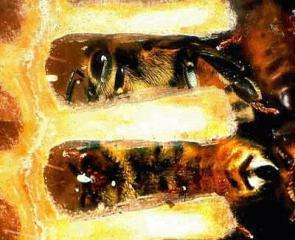
A new study from the American Naturalist finds that honeybee workers’ sons are reared 100 times less in species with a queen mated to multiple males. Credit: Courtesy F. Ratnieks

Worker bees, wasps, and ants are often considered neuter. But in many species they are females with ovaries, who although unable to mate, can lay unfertilized eggs which turn into males if reared. For some species, such as bumble bees, this is the source of many of the males in the species. But in others, like the honeybee, workers "police" each other – killing eggs laid by workers or confronting egg-laying workers.

In 1964 the English biologist William Hamilton put forward his "relatedness hypothesis", a major landmark in kin selection theory. His hypothesis was that worker bees, wasps and ants do not reproduce because most workers are half sisters. Instead the workers favor the queen's male progeny, since she has mated with multiple males, ensuring variation in the species. According to this theory, a species where the mother queen mates with multiple males would have more worker policing. This theory is widespread and in animal behavior textbooks.

However, Hamilton's relatedness hypothesis was challenged in 2004 by researchers from the University of Lausanne, Switzerland. They compared 50 species and found no evidence that multiple mating by the queen correlated with reduced rearing of workers' sons or greater worker reproductive policing. Were the textbooks wrong"

A new study appearing in the current issue of The American Naturalist strongly supports Hamilton's original theory. Tom Wenseleers and Francis Ratnieks (University of Sheffield) compared 90 species and found that workers' sons are reared 100 times less in species with a queen mated to multiple males. They also found worker policing by the queen, with the queen eating working-laid eggs, in all species with multiple-mated queens, but in only 20 percent with single-mated queens.

"It seems that the textbooks do not need rewriting," write the authors. "Kin selection theory is important when studying relatedness in social behavior. Social insects, with their great variation in kinship, have been a key test bed of the theory, and the theory has revolutionized our understanding of insect societies."

Source: University of Chicago


print this article email this article download pdf blog this article bookmark this article     Stumble it Digg this share on Facebook retweet share on Reddit add to delicious
Rate this story - 3.7 /5 (6 votes)


December 4, 2006 all stories

Comments: 0

3.7 /5 (6 votes)
  • Stumble this up

  • Digg this

  • share this

  • hide
  • Related Stories

  • Termite creates sustainable monoculture fungus-farming
    created Nov 20, 2009 | popularity not rated yet | comments 0
  • Parasites keep things sexy in 'hotspots'
    created Jul 23, 2009 | popularity not rated yet | comments 0
  • Worker ants of the world, unite! You have nothing to lose but your fertility
    created Nov 19, 2008 | popularity not rated yet | comments 0
  • 'Time-sharing' tropical birds key to evolutionary mystery
    created Nov 13, 2007 | popularity not rated yet | comments 0
  • Ugly duckling mole rats might hold key to longevity
    created Oct 05, 2007 | popularity not rated yet | comments 0


Other News

meat

Pork meat grown in the laboratory

Biology / Biotechnology

created 13 hours ago | popularity 4.7 / 5 (18) | comments 14

(PhysOrg.com) -- Scientists from Eindhoven University in The Netherlands have for the first time grown pork meat in the laboratory by extracting cells from a live pig and growing them in a petri dish.


North Pole wolf emails locations to researchers

North Pole wolf emails locations to researchers

Biology / Plants & Animals

created 6 hours ago | popularity not rated yet | comments 0

In July the scientists, one from the United States, the other from Canada, put the satellite collar on Brutus, the leader of his wolf pack, on remote Ellesmere Island, only 600 miles from the North Pole. Their ...


Ant

Bacterial gut symbionts are tightly linked with the evolution of herbivory in ants

Biology / Plants & Animals

created 7 hours ago | popularity not rated yet | comments 0

Broadly speaking, ants have two different feeding strategies. A large proportion of all species are "carnivorous," meaning that they are generalist predators feeding on other small animals or scavenging on ...


ARS Survey Helps Growers Track Two Key Cotton Pests

ARS Survey Helps Growers Track Two Key Cotton Pests

Biology / Ecology

created 1hour ago | popularity not rated yet | comments 0

(PhysOrg.com) -- Cotton growers will be better able to keep an eye out for two common pests because of a comprehensive survey by Agricultural Research Service (ARS) scientists at College Station, Texas.


How did flowering plants evolve to dominate Earth?

Biology / Evolution

created 9 hours ago | popularity 4.6 / 5 (7) | comments 2

To Charles Darwin it was an 'abominable mystery' and it is a question which has continued to vex evolutionists to this day: when did flowering plants evolve and how did they come to dominate plant life on earth? Today a study ...