Learning During Sleep?
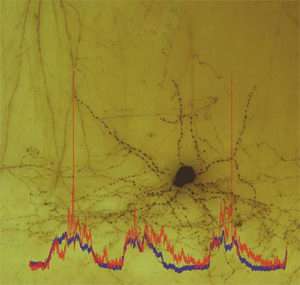
If I can’t remember this morning where I put my car keys last night, it’s due to my memory failing me again. Scientists at the Max Planck Institute for Medical Research in Heidelberg, Germany, have been investigating how memories might be consolidated. Their new study offers the hitherto strongest proof that new information is transferred between the hippocampus, the short term memory area, and the cerebral cortex during sleep.
According to their findings and contrary to previous assumptions, the cerebral cortex actively controls this transfer. The researchers developed a new technique for their investigations which promises previously impossible insight into the largely under-researched field of information processing in the brain (Nature Neuroscience, November 2006).
The question of how the brain stores or discards memories still remains largely unexplained. Many brain researchers regard the consolidation theory as the best approach so far. This states that fresh impressions are first stored as short-term memories in the hippocampus. They are then said to move within hours or a few days - usually during deep sleep - into the cerebral cortex where they enter long-term memory.
Investigations by Thomas Hahn, Mayank Mehta and the Nobel Prize winner Bert Sakmann from the Max Planck Institute for Medical Research in Heidelberg have now shed new light on the mechanisms that create memory. According to their findings, the areas of the brain work together, but possibly in a different way from that previously assumed. "This is a technically sophisticated study which could have considerable influence on our understanding of how nerve cells interact during sleep consolidation," confirmed Edvard Moser, Director of the Centre for the Biology of Memory in Trondheim, Norway.
It has been difficult up to now to use experiments to examine the brain processes that create memory. The scientists in Heidelberg developed an innovative experimental approach especially for this purpose. They succeeded in measuring the membrane potential of individual interneurones (neurones that suppress the activity of the hippocampus) in anaethetised mice. At the same time, they recorded the field potential of thousands of nerve cells in the cerebral cortex. This allowed them to link the behaviour of the individual nerve cells with that of the cerebral cortex. The researchers discovered that the interneurones they examined are active at almost the same time as the field potential of the cerebral cortex. There was just a slight delay, like an echo.
This was a surprising finding, because the interneurones suppress those neurones in the hippocampus which are supposed to write information to the cerebral cortex precisely during phases of high activity. According to Mayank Mehta the result can be interpreted in very different ways. "Either the mechanism contributes to memory consolidation, or the information transfer from one part of the brain to another during sleep does not proceed as we have previously assumed." The brain researchers now want to find out which of the possible explanations applies.
In any case, the scientists can use their new experimental method to investigate many other open questions in brain research. Thomas Hahn emphasised: "Putting the behaviour of a single neuron in the context of wider-scale patterns of activity promises to yield completely new insights into the principles according to which our brain is organised."
Ciation: Thomas Hahn, Bert Sakmann & Mayank R. Mehta, Phase-locking of hippocampal interneurons’ membrane potential to neocortical up-down states, Nature Neuroscience, November (2006)
Source: Max-Planck-Institute for Medical Research


