How movement lubricates bone joints
December 5th, 2006 How movement lubricates bone joints

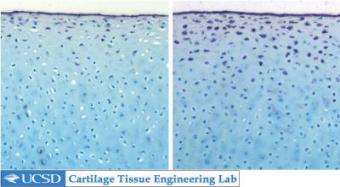
When the knee joint is not subjected to continuous passive motion (left), less proteoglycan 4 is produced by chondrocyte cells than when the knee joint is continuously moved (right). The dark purple stain is a specific visualization tool to identify chondrocyte cells in cartilage that are producing proteoglycan 4. Credit: UC San Diego

Taking a cue from machines that gently flex patients’ knees to help them recover faster from joint surgery, bioengineering researchers at UC San Diego have shown that sliding forces applied to cartilage surfaces prompt cells in that tissue to produce molecules that lubricate and protect joints.

The results reported in Osteoarthritis and Cartilage are important in the ongoing efforts of the group led by Robert Sah, a Howard Hughes Medical Institute (HHMI) professor at UCSD’s Jacobs School of Engineering, to grow cartilage in the laboratory that can be used to replace patients’ injured or diseased joint surfaces.

“We have shown that shear forces on cartilage prompt chondrocyte cells in it to produce proteoglycan 4,” said Sah. “This is an important step toward our goal of eventually growing joint tissue for transplantation.”
How movement lubricates bone joints

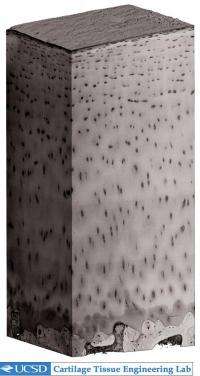
The surface (top) of joint cartilage has the highest concentration of chondrocyte cells, which are crucial to maintenance of a wear-resistant, frictionless, load-bearing surface for joint articulation. Credit: UC San Diego

Proteoglycan, a name that reflects its protein and polysaccharide components, is a basic building block of connective tissue throughout the body. The chondrocyte cells of cartilage make several forms of proteoglycans, including several that build up in cartilage and contribute to its stiffness. However, proteoglycan-4 is primarily secreted into the joint fluid where it coats and lubricates cartilage surfaces.

Unfortunately, the smooth surface of the articular cartilage at the ends of bones located at joints often deteriorates with aging, becoming increasingly roughened and eroded. Those joints become painful and progress to osteoarthritis. Surgeons can replace damaged and diseased joints with artificial joints, but they would like to be able to simply resurface patients’ existing joints with cartilage.

In a series of experiments, Sah’s team attached bovine stifle joints, which are similar to human knee joints, to a bio-reactor that provided continuous irrigation with sterile nutritional fluids under normal physiological conditions. Immobile joints were compared to joints that were flexed 24 hours in a way that mimicked walking motions. The flexing was provided by a specially designed continuous passive motion device.

The team measured up to a three-fold increase in chondrocytes secreting proteoglycan 4 in continuously flexed joints compared to immobile controls. The flexing motion caused cartilage on the surfaces of opposing bones to slide against each other, creating so-called shear forces. In one large surface region of continuously sliding cartilage, 40 percent of the chondrocytes were secreting proteoglycan 4, whereas in the same areas of cartilage in immobilized joints only 13 percent of the chondrocytes were secreting proteoglycan 4. In areas of the joints exposed to only intermittent cartilage sliding, the effect on proteoglycan 4 production was intermediate between continuously sliding and immobilized regions of the joints.

“A challenge for us is to create large tissue grafts for transplantation,” said Sah. “We are systematically addressing the technical challenges to maintain and grow healthy fragments of bone and cartilage in the laboratory and now we can use nature’s self-regulating system, whereby application of shear forces to this tissue increases its synthesis of proteoglycan 4.”

Scientists have known for years that defects in a gene for proteoglycan 4 result in a type of childhood joint failure that resembles osteoarthritis in the elderly. Sah’s goal is to stimulate healthy chondrocytes in cartilage tissue grown in the laboratory to form robust tissue that makes proteoglycan 4 and has a smooth, well-lubricated surface.

Source: University of California - San Diego


print this article email this article download pdf blog this article bookmark this article     Digg this Stumble it share on Facebook share on Reddit add to delicious save to Yahoo! bookmarks
4.1/5 after 9 votes


December 5th, 2006 all stories
Medicine & Health / Research

Comments: 0
Rank: 4.1/5 after 9 votes

  • Stumble this up

  • Digg this

  • Share it:
  • share on Facebook
  • share on MySpace
  • share on Slashdot
  • rss-newsfeed
  • share on Google
  • share on Reddit
  • add to delicious
  • save to Yahoo! bookmarks
  • share on Windows Live
  • Add to Mixx!
Rating: 4.1/5 after 9 votes

  • Related Stories

  • Cartilage regeneration '20,000 Leagues Under the Sea'
    created Jun 04, 2008 | popularity not rated yet | comments 0
  • New trigger for chronic inflammation in rheumatoid arthritis discovered
    created Jun 28, 2009 | popularity not rated yet | comments 0
  • X-Rays for Early Alzheimer's Disease Detection
    created Jun 15, 2009 | popularity not rated yet | comments 0
  • Early Detection of Osteoarthritis in Dogs Could Open Doors for a Cure
    created Jun 10, 2009 | popularity not rated yet | comments 0
  • How embryo movement stimulates joint formation
    created May 18, 2009 | popularity not rated yet | comments 0

Tags


  • Physicists Demonstrate Quantum Memory with Matter Qubits
    Physicists Demonstrate Quantum Memory with Matter Qubits
    Physics / General Physics
    created Jul 03, 2009 | popularity 4.4 / 5 (17) | comments 1
  • 'Holey' Nanosheets for Wastewater Dye Removal
    Nanotechnology / Nanomaterials
    created Jul 01, 2009 | popularity 5 / 5 (5) | comments 1
  • Jellyfish Robot Swims Like its Biological Counterpart
    Jellyfish Robot Swims Like its Biological Counterpart
    Electronics / Robotics
    created Jun 26, 2009 | popularity 4.4 / 5 (8) | comments 1
  • Could Maxwell's Demon Exist in Nanoscale Systems?
    Could Maxwell's Demon Exist in Nanoscale Systems?
    Physics / General Physics
    created Jun 24, 2009 | popularity 4.4 / 5 (18) | comments 29
  • Living Safely with Robots, Beyond Asimov's Laws
    Living Safely with Robots, Beyond Asimov's Laws
    Electronics / Robotics
    created Jun 22, 2009 | popularity 4.6 / 5 (54) | comments 40
  • Other News

    Alzheimer's research pinpoints antibodies that may prevent disease

    Medicine & Health / Research

    created 43 minutes ago | popularity not rated yet | comments 0

    Antibodies to a wide range of substances that can aggregate to form plaques, such as those found in Alzheimer's patients, have been identified in the blood and cerebrospinal fluid of healthy people. Levels of these antibodies ...


    Component of vegetable protein may be linked to lower blood pressure

    Medicine & Health / Research

    created 20 minutes ago | popularity 4 / 5 (1) | comments 0

    Consuming an amino acid commonly found in vegetable protein may be associated with lower blood pressure, researchers report in Circulation: Journal of the American Heart Association.


    Internet-based intervention may improve insomnia

    Medicine & Health / Psychology & Psychiatry

    created 50 minutes ago | popularity not rated yet | comments 0

    An online insomnia intervention based on established face-to-face cognitive behavioral therapy techniques appears to improve patients' sleep, according to a report in the July issue of Archives of General Psychiatry, one of the ...


    Understanding the anticancer effects of vitamin D3

    Medicine & Health / Cancer

    created 42 minutes ago | popularity not rated yet | comments 0

    The active form of vitamin D3 seems to have anticancer effects. To try and understand the mechanisms underlying these effects, researchers previously set out to identify genes whose expression in a human colon cancer cell ...


    To predict the severity of mental disease, consider the family

    Medicine & Health / Psychology & Psychiatry

    created 1hour ago | popularity not rated yet | comments 0

    We've all been asked at routine visits to the doctor to record our family's history with medical problems like cancer, diabetes or heart disease. But when it comes to mental disorders, usually mum's the word.