Stretch a DNA Loop, Turn Off Proteins
December 5, 2006
Stretch a DNA Loop, Turn Off Proteins

Photo Credit: Mike White, UCSD

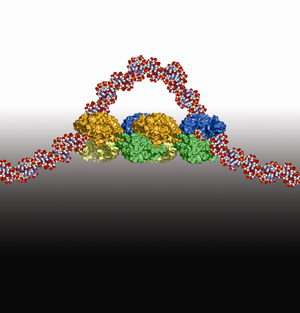
It may look like mistletoe wrapped around a flexible candy cane. But this molecular model shows how some proteins form loops in DNA when they chemically attach, or bind, at separate sites to the double-helical molecule that carries life’s genetic blueprint.

Biologists have discovered that the physical manifestation of DNA loops are a consequence of many biochemical processes in the cell, such as the regulation of gene expression. In other words, these loops indicate the presence of enzymes or other proteins that are turned on. Now physicists at the University of California, San Diego have discovered that stretching the DNA molecule can also turn off the proteins known to cause loops in DNA.

“We showed that certain enzymes acting on DNA could be switched off or on simply by applying a small amount of mechanical tension across the DNA molecule,” said Douglas Smith, an assistant professor of physics at UCSD who headed the team that published the discovery in the December issue of the Biophysical Journal.

“We showed this by mechanically manipulating and stretching single DNA molecules. This switching effect could provide a molecular mechanism for cells to be able to sense and respond to mechanical stresses that they may normally experience. Such stresses could be generated internally by the cells themselves, such as when the cell undergoes changes in shape during the cell cycle, or as external stresses from the environment.”

The amount of tension or stretching that needs to be applied to the molecule is extremely small, Smith added, only one pico-Newton, or one-trillionth of the force generated by the weight of an apple.

Other members of the UCSD team were Gregory Gemmen, a physics graduate student, and Rachel Millin, a laboratory assistant. The study was supported by grants from the Burroughs Wellcome Fund, Kinship Foundation and Arnold and Mabel Beckman Foundation.

Source: UCSD

4.5 /5 (8 votes)  

Rank 4.5 /5 (8 votes)
Tags

Relevant PhysicsForums posts

More news stories

The power of estrogen -- male snakes attract other males

A new study has shown that boosting the estrogen levels of male garter snakes causes them to secrete the same pheromones that females use to attract suitors, and turned the males into just about the sexiest ...

Biology / Plants & Animals

created 11 hours ago | popularity 4.8 / 5 (5) | comments 0 | with audio podcast

Grass to gas: Researchers' genome map speeds biofuel development

Researchers at the University of Georgia have taken a major step in the ongoing effort to find sources of cleaner, renewable energy by mapping the genomes of two originator cells of Miscanthus x giganteus, a large perenn ...

Biology / Biotechnology

created 8 hours ago | popularity 4 / 5 (4) | comments 0 | with audio podcast

Experts reveal how plants don't get sunburn

(PhysOrg.com) -- Experts at the University of Glasgow have discovered how plants survive the harmful rays of the sun.

Biology / Cell & Microbiology

created 11 hours ago | popularity 5 / 5 (2) | comments 0 | with audio podcast

Miami battling invasion of giant African snails

No one knows how they got there. But an invasion of African giant snails has southern Florida in a panic over potential crop damage, disease and general yuckiness surrounding the slimy gastropods.

Biology / Ecology

created 15 hours ago | popularity 4 / 5 (1) | comments 4

Protein libraries in a snap

(PhysOrg.com) -- A Rice University undergraduate will depart with not only a degree but also a possible patent for his invention of an efficient way to create protein libraries, an important component of biomolecular ...

Biology / Cell & Microbiology

created 14 hours ago | popularity 5 / 5 (3) | comments 0 | with audio podcast


Google users warned of threat to smartphone wallets

Users of Google smartphone wallets were being warned on Friday that there is a way to crack pass codes intended to thwart thieves from going on illicit shopping sprees.

Anonymous knocks CIA website offline (Update)

The website of the Central Intelligence Agency was inaccessible on Friday after the hacker group Anonymous claimed to have knocked it offline.

Complex wiring of the nervous system may rely on a just a handful of genes and proteins

Researchers at the Salk Institute have discovered a startling feature of early brain development that helps to explain how complex neuron wiring patterns are programmed using just a handful of critical genes. ...

New error-correcting codes guarantee the fastest possible rate of data transmission

Error-correcting codes are one of the triumphs of the digital age. They’re a way of encoding information so that it can be transmitted across a communication channel — such as an optical fiber o ...

Putting the squeeze on planets outside our solar system

(PhysOrg.com) -- Using high-powered lasers, scientists at Lawrence Livermore National Laboratory and collaborators discovered that molten magnesium silicate undergoes a phase change in the liquid state, abruptly ...

Humans may have helped the decline of African rainforests 3000 years ago

(PhysOrg.com) -- Large areas of rainforests in Central Africa mysteriously disappeared over three thousand years ago, to be replaced by savannas. The prevailing theory has been that the cause was a change ...