Catch and Release: Fishing for Barium Ions
December 5, 2006 Catch and Release: Fishing for Barium Ions

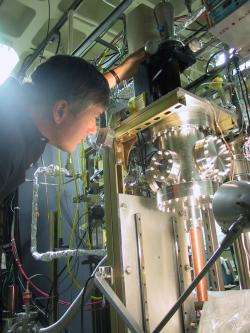
Peter Rowson examines a vacuum system containing a liquid xenon cell, which was used to test cryogenically cooled "fishing poles." Credit: Stanford Linear Accelerator Center

How do you identify the rare thing you're looking for in a vast sea? Go fishing.

Researchers on the Enriched Xenon Observatory (EXO) project, including a group from SLAC, are currently developing ways to catch barium ion "fish" from inside a multi-ton vessel of liquid. They then remove the ions from the liquid and release them from the fishing pole so they can be identified as barium.

A barium-136 ion is the unmistakable sign that somewhere in the sea of xenon-136, a xenon atom underwent radioactive decay. If the two electrons released from that decay have a particular energy, scientists will have hooked the proof that neutrinos are their own anti-particle—an exciting but unproven idea. The observation will also give EXO a way to measure the scanty mass of neutrinos.

The radioactive decay normally emits two neutrinos as well, yet ironically, finding a decay with no neutrinos is what will tell scientists that neutrinos and anti-neutrinos are the same thing. In "neutrinoless double beta decay," the electrons carry all the decay energy otherwise shared with the neutrinos.

Fishing for barium will help the experiment separate the real fish from spurious fish—electrons in the right energy range that come from other sources, such as natural radioactivity and cosmic rays.

After a xenon decay, "the barium ion is sitting there. It hardly moves, so you have to go fish it out," said EXO physicist Peter Rowson.

SLAC has already demonstrated that an electrostatic probe—a small metal fishing pole—can pick up ions from xenon liquid. The probe's electric field attracts positively charged ions. R&D now centers on how to unhook the barium ion from the probe, so it can be identified by a laser system developed by Stanford University, which leads the EXO collaboration. The SLAC group has developed one approach, a cryogenically cooled probe.

"When the probe is dipped in the liquid, xenon ice forms and the ion gets trapped on ice. We pull the probe out, let it thaw and release the ion," said Rowson.

Just don't try it on real fish.

Source: by Heather Rock Woods, Stanford Linear Accelerator Center


print this article email this article download pdf blog this article bookmark this article     Stumble it Digg this share on Facebook retweet share on Reddit add to delicious
Rate this story - 4.4 /5 (14 votes)


December 5, 2006 all stories

Comments: 0

4.4 /5 (14 votes)
  • Stumble this up

  • Digg this

  • share this

  • hide
  • Related Stories


  • hide
  • Relevant PhysicsForums posts

Other News

Pushing light beyond its known limits

Pushing light beyond its known limits

Physics / Optics & Photonics

created 53 minutes ago | popularity not rated yet | comments 0

Scientists at the University of Adelaide have made a breakthrough that could change the world's thinking on what light is capable of.


Do we need dark matter?

Do we need dark matter?

Physics / General Physics

created 5 hours ago | popularity 3.3 / 5 (4) | comments 15

It's the biggest problem in physics: the matter we can see in the universe accounts for just five per cent of the observed gravity that holds galaxies together.


The LHC tunnel

Peckish bird briefly downs big atom smasher

Physics / General Physics

created Nov 09, 2009 | popularity 4 / 5 (11) | comments 17

A peckish bird briefly knocked out part of the world's biggest atom smasher by causing a chain reaction with a piece of bread, the European Organisation for Nuclear Research (CERN) said Monday.


First Bose-Einstein condensation of strontium

First Bose-Einstein condensation of strontium

Physics / Quantum Physics

created Nov 09, 2009 | popularity 5 / 5 (7) | comments 4

In an international first, scientists from the Institute of Quantum Optics and Quantum Information (IQOQI, Austria) produced a Bose-Einstein condensate of the alkaline-earth element strontium, thus narrowly ...


Quantum gas microscope offers glimpse of quirky ultracold atoms

Quantum gas microscope offers glimpse of quirky ultracold atoms

Physics / Quantum Physics

created Nov 04, 2009 | popularity 4.6 / 5 (19) | comments 4

(PhysOrg.com) -- Physicists at Harvard University have created a quantum gas microscope that can be used to observe single atoms at temperatures so low the particles follow the rules of quantum mechanics, ...