Penn researchers discover initial steps in the development of taste
Of the five senses, taste is one of the least understood, but now researchers at the University of Pennsylvania School of Medicine have come one step closer to understanding how the sense of taste develops.
They have pinpointed a molecular pathway that regulates the development of taste buds. Using genetically engineered mice, they discovered that a signaling pathway activated by small proteins called Wnts is required for initiating taste-bud formation. They have also determined that Wnt proteins are required for hooking up the wiring of taste signals to the brain.
Senior author Sarah E. Millar, PhD, Associate Professor in the Departments of Dermatology and Cell and Developmental Biology, Penn postdoctoral fellow Fei Liu, PhD, and colleagues report their findings in the most recent online issue of Nature Genetics. "The developmental biology of taste is underexplored," says Millar of her team's impetus for the study.
The researchers demonstrated that blocking the action of Wnt proteins in surface cells of the developing tongue prevents taste-bud formation, while stimulating Wnt activity causes the formation of excessive numbers of enlarged taste papillae that are able to attract taste-related nerve fibers. This study represents the first genetic analysis of taste-organ initiation in mammals. While these studies were performed in mice, the researchers believe that their findings will also hold true for understanding the basis of taste-bud development in humans.
Taste buds are the sensory organs that transmit chemical stimuli from food and other sources to nerve cells, which convey these signals to the taste centers in the brain. Taste buds sit in the small bumps in the surface and sides of the tongue called papillae.
The signaling pathway activated by Wnt proteins is critical to the development of many organ systems, and its inappropriate activation causes human diseases including colon cancer. In previous studies, Millar and colleagues have shown that this pathway is essential for initiating the formation of hair follicles and mammary glands in mice.
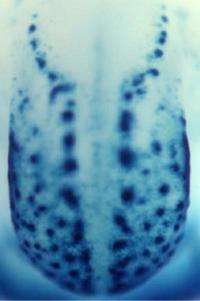
The sites of Wnt signaling are easily visualized in specially engineered transgenic mice, using an enzymatic assay. "We noticed in the tongue that there was this beautiful pattern of blue spots that correspond to the developing taste papillae," says Millar. "This connected the Wnt pathway to their development."
In the present study, the researchers found that in mice in which the actions of Wnt proteins were blocked, taste papilla buds completely failed to develop. Conversely, in mice in which Wnt signaling was over activated, their tongues were covered with many and large papillae and taste buds.
"Unlike most surface epithelial cells, taste buds have characteristics of neurons as well as skin. Like other types of epithelial cells they turn over and regenerate, but they also express chemoreceptors and make synapses with neurons," explains Millar. The group studied how developing taste buds become wired into the nervous system. In early tongue development, neurons enter the tongue epithelium and make synapses with taste bud cells. This study confirmed that taste buds produce signals that attract nerve fibers to them. When taste-bud development was prevented by blocking Wnt signaling, the nerve fibers did not enter the tongue epithelium.
"They don't know where to go on their own," she says.
Millar also mentions that by now understanding the basis for the initiation of taste-papilla formation, the evolution and difference between species in the numbers and patterns of taste buds can be more fully explored. All animals that taste have taste buds, but there are differences, for example humans have more (around 200) taste papillae than mice, and they are arranged in a different pattern.
Future research directions will include determining whether Wnt signaling is also important for the periodic regeneration of taste buds from taste-bud stem cells that occurs throughout life in adult animals. Taste-bud regeneration can be affected by chemotherapy, so understanding this process will have important implications for patient care.
Source: University of Pennsylvania School of Medicine


