Hotspots or not? Isotopes score one for traditional theory
December 6, 2006 Hotspots or not? Isotopes score one for traditional theory

Enlarge

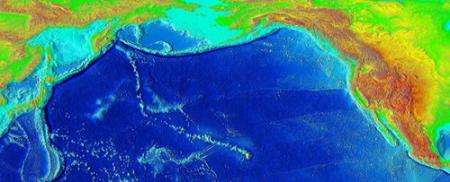
This trail of underwater mountains, known as the Hawaiian-Emperor Seamount Chain or the Emperor Seamounts, was created as the tectonic plate moved across the Hawaii hotspot over the course of millions of years. A study of uranium isotopes strongly supports upwelling of mantle material as the original source of these islands. Image: NOAA

New chemical evidence sheds light on the physical constraints of 'hotspots' -- locations where upwellings of Earth's mantle material form seamounts and island chains. Although the existence of hotspots has been debated over the past 30 years, consistent data from uranium isotope decay series at eight island locations supports the idea that concentrated plumes of hot mantle material formed these islands.

A running battle has evolved over the past 30 years concerning hotspots, with one camp claiming that it’s not necessary to invoke mantle plumes to explain such volcanic islands and a sizeable portion of the community supporting mantle plumes as the most internally consistent explanation for a wide variety of data.

A study published this week in the journal Nature raises the bar for plume opponents by finding a close correlation between modeled and observed ratios of uranium-series isotopes across eight island locations. The study strongly supports upwelling of mantle material as the source of these islands. Moreover, the detailed data allow researchers to estimate the change in temperature, speed and size of mantle plumes at the locations studied.

Alberto Saal, assistant professor of geology at Brown University, contributed data from the Ga-lapagos Islands, complementing information from researchers working in Hawaii, Pitcairn, the Azores, the Canary Islands, the Afar region, and Iceland. With such a breadth of data in hand, lead author Bernard Bourdon, professor at the Swiss Federal Institute of Technology in Zürich (formerly at the Institut de Physique du Globe in Paris), was able to build robust correlations be-tween the ratios of isotopes in the actinide series and the flux of material needed to build the ob-served islands.

“What’s exciting about this,” says Saal, “is that it allows us to make inferences about physical conditions based on chemical measurements.” While it’s impossible to visit the boundary of the mantle to make the physical measurements, it is possible to collect the chemical evidence that has been brought all the way to the surface.

When mantle rocks melt, the ratio of uranium isotopes to their decay products changes dramati-cally, then moves back to equilibrium at a steady, predictable rate. Using this change in ratios, the researchers were able to determine how quickly and completely the material melted. This also allowed them to estimate the difference in temperature between the mantle and the plumes, which determines the speed and size of the upwellings.

Beyond adding to the general evidence for mantle plumes, the study allows researchers to gener-ate some numbers that could potentially be tested. “We think we can provide some extra con-straints on these parameters that are generally poorly known,” says Bourdon.

Their estimates of temperature differences ranged between 50 and 200 degrees C with the larger differences seen in areas believed to have stronger plumes – such as Hawaii and the Galapagos. Assuming symmetrical plumes, Bourdon and his colleagues were also able to make estimates of the radius of mantle plumes at each location that roughly fit with estimates of plume diameters from seismological sources.

The more concrete researchers can make the notion of hotspots, the better chance they have to prove it right – or wrong.

Source: Brown University


print this article email this article download pdf blog this article bookmark this article     Stumble it Digg this share on Facebook retweet share on Reddit add to delicious
Rate this story - 4.2 /5 (13 votes)


December 6, 2006 all stories

Comments: 0

4.2 /5 (13 votes)
  • Stumble this up

  • Digg this

  • share this

  • hide
  • Related Stories

  • New Technology Allows Geophysicist To Test Theory About Formation of Hawaii (w/ Podcast)
    created Dec 11, 2009 | popularity not rated yet | comments 0
  • Ancient Magma 'Superpiles' May Have Shaped The Continents
    created Dec 15, 2008 | popularity not rated yet | comments 0
  • Electronic heat trap grips deep Earth
    created Nov 12, 2008 | popularity not rated yet | comments 0
  • 'Dynamic duo' develops framework for Earth's inaccessible interior
    created May 01, 2008 | popularity not rated yet | comments 0
  • Mercury's shifting, rolling past
    created Mar 27, 2008 | popularity not rated yet | comments 0


  • hide
  • Relevant PhysicsForums posts

  • Fusion or fission within the Earth?
    created Dec 22, 2009
  • West Mata - Explosive Deep-Ocean Volcano
    created Dec 20, 2009
  • did al gore really say that
    created Dec 20, 2009
  • AIRS and Atmospheric Carbon Dioxide
    created Dec 16, 2009
  • More from Physics Forums - Earth

Other News

Iran to unveil new home-built satellite: report

Space & Earth / Space Exploration

created 10 hours ago | popularity 4.5 / 5 (2) | comments 1

Iran will unveil a new home-built satellite in February, a newspaper reported Thursday, amid Western concerns that Tehran is using its nuclear and space industries to develop atomic and ballistic weapons.


Keck Telescopes Take Deeper Look at Planetary Nurseries

Keck Telescopes Take Deeper Look at Planetary Nurseries

Space & Earth / Astronomy

created 22 hours ago | popularity 4.7 / 5 (7) | comments 0

(PhysOrg.com) -- Astronomers using the W. M. Keck Observatory have peered far into a young planetary system, giving an unprecedented view of dust and gas that might eventually form planets similar to Jupiter, ...


Global warming likely to be amplified by slow changes to Earth systems

Global warming likely to be amplified by slow changes to Earth systems

Space & Earth / Earth Sciences

created Dec 20, 2009 | popularity 2.6 / 5 (38) | comments 45

Researchers studying a period of high carbon dioxide levels and warm climate several million years ago have concluded that slow changes such as melting ice sheets amplified the initial warming caused by greenhouse ...


Computer simulation strengthens link between climate change and release of subsea methane

Computer simulation strengthens link between climate change and release of subsea methane

Space & Earth / Earth Sciences

created Dec 17, 2009 | popularity 4.3 / 5 (22) | comments 41

(PhysOrg.com) -- A first-of-its-kind computer simulation that mirrors real-world observations of methane bubbling up from a seabed in the Arctic Ocean provides further evidence that warming oceans may unleash ...


Arctic ice

Study: Earth's polar ice sheets vulnerable to even moderate global warming

Space & Earth / Earth Sciences

created Dec 16, 2009 | popularity 2.8 / 5 (45) | comments 40

A new analysis of the geological record of the Earth's sea level, carried out by scientists at Princeton and Harvard universities and published in the Dec. 16 issue of Nature, employs a novel statistical approa ...