Dramatic snake colour-change mystery solved
December 6th, 2006 Dramatic snake colour-change mystery solved

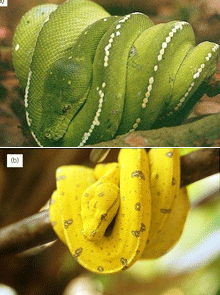
An adult green python (top) and a spectacular yellow juvenile green python. Credit: Australian National University

The mystery surrounding a snake that undergoes a spectacular colour change has been solved by ANU ecologists who have found that the skin of the green python – which begins life either bright yellow or red – transforms to blend into a new habitat as the snake gets older.

Dr David Wilson and Dr Robert Heinsohn from the Centre for Resource and Environmental Studies at ANU, with Professor John Endler of Exeter University, solved the mystery after a three year study radio-tracking the green python at Cape York Peninsula.

“Animals sometimes change colour during their lives, but none as dramatically as the green python of northern Australia and New Guinea. It has puzzled evolutionary biologists for decades,” Dr Heinsohn said.

“This beautiful reptile is popular in the pet trade because it hatches either bright yellow or red, but eventually turns emerald green. It turns out there is a very good reason for this dramatic change.”

For the study, published this week in the scientific journal Biology Letters, the researchers radio-tracked a large number of juvenile and adult pythons and analysed their colours using advanced spectrophotometry.

To their surprise, they found that the brightly coloured youngsters live in a completely different habitat to the older snakes. The juveniles remained outside the rainforest where they hunted small prey such as skinks and cockroaches, whereas the adults moved into the rainforest canopy to hunt rodents and birds.

The juvenile yellow and red colour allows them to blend in remarkably well with the multi-coloured leaves and grass at the forest edge. The adult green allows them to hide from their predators as they hunt for birds and rodents in the canopy.

“It was only when we established the total divergence in behaviour of the juveniles and adults that we could begin to understand their remarkably different colours.

“It takes a year before the young ones are large enough to catch bigger prey like birds. They then shed their skins, change to green, and move inside the rainforest to try their luck off the ground.

“Drab juveniles are the norm in the animal world, but the brightly coloured young of green pythons are unique. They are helping us to understand where the bright and beautiful colours seen in nature come from and how they are maintained,” Dr Heinsohn said.

Source: Australian National University


print this article email this article download pdf blog this article bookmark this article     Digg this Stumble it share on Facebook share on Reddit add to delicious save to Yahoo! bookmarks
4.4/5 after 16 votes


December 6th, 2006 all stories
Biology /

Comments: 0
Rank: 4.4/5 after 16 votes

  • Stumble this up

  • Digg this

  • Share it:
  • share on Facebook
  • share on MySpace
  • share on Slashdot
  • rss-newsfeed
  • share on Google
  • share on Reddit
  • add to delicious
  • save to Yahoo! bookmarks
  • share on Windows Live
  • Add to Mixx!
Rating: 4.4/5 after 16 votes

  • Related Stories

  • Zero in on ozone with fluorescent solution that detects harmful molecule in air and body
    created Jun 22, 2009 | popularity not rated yet | comments 0
  • Big impact from tiny semiconductor lasers (w/Video)
    created Jun 18, 2009 | popularity not rated yet | comments 0
  • Unusual shape of exploded star puzzles scientists
    created Jun 17, 2009 | popularity not rated yet | comments 0
  • Nanocrystals reveal activity within cells
    created Jun 16, 2009 | popularity not rated yet | comments 0
  • PE requirement isn't enough to fight obesity
    created Jun 16, 2009 | popularity not rated yet | comments 0

Tags


  • Physicists Demonstrate Quantum Memory with Matter Qubits
    Physicists Demonstrate Quantum Memory with Matter Qubits
    Physics / General Physics
    created Jul 03, 2009 | popularity 4.4 / 5 (17) | comments 1
  • 'Holey' Nanosheets for Wastewater Dye Removal
    Nanotechnology / Nanomaterials
    created Jul 01, 2009 | popularity 5 / 5 (5) | comments 1
  • Jellyfish Robot Swims Like its Biological Counterpart
    Jellyfish Robot Swims Like its Biological Counterpart
    Electronics / Robotics
    created Jun 26, 2009 | popularity 4.4 / 5 (8) | comments 1
  • Could Maxwell's Demon Exist in Nanoscale Systems?
    Could Maxwell's Demon Exist in Nanoscale Systems?
    Physics / General Physics
    created Jun 24, 2009 | popularity 4.4 / 5 (18) | comments 29
  • Living Safely with Robots, Beyond Asimov's Laws
    Living Safely with Robots, Beyond Asimov's Laws
    Electronics / Robotics
    created Jun 22, 2009 | popularity 4.6 / 5 (52) | comments 40
  • Other News

    California water plan aims to save Puget Sound orcas

    Biology / Ecology

    created 7 hours ago | popularity not rated yet | comments 0

    A plan to restore salmon runs on California's Sacramento River also could help revive killer whale populations 700 miles to the north in Puget Sound, as federal scientists struggle to protect endangered species in a complex ...


    Scientists 'rebuild' giant moa using ancient DNA

    Biology / Plants & Animals

    created Jul 01, 2009 | popularity 5 / 5 (10) | comments 12

    (PhysOrg.com) -- Scientists have performed the first DNA-based reconstruction of the giant extinct moa bird, using prehistoric feathers recovered from caves and rock shelters in New Zealand.


    Pacific Giant Salamander (Dicamptodon tenebrosus)

    Salamanders, regenerative wonders, heal like mammals, people

    Biology / Microbiology

    created Jul 01, 2009 | popularity 5 / 5 (20) | comments 11

    The salamander is a superhero of regeneration, able to replace lost limbs, damaged lungs, sliced spinal cord -- even bits of lopped-off brain. But it turns out that remarkable ability isn't so mysterious after ...


    Genetically modified trees

    Anti-biotech groups obstruct forest biotechnology

    Biology / Biotechnology

    created Jun 30, 2009 | popularity 3.7 / 5 (7) | comments 5

    The potential of forest biotechnology to help address significant social and environmental issues is being "strangled at birth" by the rigid opposition of some groups and regulations that effectively preclude ...


    Super-sleepers could help super-sizers!

    Super-sleepers could help super-sizers!

    Biology / Plants & Animals

    created Jun 29, 2009 | popularity 5 / 5 (2) | comments 4

    Burrowing frogs can survive buried for several years without food or water. Scientists have discovered that the metabolism of their cells changes radically during the dormancy period allowing the frogs to ...