Fibers used in bullet-proof vests quadruple toughness of dental composites
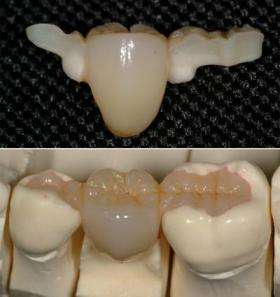
Vistasp Karbhari, a professor of structural engineering at UC San Diego, has developed fiber-reinforced polymer composites as strong, lightweight materials for aerospace, automotive, civil and marine applications, so he thought, "If they work so well in highway bridges, why not dental bridges?"
In a paper scheduled for publication in Dental Materials, Karbhari and Howard Strassler, a professor and director of Operative Dentistry at the University of Maryland Dental School, report the results of detailed engineering tests on dental composites containing glass fibers as well as the type of polyethylene fibers used in bullet-proof vests.
Karbhari and Strassler found that the toughness of fiber-reinforced dental materials depends on the type and orientation of the fiber used. Their report, available at the Dental Materials website, shows that braided polyethylene fibers performed the best, boosting toughness by up to 433 percent compared to the composite alone.
Many of the strength and durability tests reported in the paper are not currently required by the U.S. Food and Drug Administration (FDA), which regulates dental composites as class II prescription devices. The agency requires eight minimum tests plus biocompatibility tests to ensure that dental composites are safe and nontoxic.
“Fiber-reinforced composites are now widely used in the aerospace and automotive industries and the experience we’ve gained in these applications can be applied in a more rigorous way in dentistry and medicine to tailor performance to exacting requirements,” said Karbhari. Dentists began using particle filled composites 10 years ago as an alternative to ceramics and mercury-containing metal amalgams. Strassler selected three commercially available fiber-reinforced composites for analysis.
Dental composites made with glass or polyethylene fibers are sold as pliable ribbons that dentists mold into the required shape and then harden with curing lights. “Many reinforcing fibers can add strength and toughness to dental composites,” Karbhari said, “but if they are improperly aligned they could actually accelerate damage to existing teeth.”
“What’s been missing until now is a rigorous, reproducible way to test the durability and resistance to breakage for these materials,” Strassler said. “Makers of fiber-reinforced dental composites need a much better understanding of how their products actually perform as part of a restoration, crown, or bridge, and this study provides an analytical standard with which all composites should be evaluated in the future.”
The three products tested were a 3-millimeter-wide ribbon of unidirectional glass fibers, a 3-millimeter-wide ribbon of polyethylene fibers woven in a figure-8 stop-stitch leno-weave, and a 4-millimeter wide ribbon of polyethylene fibers woven in a biaxial braid. The resistance to breakage and various measures of toughness of the three preparations were compared to the dental composite alone.
“All three fiber fabrics dramatically increased the durability and strength of the dental composite, but the polyethylene fibers braided in a biaxial ribbon performed best,” said Karbhari. “The tests required by the FDA indicate that fiber-reinforced composites are safe, but those tests are only partially informative. Our analyses show that we can optimize these materials to match and improve performance of teeth, for greater durability, toughness, and resistance to breakage.”
Source: University of California - San Diego


