Researchers clear way to stronger glass
Look at your window - not out it, but at it. Though the window glass looks clear, if you could peer inside the pane you would see a surprising molecular mess, with tiny particles jumbled together any which way.
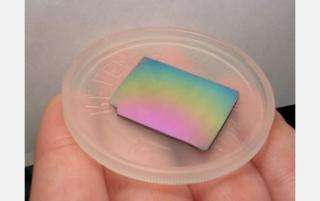
Now, researchers at the University of Wisconsin-Madison have developed a new glass-making technique that eliminates some of that mess. With the new technology, described in a study in the Dec. 8 issue of Science, they created a novel glass that is stronger and more stable than glass made in traditional ways. Though not suitable to replace everyday products like window panes or eyeglasses, this new glass may allow pharmaceutical companies the opportunity to explore previously unusable drug compounds.
When considered at the molecular level, most solid materials can be described as either crystals or glasses, explains lead author Mark Ediger, a UW-Madison chemistry professor. The difference lies in the degree of internal organization of their constituent molecules.
"A crystal is like toy soldiers all lined up marching together," Ediger says. "A glass is a teenager's room, with stuff packed in everywhere."
Just as levels of messiness can range from cluttered to chaotic, levels of molecular disorder can vary between different types of glass. Glasses composed of more organized molecules are more stable and durable, while glasses with haphazard molecular assemblies are less stable and may degrade over time.
Conventional glasses are relatively disordered and molecularly unstable because of how they are made. Glass ingredients are melted, then cooled and allowed to harden. As the molten glass cools, Ediger says, "The molecules slow down, then get stuck. The question is, did they get stuck in an organized state or in an unorganized state?"
Normally, a piece of glass is allowed to cool all at once and the inner molecules, unable to move freely, tend to be trapped in disarray. Ediger and his team, in collaboration with researchers in the UW-Madison School of Pharmacy and the National Institute of Standards and Technology, designed a new technique that gives all the molecules a chance to arrange themselves a little more neatly.
In their new work, funded by grants from the National Science Foundation and the U.S. Department of Agriculture, Ediger and his team build glass layer by layer using a method called "vapor deposition." Glass is heated to the point of evaporation and allowed to condense on a cold surface, where the vapor forms an ultrathin liquid film. By adding layers to the surface one at a time, each sheet of particles can move into a more organized arrangement before solidifying.
Though the new glasses do not reach the precision of crystals, they are denser and far stronger than traditional glass. "We were just astonished," says Ediger. "These materials were so unusual, it took a whole year to understand what was going on."
Ediger estimates that the more stable glass would take at least 10,000 years to make using conventional technology, because the liquid glass would have be cooled extremely slowly. With the new vapor deposition method, it takes about an hour.
For now, the Wisconsin researcher has no expectations of using the method for large items like window glass. The microscopic scale of the layering technique makes it best suited for thin films and small products. With UW-Madison pharmacy professor Lian Yu, Ediger is working toward possible medical applications for the new stable glass.
Like other solids, pharmaceutical compounds can form crystals or glasses when melted and cooled. For potential drugs, molecular stability is critical, Ediger says. Forms that are too unstable can degrade and change their effects over time, while those that are too stable may be insoluble in the human body.
By using their method as a general technique to control stability and solubility of molecular glass, Ediger says, it may be possible to develop drug compounds that were previously unusable. They may also be able to use stable glass films to extend the shelf life of existing medical tools like off-the-shelf blood and pregnancy testing kits.
So far, Ediger's team has successfully made stable glass with an anti-inflammatory called indomethacin, a common test drug Ediger refers to as "the fruit fly of the drug industry." Encouraged by their results, the group plans to test more materials in the search for additional applications.
Source: University of Wisconsin-Madison


