Ancient ape ruled out of man's ancestral line
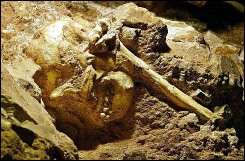
December 7, 2006 'Little foot,' an almost complete hominid skeleton

´Little foot,´ an almost complete hominid skeleton

Ancient remains, once thought to be a key link in the evolution of mankind, have now been shown to be 400,000 years too young to be a part of man’s family tree.

The remains of the apeman, dubbed Little Foot, were discovered in a cave complex at Sterkfontein by a local South African team in 1997. Its bones preserved in sediment layers, it is the most complete hominid fossil skeleton ever found.

Little Foot is of the genus Australopithecus, thought by some to be part of the ancestral line which led directly to man. But research by Dr Jo Walker and Dr Bob Cliff of the University of Leeds School of Earth and Environment, with Dr Alf Latham of Liverpool University's School of Archaeology, Classics and Egyptology, shows the remains are more than a million years younger than earlier estimates.

The team used uranium lead chronology to date the remains. Working on extracts of stalagmite deposits from immediately above and below the body, they dated the skeleton at around 2.2 million years old.

Their findings, published in the American journal Science, are controversial. Earlier estimates had put the age of Little Foot at three to four million years old placing it potentially on a direct line to humans.

The first recognisable stone tools appeared in Africa around 2.6 million years ago, but they were not made by Australopiths. Rather it is thought the first tool maker was Homo habilis, whose evolution is believed to have led directly to man. Rather than being older than Homo habilis – and a possible direct ancestor – Little Foot is more likely a distant cousin.

His remains are cemented in hard mineral deposits in the Sterkfontein cave complex which has yielded a number of other ancient finds. It is thought he either fell down a shaft or somehow got trapped in the cave and died there to be covered by the sediment layers from which he is now being slowly extracted. These sediments are themselves sandwiched between stalagmite layers which provided the materials for the dating process.

Australopithecus walked on two legs, but stood just 130cm tall and had a brain comparable in size with a modern chimpanzee. As Dr Walker explained: “In many of these finds, the smallest bones have disintegrated, but here the feet and hands are well preserved - and these could enable researchers to show how well adapted this early primate was to walking on two feet.”

But the sediment encasing Little Foot is harder than the bone – making extracting him a painstaking process for the South African team.

And Drs Latham and Cliff have now turned their own attention to further Australopith findings at Makapansgat, also in South Africa, where other specimens of Australopithecus have been found.

Source: University of Leeds


Rate this story - 3.7 /5 (24 votes)


December 7, 2006 all stories

Comments: 0

3.7 /5 (24 votes)

  • hide
  • Related Stories

  • Scientists say magma building up in Mayon volcano
    created Dec 26, 2009 | popularity not rated yet | comments 0
  • U of A students reaffirm the work of a 1920s paleontologist
    created Dec 14, 2009 | popularity not rated yet | comments 0
  • BoarCroc, RatCroc, DogCroc, DuckCroc and PancakeCroc
    created Nov 19, 2009 | popularity not rated yet | comments 0
  • 15,000 reasons to worry about invasive species
    created Nov 09, 2009 | popularity not rated yet | comments 0
  • Researchers to study hidden lakes beneath West Antarctic ice sheet
    created Oct 21, 2009 | popularity not rated yet | comments 0


  • hide
  • Relevant PhysicsForums posts

  • Do we lose weight by respiration ? (Losing carbons)
    created 2 hours ago
  • Sleeping habits and the risk of cancer
    created Feb 08, 2010
  • Pressure in chambers of the heart
    created Feb 07, 2010
  • Primordial soup canned?
    created Feb 07, 2010
  • More from Physics Forums - Biology

Other News

TED takes on 'What the world needs now'

Other Sciences / Other

created 3 hours ago | popularity not rated yet | comments 0

Let the mind-bending begin! A TED conference that attracts brilliant minds and challenges them to solve humanity's ills got underway Tuesday in the southern California city of Long Beach.


New research reveals burglars have changed their 'shopping list'

Other Sciences / Social Sciences

created 4 hours ago | popularity 3.5 / 5 (2) | comments 3

Globalisation, and particularly cheaper electronic goods from China and the Far East, has altered behaviour among Britain's burglars according research in progress at the University of Leicester.


Study challenges bird-from-dinosaur theory of evolution - was it the other way around?

Study challenges bird-from-dinosaur theory of evolution - was it the other way around?

Other Sciences / Archaeology & Fossils

created 15 hours ago | popularity 3.7 / 5 (11) | comments 4 | with audio podcast

(PhysOrg.com) -- A new study just published in the Proceedings of the National Academy of Sciences provides yet more evidence that birds did not descend from ground-dwelling theropod dinosaurs, experts say, a ...


'Counterfactual' thinkers are more motivated and analytical, study suggests

Other Sciences / Social Sciences

created 19 hours ago | popularity 4.4 / 5 (5) | comments 6 | with audio podcast

(PhysOrg.com) -- "If only I had..." Almost everyone has said those four words at some time. Rather than intensifying regret, '"what if" reflection about pivotal moments in the past helps people to weave a coherent life story, ...


Office romance? Not a problem most of time: study

Office romance? Not a problem most of time: study

Other Sciences / Social Sciences

created 17 hours ago | popularity not rated yet | comments 1

(PhysOrg.com) -- Pam and Jim on The Office. Meredith and McDreamy on Grey's Anatomy. Television shows depict many workplace romances, but in the real world how do co-workers view love on the job? According ...