Ethylene Suggested for Hydrogen Storage
December 7th, 2006 Ethylene Suggested for Hydrogen Storage

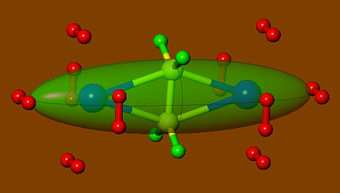
Results of modeling studies indicate that attaching titanium atoms (blue) to the ends of an ethylene molecule (yellow-green) will result in a capsule-shaped complex that absorbs 10 hydrogen molecules (red). The results open a new avenue in the pursuit of materials that will enable efficient solid-state storage of hydrogen. Credit: NIST

Ethylene, a ho-hum material that is the building block of the most common plastic, might have an exciting future in storing hydrogen, the hoped-for transportation fuel of the future. New research reported by scientists from the National Institute of Standards and Technology and Turkey’s Bilkent University makes the surprising prediction that “ethylene, a well-known inexpensive molecule, can be an important basis in developing frameworks for efficient and safe hydrogen-storage media.”

The team’s calculations show that attaching titanium atoms at opposite ends of an ethylene molecule (four hydrogen atoms bound to a pair of carbon atoms) will result in a very attractive “two for” deal. The addition of the two metal atoms results in a net gain of up to 10 hydrogen molecules that can absorb onto the ethylene-titanium complex, for a total of 20 hydrogen atoms. As important, the engineered material is predicted to release the hydrogen with only a modest amount of heating.

The absorbed hydrogen molecules account for about 14 percent of the weight of the titanium-ethylene complex. That’s about double the Department of Energy’s minimum target of 6.5 percent for economically practical storage of hydrogen in a solid state material. Although significant challenges stand in the way, solid state storage is preferred to storing hydrogen as a liquid or compressed gas, both of which require large-volume tanks.

“The success of future hydrogen and fuel-cell technologies is critically dependent upon the discovery of new materials that can store large amounts of hydrogen at ambient conditions,” explains Taner Yildirim, a theorist at the NIST Center for Neutron Research.

Yildirim and collaborators have been searching for routes to develop these needed materials. Their earlier research has pointed to several candidates, including carbon nanotubes coated with titanium atoms. Difficulties in securing bulk amounts of small-diameter nanotubes and other challenges have foiled efforts to create these materials in the laboratory.

The team anticipates that ethylene-based complexes, made with titanium or other so-called transition metals, will prove easier to synthesize and, then, to evaluate for their potential for high-capacity hydrogen storage.

Citation: E. Durgun, S. Ciraci, W. Zhou, and T. Yildirim. Transition-metal-ethylene complexes as high-capacity hydrogen-storage media. Physical Review Letters. 97, 226102 (2006)

Source: NIST


print this article email this article download pdf blog this article bookmark this article     Digg this Stumble it share on Facebook share on Reddit add to delicious save to Yahoo! bookmarks
4.5/5 after 24 votes


December 7th, 2006 all stories
Physics / Condensed Matter

Comments: 0
Rank: 4.5/5 after 24 votes

  • Stumble this up

  • Digg this

  • Share it:
  • share on Facebook
  • share on MySpace
  • share on Slashdot
  • rss-newsfeed
  • share on Google
  • share on Reddit
  • add to delicious
  • save to Yahoo! bookmarks
  • share on Windows Live
  • Add to Mixx!
Rating: 4.5/5 after 24 votes


Tags


  • Physicists Demonstrate Quantum Memory with Matter Qubits
    Physicists Demonstrate Quantum Memory with Matter Qubits
    Physics / General Physics
    created Jul 03, 2009 | popularity 4.4 / 5 (17) | comments 1
  • 'Holey' Nanosheets for Wastewater Dye Removal
    Nanotechnology / Nanomaterials
    created Jul 01, 2009 | popularity 5 / 5 (5) | comments 1
  • Jellyfish Robot Swims Like its Biological Counterpart
    Jellyfish Robot Swims Like its Biological Counterpart
    Electronics / Robotics
    created Jun 26, 2009 | popularity 4.4 / 5 (8) | comments 1
  • Could Maxwell's Demon Exist in Nanoscale Systems?
    Could Maxwell's Demon Exist in Nanoscale Systems?
    Physics / General Physics
    created Jun 24, 2009 | popularity 4.4 / 5 (18) | comments 29
  • Living Safely with Robots, Beyond Asimov's Laws
    Living Safely with Robots, Beyond Asimov's Laws
    Electronics / Robotics
    created Jun 22, 2009 | popularity 4.6 / 5 (53) | comments 40
  • Other News

    UQ researchers break the law -- of physics

    Physics / General Physics

    created 5 hours ago | popularity 4.7 / 5 (9) | comments 0

    (PhysOrg.com) -- Two UQ Science researchers have proved two famous physical laws that have been widely used for the past 25 years do not always work.


    Scientists create first electronic quantum processor

    Scientists create first electronic quantum processor

    Physics / General Physics

    created Jun 28, 2009 | popularity 4.8 / 5 (54) | comments 42

    A team led by Yale University researchers has created the first rudimentary solid-state quantum processor, taking another step toward the ultimate dream of building a quantum computer.


    Science journals

    How to Spot an Influential Paper Based on its Citations

    Physics / General Physics

    created Jul 04, 2009 | popularity 3.9 / 5 (10) | comments 6

    (PhysOrg.com) -- At first it may seem that the number of citations received by a published scientific paper is directly related to that paper's quality of content. The higher the quality, the more people read ...


    Fermilab's CDF observes Omega-sub-b baryon

    Fermilab's CDF observes Omega-sub-b baryon

    Physics / General Physics

    created Jun 29, 2009 | popularity 4.7 / 5 (18) | comments 7

    (PhysOrg.com) -- At a recent physics seminar at the Department of Energy’s Fermi National Accelerator Laboratory, Fermilab physicist Pat Lukens of the CDF experiment announced the observation of a new particle, ...


    New insights, and a new angle, on high-temperature superconductivity

    New insights, and a new angle, on high-temperature superconductivity

    Physics / Superconductivity

    created Jun 29, 2009 | popularity 4.9 / 5 (14) | comments 7

    (PhysOrg.com) -- A Princeton-led research team has revealed surprising information about how electron behavior influences the conduction of electricity in a class of high-temperature superconductors. An increased ...