Better track leads to new particles
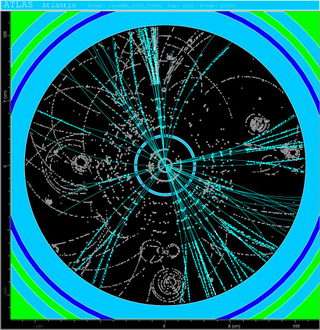
In particle accelerators new particles often arise as a result of collisions between elementary particles. However the track left by these particles is often difficult to trace. Dutch researcher Thijs Cornelissen developed an algorithm to reconstruct the particle tracks and that is being used in a European research institute for particle physics. His method provides greater insights into the origin of particles that arise as a result of collisions.
Last year, Cornelissen contributed to the development of the ATLAS detector of the Large Hadron Collider (LHC), the new particle accelerator of the European Organisation for Nuclear Research (CERN) in Geneva. Material is made up of very small particles, which are too small to be seen with a microscope. These particles can, however, be studied using particle accelerators. A particle accelerator accelerates particles up to extremely high energies after which they collide releasing new particles. The particles produced pass through various components of the accelerator and the detector, before the detector makes a reconstruction of their track.
The detector measures the exact positions of a particle that passes through it. Using this collection of points, computer calculations can be performed to determine the track of the particle. The tracks are deflected by the presence of a magnetic field within the detector. This deflection is used to calculate the impulse of the particle.
The particle track is influenced by the material in the detector, such as the copper and aluminium found in the cables and magnets. The particles lose some of their energy when they pass through a layer of material, and this alters the deflection of the track. Multiple scattering of the particles also affects the direction of the track. In his PhD thesis, Cornelissen describes an algorithm that tries to correct for these material effects so as to achieve the best possible resolution on the track construction. This reconstruction is vitally important for determining which particles arose from the collision.
Cornelissen's algorithm has been tested with simulated data and has been applied to real data obtained by prototypes of the detectors that will be used in ATLAS. For example, tracks of cosmic particles can also be accurately detected and reconstructed. That is particularly important for the start of the LHC and the real measurements of the ATLAS experiment, which are planned to take place before the end of 2007.
Source: NWO


