Engineering professor shakes things up with earthquake tests
Most Texans have little reason to think about earthquakes or seismic damage much in their everyday lives. But for Dr. David Rosowsky of Texas A&M University, extreme events like earthquakes, hurricanes and the performance of structures under such conditions are more than just an interest — they are his passion.
Rosowsky, department head and A.P. and Florence Wiley Chair Professor in the Zachry Department of Civil Engineering at Texas A&M and a researcher in the Texas Engineering Experiment Station, is part of a team working on a four-year, $1.24 million project funded by the National Science Foundation through the Network for Earthquake Engineering Simulation (NEES). The project studies the performance of engineered wood structures subjected to seismic loading.
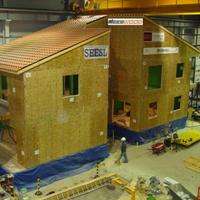
The project's first phase included a large-scale test conducted in the summer of 2006 at the University of Buffalo's Structural Engineering and Earthquake Simulation Lab, and was led by a team of faculty and students from Colorado State University, University of Buffalo, Texas A&M, Cornell University and Rensselaer Polytechnic Institute. A two-story, 1,800 square-foot, fully furnished townhouse was built and placed inside the lab on two moveable, piston-powered shake tables, among the largest of their kind in the United States. Engineers and researchers jolted, shook and rattled the house in a series of five mock earthquakes that grew in size and magnitude.
According to Rosowsky, wood is one of the most common construction materials for residential and other low-rise structures in the country. This fact, coupled with the growing interest in building taller wood frame structures in some of the most seismically active parts of the country, produces a need to develop an engineering design philosophy for wood structures built in earthquake-prone regions to ensure life safety and minimize structural damage and costs to acceptable levels.
"We hope to use the data collected from this project to better understand how wood structures behave under earthquake loads," Rosowsky said. "If we can predict where the weaknesses lie within these structures, we can take steps to strengthen those problem areas, and build structures better able to withstand the damaging earthquake forces, minimizing structural displacement and the resulting damage."
The fourth shake test of the project rattled the townhouse with the force of a magnitude 6.4 earthquake, much like the one that pummeled Northridge, Calif., in 1994. That disaster resulted in 60 deaths and is believed to be the costliest earthquake in U.S. history, with damages reaching $40 billion.
The test house was put to the ultimate trial with the fifth and final experiment on Nov. 14 when it was subjected to what is known as the maximum credible earthquake. This earthquake is the strongest possible quake at a given area based on the local seismology and geology. This final test of phase one resembled the infamous 1906 San Francisco earthquake that produced tremors measuring from 7.7 to 8.3 on the Richter scale and resulted in the loss of around 3,000 lives.
Phase two takes the project across the globe to Miki City, Japan. There in early 2009, Rosowsky and the team of researchers will test a six-story building on E-Defense, the world's largest shake table.
"While wood structures are not as ubiquitous in Japan as they are in the United States, North American 'stick-frame' style construction is gaining popularity and both American and Canadian companies are moving to capitalize on great new opportunities," Rosowsky said.
With Japan located in a highly seismic region, Rosowsky believes that both the United States and Japan have strong incentives to develop new, engineered design procedures for wood frame structures subject to earthquake loading.
"These tests, conducted in the United States and in Japan, are the largest shake- table tests of wood frame structures ever performed," Rosowsky said. "We can learn an enormous amount from this project and through the development of new design procedures, have a significant impact on the safety and damage resistance of a very large class of buildings."
Source: Texas A&M University


