Regional nuclear war could devastate global climate
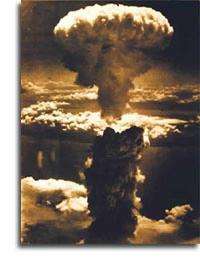
Even a small-scale, regional nuclear war could produce as many direct fatalities as all of World War II and disrupt the global climate for a decade or more, with environmental effects that could be devastating for everyone on Earth, university researchers have found.
These powerful conclusions are being presented Dec. 11 during a press conference and a special technical session at the annual meeting of American Geophysical Union in San Francisco. The research also appears in twin papers posted on Atmospheric Chemistry and Physics Discussions, an online journal.
A team of scientists at Rutgers, The State University of New Jersey; the University of Colorado at Boulder (CU-Boulder); and UCLA conducted the rigorous scientific studies reported.
Against the backdrop of growing tensions in the Middle East and nuclear "saber rattling" elsewhere in Asia, the authors point out that even the smallest nuclear powers today and in the near future may have as many as 50 or more Hiroshima-size (15 kiloton) weapons in their arsenals; all told, about 40 countries possess enough plutonium and/or uranium to construct substantial nuclear arsenals.
Owen "Brian" Toon, chair of the department of atmospheric and oceanic sciences and a member of the Laboratory for Atmospheric and Space Physics at CU-Boulder, oversaw the analysis of potential fatalities based on an assessment of current nuclear weapons inventories and population densities in large urban complexes. His team focused on scenarios of smoke emissions that urban firestorms could produce.
"The results described in one of the new papers represent the first comprehensive quantitative study of the consequences of a nuclear conflict between smaller nuclear states," said Toon and his co-authors. "A small country is likely to direct its weapons against population centers to maximize damage and achieve the greatest advantage," Toon said. Fatality estimates for a plausible regional conflict ranged from 2.6 million to 16.7 million per country.
Alan Robock, a professor in the department of environmental sciences and associate director of the Center for Environmental Prediction at Rutgers’ Cook College, guided the climate modeling effort using tools he previously employed in assessing volcano-induced climate change. Robock and his Rutgers co-workers, Professor Georgiy Stenchikov and Postdoctoral Associate Luke Oman (now at Johns Hopkins University) generated a series of computer simulations depicting potential climatic anomalies that a small-scale nuclear war could bring about, summarizing their conclusions in the second paper.
"Considering the relatively small number and size of the weapons, the effects are surprisingly large. The potential devastation would be catastrophic and long term," said Richard Turco, professor of atmospheric and oceanic sciences, and a member and founding director of UCLA's Institute of the Environment. Turco once headed a team including Toon and Carl Sagan that originally defined "nuclear winter."
While a regional nuclear confrontation among emerging third-world nuclear powers might be geographically constrained, Robock and his colleagues have concluded that the environmental impacts could be worldwide.
"We examined the climatic effects of the smoke produced in a regional conflict in the subtropics between two opposing nations, each using 50 Hiroshima-size nuclear weapons to attack the other’s most populated urban areas," Robock said. The researchers carried out their simulations using a modern climate model coupled with estimates of smoke emissions provided by Toon and his colleagues, which amounted to as much as five million metric tons of "soot" particles.
"A cooling of several degrees would occur over large areas of North America and Eurasia, including most of the grain-growing regions," Robock said. "As in the case with earlier nuclear winter calculations, large climatic effects would occur in regions far removed from the target areas or the countries involved in the conflict."
When Robock and his team applied their climate model to calibrate the recorded response to the 1912 eruptions of Katmai volcano in Alaska, they found that observed temperature anomalies were accurately reproduced. On a grander scale, the 1815 eruption of Tambora in Indonesia – the largest in the last 500 years – was followed by killing frosts throughout New England in 1816, during what has become known as "the year without a summer." The weather in Europe was reported to be so cold and wet that the harvest failed and people starved. This historical event, according to Robock, perhaps foreshadows the kind of climate disruptions that would follow a regional nuclear conflict.
But the climatic disruption resulting from Tambora lasted for only about one year, the authors note. In their most recent computer simulation, in which carbon particles remain in the stratosphere for up to 10 years, the climatic effects are greater and last longer than those associated with the Tambora eruption.
"With the exchange of 100 15-kiloton weapons as posed in this scenario, the estimated quantities of smoke generated could lead to global climate anomalies exceeding any changes experienced in recorded history," Robock said. "And that’s just 0.03 percent of the total explosive power of the current world nuclear arsenal."
Source: Rutgers, the State University of New Jersey


