Abrupt ice retreat could produce ice-free arctic summers by 2040
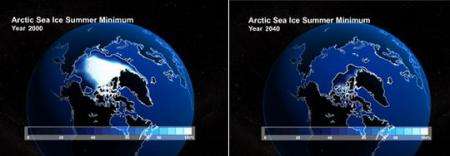
The recent retreat of Arctic sea ice is likely to accelerate so rapidly that the Arctic Ocean could become nearly devoid of ice during summertime as early as 2040, according to new research published in the December 12 issue of Geophysical Research Letters.
The study, by a team of scientists from the National Center for Atmospheric Research (NCAR), the University of Washington, and McGill University, analyzes the impact of greenhouse gas emissions on the Arctic. Scenarios run on supercomputers show that the extent of sea ice each September could be reduced so abruptly that, within about 20 years, it may begin retreating four times faster than at any time in the observed record.
"We have already witnessed major losses in sea ice, but our research suggests that the decrease over the next few decades could be far more dramatic than anything that has happened so far," says NCAR scientist Marika Holland, the study's lead author. "These changes are surprisingly rapid."
Arctic sea ice has retreated in recent years, especially in the late summer, when ice thickness and area are at a minimum. To analyze how global warming will affect the ice in coming decades, the team studied a series of seven simulations run on the NCAR-based Community Climate System Model, one of the world's leading tools for studying climate change. The scientists first tested the model by simulating fluctuations in ice cover since 1870, including a significant shrinkage of late-summer ice from 1979 to 2005. The simulations closely matched observations, a sign that the model was accurately capturing the present-day climate variability in the Arctic.
The team then simulated future ice loss. The model results indicate that, if greenhouse gases continue to build up in the atmosphere at the current rate, the Arctic's future ice cover will go through periods of relative stability followed by abrupt retreat. For example, in one model simulation, the September ice shrinks from about 2.3 million to 770,000 square miles in a 10-year period. By 2040, only a small amount of perennial sea ice remains along the north coasts of Greenland and Canada, while most of the Arctic basin is ice-free in September. The winter ice also thins from about 12 feet thick to less than 3 feet.
Why expect abrupt change?
The research team points to several reasons for the abrupt loss of ice in a gradually warming world. Open water absorbs more sunlight than does ice, meaning that the growing regions of ice-free water will accelerate the warming trend. In addition, global climate change is expected to influence ocean circulations and drive warmer ocean currents into the Arctic.
"As the ice retreats, the ocean transports more heat to the Arctic and the open water absorbs more sunlight, further accelerating the rate of warming and leading to the loss of more ice," Holland explains. "This is a positive feedback loop with dramatic implications for the entire Arctic region."
Avoiding abrupt change
The scientists also conclude that different rates of greenhouse gas emissions can affect the probability of abrupt ice loss. By examining 15 additional leading climate models, they found that if emissions of carbon dioxide and other greenhouse gases were to slow, the likelihood of rapid ice loss would decrease. Instead, summer sea ice would probably undergo a much slower retreat.
"Our research indicates that society can still minimize the impacts on Arctic ice," Holland says.
The study drew on extensive and sophisticated computer modeling recently carried out for the Intergovernmental Panel on Climate Change. The IPCC's next assessment report will be released early in 2007.
Source: University Corporation for Atmospheric Research


