New Technique Studies How Plastic Solar Cells Turn Sunlight into Electricity
December 11, 2006
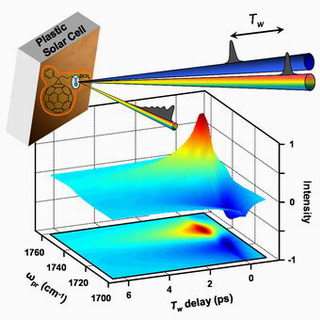
A plot of the wavelength of emitted infrared light vs. the time delay of the light emission provides information about the path of an electron within a plastic solar cell. This information about how the cell makes an electric current from light will lead to improvements in the efficiency and usable lifetime of solar cells. Credit: Penn State
A new analytical technique that uses infrared spectroscopy to study light-sensitive organic materials could lead to the development of cheaper, more efficient solar cells. Using infrared (IR) spectroscopy to study the vibrations of atoms within the material, the technique provides information about the movement of electrons within a film of carbon-based materials.
Obtaining this information is a critical step in the development of a new class of solar cells, which promise significant savings in production costs compared to conventional silicon-based cells. The new analytical technique, published as the cover story in this week's issue of the Journal of Physical Chemistry B, was developed by a team led by Penn State University researcher John B. Asbury, assistant professor of chemistry.
Organic photovoltaic devices (OPV) have become important because they are much less expensive to produce than silicon-based solar cells. The material consists of a film made of two different types of chemicals: a polymer that releases an electron when it is struck by a photon of light and a large molecule that accepts the freed electrons, which is based on the soccer-ball-shaped "buckminsterfullerene" carbon molecules popularly known as "buckyballs."
Because the electrical interactions needed to produce an electric current occur at the interfaces of the two components of this polymer blend, materials scientists need to understand the arrangement of molecules in the film. Asbury's new analytical technique provides a closer look at this arrangement than the techniques that traditionally have been used.
Previous studies, using atomic-force microscopy, supply general information about the packing of the molecules, but they provide very limited information about the interfaces where the molecules actually come together. IR spectroscopy, on the other hand, provides a more detailed picture of the interface by tracing the exchange of electrons between two molecules of the film.
"The problems with OPVs today are that they are not efficient enough and they tend to stop working over time," says Asbury. In order to develop a useful electric current, the flow between the two components must be optimized. "To improve performance, we need to understand what happens at the molecular level when light is converted to electrons," Asbury explains.
When the film is exposed to light, each photon excites an electron in the polymer. If an interface between the polymer molecule and the functionalized buckminsterfullerene exists, a current can be produced. However, in the materials developed to date, many of the electrons appear to become sidetracked. Asbury exposes the film to light using ultrashort laser pulses, which causes photons of light to be converted to electrons across the entire surface at the same time. Two-dimensional IR spectroscopy is used to monitor the vibration of the molecules within the film.
"The vibrations of the molecules are strongly affected by the presence or absence of electrons," says Asbury. "We use these vibrations as a probe to track the movement of electrons. By varying the structures of the materials, we expect to identify the side paths that reduce efficiency and ultimately to use that information to guide material design." The ultimate goal is a solar cell that is sufficiently inexpensive and efficient that it can be used on a rooftop to provide the electrical energy needed in a building.
In addition to Asbury, the Penn State research team includes graduate students Larry W. Barbour and Maureen Hegadorn.
Source: Penn State
-
Record conductivity achieved in strained lattice organic semiconductor
Dec 21, 2011 |
4.3 / 5 (4) |
0
-
Bright future for gaN nanowires
Nov 29, 2011 |
4.8 / 5 (4) |
0
-
DSC recipe brings good news to solar cell economics
Nov 06, 2011 |
4.7 / 5 (11) |
20
-
Electrochemistry controlled with a plasma electrode
Oct 20, 2011 |
5 / 5 (2) |
0
-
Lessons to be learned from nature in photosynthesis
Sep 23, 2011 |
4.7 / 5 (10) |
0
-
Engineers build first sub-10-nm carbon nanotube transistor
Feb 01, 2012 |
4.9 / 5 (31) |
30
-
Something old, something new: Evolution and the structural divergence of duplicate genes
Jan 31, 2012 |
4.6 / 5 (7) |
1
-
The hidden nanoworld of ice crystals: Revealing the dynamic behavior of quasi-liquid layers
Jan 30, 2012 |
5 / 5 (3) |
1
-
Stock market network reveals investor clustering
Jan 27, 2012 |
3.9 / 5 (23) |
8
-
Of microchemistry and molecules: Electronic microfluidic device synthesizes biocompatible probes
Jan 26, 2012 |
5 / 5 (1) |
0
-
Understanding induced emfs
2 hours ago
-
What is the precise definition of a year?
3 hours ago
-
Universe as a cellular automaton
4 hours ago
-
Question about Newton's laws
5 hours ago
-
Gravity Question (I think) with mass and speed
7 hours ago
-
Can you manipulate any formula in Physics?
8 hours ago
- More from Physics Forums - General Physics
More news stories
Explained: Sigma
It's a question that arises with virtually every major new finding in science or medicine: What makes a result reliable enough to be taken seriously? The answer has to do with statistical significance -- but ...
Feb 09, 2012 |
5 / 5 (19) |
65
Quantum physicist explains $100K offer for proof scaled-up quantum computing is impossible
(PhysOrg.com) -- MIT researcher Scott Aaronson has certainly riled the physics community with his offer this past Friday, of $100,000 to anyone who can prove that scaled-up quantum computing is impossible. ...
Diamond light, brighter than the sun
Its the size of five football pitches and generates light 10 billion times brighter than the sun. As the Diamond Light Source celebrates its tenth anniversary this year, Penny Bailey visits one of the ...
Feb 07, 2012 |
4.3 / 5 (7) |
15
|
Physicists 'record' magnetic breakthrough
An international team of scientists has demonstrated a revolutionary new way of magnetic recording which will allow information to be processed hundreds of times faster than by current hard drive technology.
Feb 07, 2012 |
4.5 / 5 (41) |
14
|
Hints of the Higgs - papers are submitted
Back in December 2011, the ATLAS and CMS experiments at CERN presented some exciting results that provided tantalising hints of the Higgs boson.
Feb 08, 2012 |
4.1 / 5 (7) |
10
Walney offshore wind farm is world's biggest (for now)
(PhysOrg.com) -- The Walney wind farm on the Irish Sea--characterized by high tides, waves and windy weather--officially opened this week. The farm is treated in the press as a very big deal as the Walney ...
GPS court ruling leaves US phone tracking unclear
A US Supreme Court decision requiring a warrant to place a GPS device on the car of a criminal suspect leaves unresolved the bigger issue of police tracking using mobile phones, legal experts say.
Europeans protest controversial Internet pact
Tens of thousands of people marched in protests in more than a dozen European cities Saturday against a controversial anti-online piracy pact that critics say could curtail Internet freedom.
Europe stakes billion-dollar bet on new rocket
A pencil-slim rocket is scheduled to lift into space from South America on Monday, carrying a billion-dollar bet that Europe can grab a juicy slice of the market to place satellites in low orbit.
Study finds that anti-diabetic medication can prevent the long-term effects of maternal obesity
In a study to be presented today at the Society for Maternal-Fetal Medicine's annual meeting, The Pregnancy Meeting, in Dallas, Texas, researchers will report findings that show that short therapy with the anti-diabetic medication ...
Netflix settlement trims 14 pct off 4Q earnings
(AP) -- Netflix pressed the rewind button on its fourth-quarter earnings after settling allegations that the video subscription service violated a consumer-privacy law.