Desert Find Lends More Strength to Theories of Possible Life on Mars
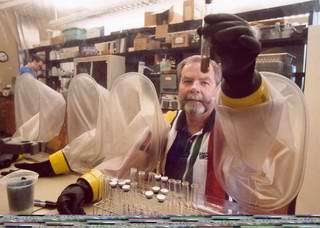
A University of Arkansas researcher has found methane-producing microorganisms in an unexpected place - arid desert soils. This finding strengthens the possibility that such microorganisms can exist under the conditions found on Mars and points the way to possible future experiments for detection of life on a distant planet.
Tim Kral, professor of biological sciences in the J. William Fulbright College of Arts and Sciences, along with researchers from the University of Southern California reported their findings online in the journal Icarus.
"You don't commonly find organisms such as methanogens in dry areas," said Kral. "But finding them in a dry area on Earth is especially significant because the surface of Mars is dry."
Researchers collected five vapor samples each from the Mars Desert Research Station in Utah and from the Idaho High Desert, as well as 40 soil samples from the Utah site, one from Death Valley, Calif., 19 from the Arctic Circle and one from the Atacama Desert in Chile. The samples were sent to Kral for analysis in his laboratory, where he has previously grown and monitored methanogens.
Examination of the vapor samples from the sites found that three of the five gas samples contained methane, indicating the possible presence of methanogens in the soil. In addition, five of the 40 soil samples from Utah produced methane when they were treated with a growth medium, again indicating the presence of methanogens.
Methanogens are found in anaerobic environments on Earth, from hot springs to the deep ocean to the intestinal tracts of humans and animals. Methanogens do not require oxygen to survive; instead, these tiny creatures breathe carbon dioxide and hydrogen gas, producing methane as a waste product. This unique form of respiration makes methanogens potentially viable residents of Mars, whose atmosphere is predominantly composed of carbon dioxide with practically no oxygen.
Methane, a gaseous compound of carbon and hydrogen, recently has been found in the atmosphere of Mars. Methane is unstable in the presence of ultraviolet sunlight and can be completely destroyed in the atmosphere in only a few hundred years. Its presence in the Martian atmosphere can only be explained if there is some process on Mars that is continually creating it.
Two potential scenarios could explain the presence of the gas, Kral said. Either the methane is being produced by living organisms, which would mean that some type of methanogens already inhabit the planet, or the methane is being made below the planet's surface by subsurface volcanic activity. The presence of such volcanic activity would mean that there is a source of energy and warmth below the surface -- two factors that are indicators that liquid water may also exist below the surface.
Finding methanogens in dry, arid climates shows that they may be able to exist in the limited water conditions found on Mars. The researchers suggest that collection methods used in the desert study could be modified for use in future biodetection experiments on Mars.
Source: University of Arkansas


