Cassini's infrared camera sees tall mountains on Saturn's moon Titan
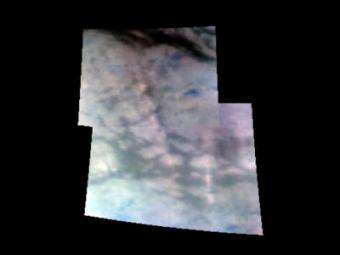
The infrared-sensitive camera on NASA's Cassini spacecraft has photographed the tallest mountains ever seen on Saturn's moon, Titan.
The mountain chain is nearly a mile high (1.5 kilometers), 93 miles long (150 kilometers) and 19 miles wide (30 kilometers). The mountains are topped by bright, white material which may be methane or other organic (carbon-containing) "snow."
"We see a massive mountain range that reminds me of the Sierra Nevada in the western United States," said Cassini scientist Robert H. Brown of the University of Arizona Lunar and Planetary Laboratory in Tucson. Brown is head of Cassini's visual and infrared mapping spectrometer (VIMS), which imaged the mountains in Titan's southern hemisphere during the Oct. 25, 2006 flyby.
The camera took its highest-resolution infrared views of Titan ever during this flyby, resolving surface features as small as 400 meters, or about 440 yards. Other features seen in the high-resolution VIMS images include fields of dunes and a deposit that resembles a volcanic flow.
If Titan were Earth, the mountains would be at latitudes near New Zealand. They probably formed as mid-ocean ridges form on Earth: The surface crust pulls apart, and material beneath the crust wells up through the crack, creating a ridge.
"These mountains are probably as hard as rock, made of icy materials, and are coated with different layers of organics," said Larry Soderblom of the U.S. Geological Survey, Flagstaff, Ariz., a Cassini interdisciplinary scientist.
"There seem to be layers and layers of various coats of organic 'paint' on top of each other on these mountain tops, almost like a painter laying the background on a canvas," Soderblom said. "Some of this organic gunk falls out of the atmosphere as rain, dust or smog onto the valley floors and mountain tops, which are coated with dark spots that appear to be brushed, washed, scoured and moved around the surface."
Cassini scientists combined the new infrared data with radar data from previous flybys to better understand the height and composition of Titan's geologic features. The shadows of the mountains are seen in the infrared images, for example, while the shapes of the mountains are seen in radar. Combining these different kinds of data is essential for scientists studying Titan's geologic processes.
The Oct. 25 infrared images also reveal a fan-shaped feature, which Brown said is probably a remnant of a volcanic flow. Cassini radar imaged this fan-shaped feature, and also a large, circular feature that appears to be the source of the flow, in less detail on a previous flyby.
"The evidence is mounting that this circular feature is a volcano," said Rosaly Lopes, radar team member at NASA's Jet Propulsion Laboratory in Pasadena, Calif. "With radar data alone, we identified it as a possible volcano, but the combination of radar and infrared makes it much clearer."
Clouds lie near the wrinkled, mountainous terrain in Titan's southern mid-latitudes. Their source has baffled scientists. "These clouds are probably methane droplets and may form when the air on Titan cools as it is pushed over the mountains by the Titanian winds," Brown said.
The new infrared images also clarify the composition of dunes that run across much of Titan. The dunes, built on water-ice bedrock, seem to consist of sand grains made of organics, Brown said.
Source: University of Arizona


