Self-Assembling Nano-Ice Discovered; Structure Resembles DNA
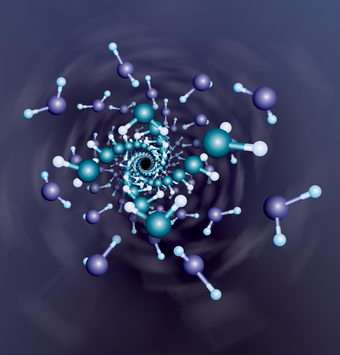
Working at the frontier between chemistry and physics, the University of Nebraska-Lincoln's Xiao Cheng Zeng usually finds his reward in discovering the unexpected through computer modeling.
Zeng and his colleagues regularly find new and often unanticipated behaviors of matter in extreme environments, and those discoveries have been published several times in major international scientific journals. Their findings, though, have been so far ahead of existing technology that their immediate practical impact was essentially nil -- until now.
Chemistry professor Zeng and two members of his UNL team recently found double helixes of ice molecules that resemble the structure of DNA and self-assemble under high pressure inside carbon nanotubes. This discovery could have major implications for scientists in other fields who study the protein structures that cause diseases such as Alzheimer's and bovine spongiform ecephalitis (mad cow disease). It could also help guide those searching for ways to target or direct self-assembly in nanomaterials and predict the kind of ice future astronauts will find on Mars and moons in the solar system.
Zeng, post-doctoral student Jaeil Bai and doctoral candidate Jun Wang reported their findings in the Dec. 11-15 online edition of the Proceedings of the National Academy of Sciences.
Zeng and his colleagues use powerful computers to model how materials behave at the nanoscale (where measurements are made in billionths of meters) under extremes of temperature, pressure and confinement. The team found the self-assembling double helix of nano-ice following a months-long experiment on UNL's PrairieFire supercomputer.
The experiment was a follow-up on a 2001 discovery through computer modeling by Zeng and another team of four new kinds of one-dimensional ice inside carbon nanotubes. Scientists elsewhere later confirmed through laboratory experiment the existence of three of the new nano-ices. One result in particular intrigued Zeng, Bai and Wang. Scientists at Argonne National Laboratory near Chicago confirmed the existence of a chain of octagon-shaped ice crystals inside a 1.4-nanometer carbon tube, just as Zeng and company expected. But the Argonne group also found an additional, unexpected chain of water molecules inside the octagon.
Zeng said that report inspired his team to take another look at one-dimensional ice, but this time with a PrairieFire that was 20 times more powerful that it had been five years earlier. The 2001 results were achieved at atmospheric pressures, but PrairieFire's added processing power enabled Zeng, Bai and Wang to design simulations that greatly increased the pressure on the water molecules.
"We were shocked to see these molecules arrange themselves in this way," said Zeng, university professor of chemistry. "We thought it would be like two tubes, one inside the other, but it didn't do that. It was helical, like DNA. I'm just speculating, but maybe the helix is a way for molecules to arrange themselves in a very compact, efficient way under high pressure.
"This ice formation can be viewed as a self-assembling process, and self-assembly is a way for molecules to bond together through weak hydrogen bonds. One example of a self-assembling material is protein. Proteins can self-assemble into structures like amyloid fibrils that can build up in the brain to cause Alzheimer's disease or prions that cause mad cow disease."
Another implication, Zeng said, is that these self-assembling helical ice structures may give scientists and engineers a different way to think about weak molecular bonds and the self-assembly process as they try to develop ways to direct self-assembly in making new materials. He said that while scientists have a good understanding of covalent bonds (the strong type of bonding where atoms share electrons), knowledge is not as complete about the weak bond, such as hydrogen bonds, that are essential to the self-assembly process. In weak bonding, atoms don't share electrons.
"We're happy to see potential applications that can maybe advance some fundamental science," Zeng said. "We're not engineers in direct contact with technology, but if our research can make some contribution, we're happy."
Zeng and his colleagues achieved their results by running four series of molecular dynamics simulations on PrairieFire and Department of Chemistry computers, using simulated carbon nanotubes ranging in diameter from 1.35 to 1.9 nanometers. They used Earth-like temperatures ranging from 117 degrees Fahrenheit to 9 degrees below zero F., but with pressures ranging from 10 to 40,000 atmospheres, with each series lasting no more than a few 10s of nanoseconds.
Most of the experiments produced the expected tubular structures, but in a simulation in a 1.35-nanometer tube at minus-9 degrees F. and 40,000 atmospheres, the ice transformed into a braid of double helix that resembles DNA in structure and in the weak bonds between the helixes. Additionally, in a simulation in a 1.9-nanometer tube at the same temperature, pressure on the confined liquid water was instantly raised from 10 atmospheres to 8,000. The confined liquid froze spontaneously into a high-density, triple-walled helical structure.
Source: University of Nebraska-Lincoln


