Team Detects 'Top Quark,' a Basic Constituent of Matter
A group of 50 international physicists, led by UC Riverside’s Ann Heinson, has detected for the first time a subatomic particle, the top quark, produced without the simultaneous production of its antimatter partner – an extremely rare event. The discovery of the single top quark could help scientists better explain how the universe works and how objects acquire their mass, thereby assisting human understanding of the fundamental nature of the universe.
The heaviest known elementary particle, the top quark has the same mass as a gold atom and is one of the fundamental building blocks of nature. Understood to be an ingredient of the nuclear soup just after the Big Bang, today the top quark does not occur naturally but must be created experimentally in a high-energy particle accelerator, an instrument capable of recreating the conditions of the early universe.
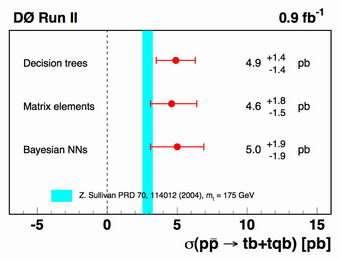
“We’ve been looking for single top quarks for 12 years, and until now no one had seen them,” said Heinson, a research physicist in the Department of Physics and Astronomy. “The detection of single top quarks – we detected 62 in total – will allow us to study the properties of top quarks in ways not accessible before. We are now able to study how the top quark is produced and how it decays. Do these happen as theory says they should? Are new particles affecting what we see? We're now better positioned to answer such questions.”
The detection of the top quark on its own was the outcome of a time-consuming process involving hundreds of scientists who constitute the “DZero” collaboration, a team of experimenters studying the top quark in particle collisions.
For its part, Heinson’s team first collected data from collision experiments conducted between 2002 and 2005 at the Tevatron Collider, the world’s highest energy particle accelerator that is comprised of a four-mile long underground ring at the Department of Energy’s Fermi National Accelerator Laboratory in Batavia, Ill. The collisions recorded were those between protons and antiprotons (the antimatter counterparts of protons).
Next, Heinson and her colleagues analyzed the record of high-energy collisions using powerful computers that helped the researchers determine which types of particles resulted from the collisions.
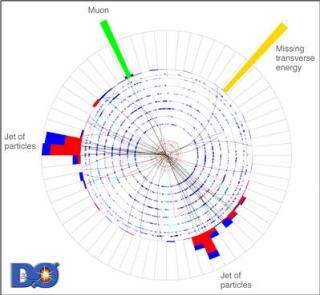
When a proton smashes head-on into an antiproton at nearly the speed of light, the collision occasionally produces a top quark. This heavy, unstable particle exists, however, for only a tiny fraction of a second before it decays into lighter particles, thereby complicating its detection. Physicists therefore must look at the top quark's descendents to identify it.
“We detected the top quark using the electronic signature of its decay products,” said Heinson, the primary author of a research paper on the single top quark’s detection that her group will submit to Physical Review Letters. “We measured the position of charged particles using a silicon vertex detector, which is an instrument – first encountered by the particles after the collision – that can precisely reconstruct the trajectories of charged particles. Since theory predicts single top quark production, we knew what to look for. It was extremely difficult, however, to find.”
In the near future, Heinson’s team plans to analyze more data generated by the Tevatron and also work with a new particle accelerator – the Large Hadron Collider – being built on the outskirts of Geneva, Switzerland, and scheduled to begin operation at the end of 2007.
Source: University of California, Riverside


