Stem Cells have Help to Renew Themselves
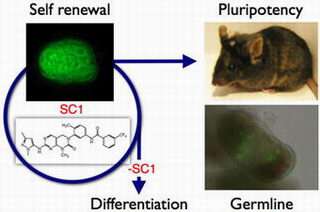
A small molecule makes stem cells able to reproduce and change. This simply structured moecule called SC1, which researchers at the Max Planck Institute for Molecular Biomedicine in Münster and their colleagues from California have discovered, encourages stem cells in the laboratory to renew themselves. As a result, the stem cells retain the ability to develop into many different types of cells. Up to now, keeping the cells pluripotent has only been possible with a great deal of effort.
Furthermore, the traditional method only delivered contaminated cells, however only very clean cells are suitable for medical applications. The search for the new molecule has also helped scientists to make new discoveries about the way in which stem cells reproduce (PNAS, 31 October 2006).
Stem cells are not fixed as to their potential development (pluripotent). Thus, stem cells from embryos may one day be able to help to manage or cure many different diseases. Initially, however, scientists want to keep large numbers of pluripotent cells in the laboratory which then differentiate into specialised cells. This is the only way they will acquire a sufficient quantity of specialised cells which might be used for therapeutic purposes.
The small SC1 molecule makes this possible. It was discovered by scientists at the Max Planck Institute for Molecular Biomedicine in Münster, their colleagues at the Scripps Research Institute in La Jolla and researchers at the Genomics Institute of the Novartis Research Foundation in San Diego. The molecule prevents the cell from specialising and loosing its pluripotence. "Thanks to this molecule, we will be able to reproduce clean stem cells relatively easily and cheaply. We have used it to keep the stem cells from mice in an undifferentiated state for a very long time," said Jeong Tae Do, one of the Max Planck researchers involved. "This represents significant progress in stem cell research."
Up to now, it has been very laborious keeping stem cells in the laboratory so that they remain pluripotent on division. For example, the researchers had to culture them on food cells sourced from a different animal and in calf serum and add a whole range of expensive substances. Human stem cells would therefore not be suitable for medical applications because they would be contaminated with animal products.
SC1 does not work on the same principle as the cocktail which researchers have previously used as a fountain of youth for stem cells. "Astonishingly, it blocks two enzymes which are involved in the differentiation process at the same time," said Jeong Tae Do. One of these enzymes is called RasGAP. SCI binds with this enzyme at an early stage in the reaction path which decides the fate of the cell. In doing this, it activates indirectly a protein which drives differentiation and also self-renewal. Later, the path forks to both options. SCI carries out its second task here and blocks the kinase ERK1 which makes a significant contribution to differentiation. It thus obstructs the path to specialisation and the stem cell has to renew itself. Whether these two biochemical signal paths also play a part in the self-renewal of stem cells has not been clear up to now. It is a completely new discovery that SCI can block it with the aid of this twin strategy.
To find a new way to keep the stem cells in the laboratory pluripotent, the scientists adopted the random approach: they tested 50,000 substances, and finally found that SC1, which is based on the basic element dihydropyrimidopyrimidine, was the most suitable. The researchers then tested whether stem cells treated with SC1 were also compatible with living organisms. For this purpose, the scientists injected a stem cell into the blastocyst of a mouse - a fertilized egg cell that had already undergone several divisions. This created a chimeric mouse with two different genomes: that of the egg cell and that of the injected stem cell. In the chimeric mouse with the stem cell treated with SC1, cells developing from the injected stem cell were integrated in all its organs. The researchers proved with this that stem cells treated with SC1 remain fully viable.
Citation: Shuibing Chen, Jeong Tae Do, Qisheng Zhang, Shuyuan Yao, Feng Yan, Eric C. Peters, Hans R. Schöler, Peter G. Schultz and Sheng Ding, Self-renewal of embryonic stem cells by a small molecule, Proceedings of the National Academy of Sciences, 31 October 2006
Source: Max-Planck-Institute of Molecular Biomedicine


