Very high frequency radiation makes dark matter visible
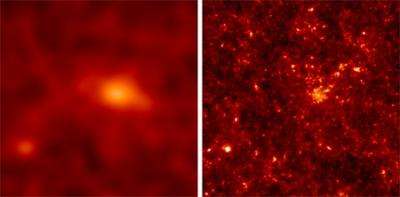
The stars and gas which are seen in galaxies account for only a few percent of the gravitating material in the Universe. Most of the rest has remained stubbornly invisible and is now thought to be made of a new form of matter never yet seen on Earth. Researchers at the Max Planck Institute for Astrophysics have discovered, however, that a sufficiently big radio telescope could make a picture of everything that gravitates, rivalling the images made by optical telescopes of everything that shines.
As light travels to us from distant objects its path is bent slightly by the gravitational effects of the things it passes. This effect was first observed in 1919 for the light of distant stars passing close to the surface of the Sun, proving Einstein's theory of gravity to be a better description of reality than Newton's. The bending causes a detectable distortion of the images of distant galaxies analogous to the distortion of a distant scene viewed through a poor window-pane or reflected in a rippled lake. The strength of the distortion can be used to measure the strength of the gravity of the foreground objects and hence their mass. If distortion measurements are available for a sufficiently large number of distant galaxies, these can be combined to make a map of the entire foreground mass.
This technique has already produced precise measurements of the typical mass associated with foreground galaxies, as well as mass maps for a number of individual galaxy clusters. It nevertheless suffers from some fundamental limitations. Even a big telescope in space can only see a limited number of background galaxies, a maximum of about 100,000 in each patch of sky the size of the Full Moon.
Measurements of about 200 galaxies must be averaged together to detect the gravitational distortion signal, so the smallest area for which the mass can be imaged is about 0.2% that of the Full Moon. The resulting images are unacceptably blurred and are too grainy for many purposes. For example, only the very largest lumps of matter (the biggest clusters of galaxies) can be spotted in such maps with any confidence. A second problem is that many of the distant galaxies whose distortion is measured lie in front of many of the mass lumps which one would like to map, and so are unaffected by their gravity. To make a sharp image of the mass in a given direction requires more distant sources and requires many more of them. MPA scientists Ben Metcalf and Simon White have shown that radio emission coming to us from the epoch before the galaxies had formed can provide such sources.
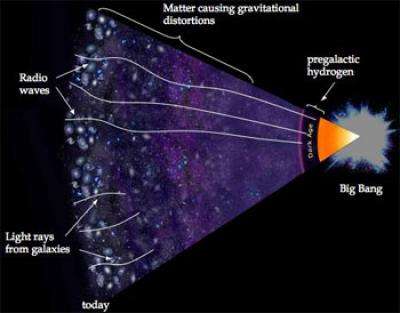
About 400,000 years after the Big Bang, the Universe had cooled off sufficiently that almost all its ordinary matter turned into a diffuse, near-uniform and neutral gas of hydrogen and helium. A few hundred million years later gravity had amplified the non-uniformities to the point where the first stars and galaxies could form. Their ultraviolet light then heated the diffuse gas back up again. During this reheating and for an extended period before it, the diffuse hydrogen was hotter or cooler than the radiation left over from the Big Bang. As a result it must have absorbed or emitted radio waves with a wavelength of 21 cm. The expansion of the Universe causes this radiation to be visible today at wavelengths of 2 to 20 metres, and a number of low-frequency radio telescopes are currently being built to search for it. One of the most advanced is the Low Frequency Array (LOFAR) in the Netherlands, a project in which the Max Planck Institute for Astrophysics is planning to take a significant role, together with a number of other German institutions.
The pregalactic hydrogen has structures of all sizes which are the precursors of galaxies, and there are up to 1000 of these structures at different distances along every line of sight. A radio telescope can separate these because structures at different distances give signals at different observed wavelengths. Metcalf and White show that gravitational distortion of these structures would allow a radio telescope to produce high-resolution images of the cosmic mass distribution which are more than ten times sharper than the best that can be made using galaxy distortions. An object similar in mass to our own Milky Way could be detected all the way back to the time when the Universe was only 5% its present age.
Such high-resolution imaging requires a extremely large telescope array, densely covering a region about 100 km across. This is 100 times the size planned for densely covered central part of LOFAR, and about 20 times bigger than densely covered core of the Square Kilometre Array (SKA) the biggest such facility currently under discussion. Such a giant telescope could map the entire gravitating mass distribution of the Universe, providing the ultimate comparison map for images produced by other telescopes which highlight only the tiny fraction of the mass which emits radiation they can detect.
We don't have to wait for the giant telescope to get unparalleled results from this technique, however. One of the most pressing issues in current physics is to gain a better understanding of the mysterious Dark Energy which currently drives the accelerated expansion of the Universe. Metcalf and White show that mass maps of a large fraction of the sky made with an instrument like SKA could measure the properties of Dark Energy more precisely than any previously suggested method, more than 10 times as accurately as mass maps of similar size based on gravitational distortions of the optical images of galaxies.
Citation: R. Benton Metcalf & S.D.M. White, High-resolution imaging of the cosmic mass distribution from gravitational lensing of pregalactic HI, preprint available at xxx.lanl.gov/abs/astro-ph/0611862/, 28. November 2006
Source: Max-Planck-Gesellschaft


