Taking nanolithography beyond semiconductors
December 14th, 2006 Taking nanolithography beyond semiconductors

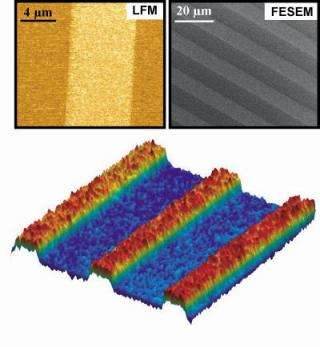
A new technique of chemical patterning developed at Penn State combines conventional lithography with molecular self-assembly for the creation of multifunctional surfaces. In this technique, a robust lithographic resist is patterned to protect chemical functionality in selected areas. In unprotected areas, the chemical functionality is selectively removed so that other chemical functionality can be placed in these regions. The process can be repeated to create multifunctional surfaces. (top left) A lateral-force microscopy (LFM) image contrasting COOH-terminated regions of high friction (light) with CH3-terminated regions (dark). (top right) Field-emission scanning-electron microscope (FESEM) image contrasting the COOH-terminated regions (dark) and CH3-terminated regions (light) (bottom) 3D rendered Field-emission scanning-electron microscope (FESEM) image of a surface patterned with two chemical functionalities. Credit: Penn State

A new process for chemical patterning combines molecular self-assembly with traditional lithography to create multifunctional surfaces in precise patterns at the molecular level. The process allows scientists to create surfaces with varied chemical functionalities and promises to extend lithography to applications beyond traditional semiconductors.

The new technique, which could have a number of practical chemical and biochemical applications, will be described in the 22 December 2006 issue of the journal Advanced Materials by a team led by Paul S. Weiss, distinguished professor of chemistry and physics at Penn State and Mark Horn, associate professor of engineering science and mechanics at Penn State.
Taking nanolithography beyond semiconductors

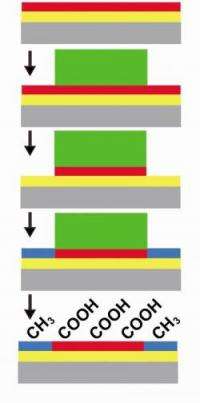
A new technique of chemical patterning developed at Penn State combines conventional lithography with molecular self-assembly for the creation of multifunctional surfaces. In this technique, a robust lithographic resist is patterned to protect chemical functionality in selected areas. In unprotected areas, the chemical functionality is selectively removed so that other chemical functionality can be placed in these regions. The process can be repeated to create multifunctional surfaces. A schematic of the photolithography-assisted chemical patterning technique, using organic-acid molecules (COOH, red) as the first component of the self-assembled monolayer (SAM) and methyl-group-terminated molecules (CH3, blue) as the second component. After the first SAM is placed, a robust lithographic resist is patterned on top of it. A section of the first component of the SAM is then removed only in the unprotected regions, and the second component of the SAM is deposited in the resulting open areas of the surface. The lithographic resist prevents movement of molecules between the SAM components. Credit: Penn State

The technique uses self-assembled monolayers (SAM) -- chemical films that are one molecule thick -- to build a layer on a surface, followed by the addition of a photolithographic resist that protects the covered parts of the film during subsequent processing. The resist acts as a shield during processing, allowing the cleaning and then self-assembly of different chemical functions on the unprotected parts of the surface.

"Other chemical patterning processes on surfaces suffer from cross-reactions and dissolution at their boundaries," says Weiss. "In our process, the resist provides a barrier and prevents interactions between the molecules already on the surface and the chemistry being done elsewhere. The resist is placed on top of the pattern by standard photolithographic techniques. After the resist is placed, molecules are removed from the exposed areas of the surface. Subsequent placement of a different SAM on the exposed surface creates a pattern of different films, with different functionalities.

Because the resist protects everything it covers, the layer under it does not have to be a single functionality. As a result, a series of pattern/protect/remove/repattern cycles can be applied, allowing complex patterns of functional monolayers on the surface of the substrate. "It allows us to work stepwise across a surface, building complex patterns," says Weiss. "We have demonstrated patterns at the micrometer scale and have the potential to go down to nanometer-scale patterns." While the two processes used by the team -- molecular self-assembly and photolithography -- are individually well-developed, the team's innovation is the successful combination of the techniques to build well-defined surfaces.

Chemical functionalities are distributed across the surface in high-quality layers as a result of the self-assembly process and in high-resolution patterns due to the use of the specialized resists. Different chemical functionalities can be used to detect or to separate a variety of species from a mixture. "The product of the process can be used to create a multiplexed, patterned, capture surface," says Weiss. "We could expose the entire surface to one mixture and capture different parts of the mixture in each region."

Source: Penn State


print this article email this article download pdf blog this article bookmark this article     Digg this Stumble it share on Facebook share on Reddit add to delicious save to Yahoo! bookmarks
3.9/5 after 22 votes


December 14th, 2006 all stories
Nanotechnology / Nanomaterials

Comments: 0
Rank: 3.9/5 after 22 votes

  • Stumble this up

  • Digg this

  • Share it:
  • share on Facebook
  • share on MySpace
  • share on Slashdot
  • rss-newsfeed
  • share on Google
  • share on Reddit
  • add to delicious
  • save to Yahoo! bookmarks
  • share on Windows Live
  • Add to Mixx!
Rating: 3.9/5 after 22 votes

  • Related Stories

  • Mars data published in Science this week
    created Jul 02, 2009 | popularity not rated yet | comments 0
  • 'Chemical Nose' to Sniff Out Cancer Earlier, Improve Treatment Options
    created Jun 23, 2009 | popularity not rated yet | comments 0
  • Nonstick and laser-safe gold aids laser trapping of biomolecules
    created Jun 17, 2009 | popularity not rated yet | comments 0
  • New study reveals structure of the HIV protein shell
    created Jun 12, 2009 | popularity not rated yet | comments 0
  • New hull coatings for Navy ships cut fuel use, protect environment (w/Video)
    created Jun 04, 2009 | popularity not rated yet | comments 0

Tags


  • Physicists Demonstrate Quantum Memory with Matter Qubits
    Physicists Demonstrate Quantum Memory with Matter Qubits
    Physics / General Physics
    created Jul 03, 2009 | popularity 4.4 / 5 (17) | comments 1
  • 'Holey' Nanosheets for Wastewater Dye Removal
    Nanotechnology / Nanomaterials
    created Jul 01, 2009 | popularity 5 / 5 (5) | comments 1
  • Jellyfish Robot Swims Like its Biological Counterpart
    Jellyfish Robot Swims Like its Biological Counterpart
    Electronics / Robotics
    created Jun 26, 2009 | popularity 4.4 / 5 (8) | comments 1
  • Could Maxwell's Demon Exist in Nanoscale Systems?
    Could Maxwell's Demon Exist in Nanoscale Systems?
    Physics / General Physics
    created Jun 24, 2009 | popularity 4.4 / 5 (18) | comments 29
  • Living Safely with Robots, Beyond Asimov's Laws
    Living Safely with Robots, Beyond Asimov's Laws
    Electronics / Robotics
    created Jun 22, 2009 | popularity 4.6 / 5 (52) | comments 40
  • Other News

    A 'quantum of sol' -- how nanotechnology could hold the key to a solar-powered future

    A 'quantum of sol' -- how nanotechnology could hold the key to a solar-powered future

    Nanotechnology / Nanomaterials

    created Jun 30, 2009 | popularity 3.9 / 5 (15) | comments 17

    (PhysOrg.com) -- A new generation of 'nano-structured' millimetre-sized solar cells that could convert the sun's energy to electricity more than twice as efficiently as current technology, is the subject of ...


    Australian researchers are set to begin human trials of a tiny nano-cell that acts as a "Trojan horse" against cancer

    Hi-tech 'Trojan horse' can kill cancer cells: researchers

    Nanotechnology / Bio & Medicine

    created Jun 29, 2009 | popularity 4.7 / 5 (12) | comments 7

    Australian researchers are set to begin human trials of a tiny nano-cell that acts as a "Trojan horse" against cancer cells, a breakthrough they say may curb the need for debilitating chemotherapy.


    'Holey' Nanosheets for Wastewater Dye Removal

    Nanotechnology / Nanomaterials

    created Jul 01, 2009 | popularity 5 / 5 (5) | comments 1

    (PhysOrg.com) -- Researchers have discovered that extremely thin sheets of nickel oxide with hexagonally shaped holes can absorb hazardous dyes from wastewater nearly as well as the best traditional methods, but are recyclable. ...


    Harnessing Nanoparticles To Track Cancer Cell Changes

    Nanotechnology / Bio & Medicine

    created Jul 03, 2009 | popularity not rated yet | comments 1

    The more dots there are, the more accurate a picture you get when you connect them. Cancer researchers adopting that philosophy have developed a new imaging technology that could give scientists the ability to simultaneously ...


    Computer-Guided Nanoparticle Therapy Destroys Tumors

    Nanotechnology / Bio & Medicine

    created Jun 29, 2009 | popularity 4.9 / 5 (12) | comments 0

    Gold nanoshells are among the most promising new nanoscale therapeutics being developed to kill tumors, acting as antennas that turn light energy into heat that cooks cancer to death. Now, a multi-institutional research team ...