Stardust findings override some commonly held astronomy beliefs
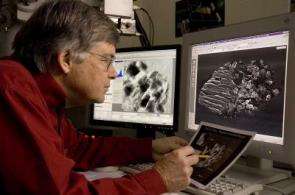
Contrary to a popular scientific notion, there was enough mixing in the early solar system to transport material from the sun's sizzling neighborhood and deposit it in icy deep-space comets. It might have been like a gentle eddy in a stream or more like an artillery blast, but evidence from the Stardust mission shows that material from the sun’s vicinity traveled to the edge of the solar system, beyond Pluto, as the planets were born.
"Many people imagined that comets formed in total isolation from the rest of the solar system. We have shown that's not true," said Donald Brownlee, the University of Washington astronomer who is principal investigator, or lead scientist, for Stardust.
"As the solar system formed 4.6 billion years ago, material moved from the innermost part to the outermost part. I think of it as the solar system partially turning itself inside out," said Brownlee, the lead author of 183 on the primary paper detailing the first research results from the Stardust mission, published in the Dec. 15 edition of the journal Science. Brownlee is a coauthor of the other six papers on Stardust results being published in Science, which also are the subject of a news conference and scientific presentations at the fall meeting of the American Geophysical Union in San Francisco.
The National Aeronautics and Space Administration's Stardust mission was launched in February 1999 and met comet Wild 2 (pronounced Vilt) beyond the orbit of Mars in January 2004. The comet formed more than 4.5 billion years ago and had remained preserved in the frozen reaches of the outer solar system until 1974 when a close encounter with Jupiter shifted the comet's orbit to a path between Mars and Jupiter. After a 2.88 billion-mile journey, Stardust returned to Earth last January with a payload of thousands of tiny particles from Wild 2.
Among the biggest surprises, Brownlee said, was finding material that formed in the hottest part of the solar system.
"If those materials had gotten any hotter they would have vaporized," he said. "The most extreme particle was the second one we worked on in my lab. These types of particles are among the oldest things in the solar system."
That particle was a calcium-aluminum inclusion, a rare material seen in some meteorites and the very type of matter that scientists used as an argument for flying Stardust to less than 150 miles from Wild 2. At that close range, the fast-moving particles could have seriously damaged the spacecraft, but Brownlee and others felt it was necessary to take that risk if they were to have a chance to determine an upper limit of material that formed near the sun that ended up at the farthest fringes of the solar system.
"Truthfully, we really didn't expect to find anything from the inner solar system. Instead, it showed up in the second particle we looked at," he said. The scientists also found magnesium olivine, a primary component of the green sand found on some Hawaiian beaches and, like a calcium-aluminum inclusion, one of the first things to form in the cooling solar nebula.
Brownlee estimates that as much as 10 percent of the material in comets came from the inner solar system. "That's a real surprise because the common expectation was that comets would be made of interstellar dust and ice."
But interstellar dust has a glassy characteristic, he said, while the particles that formed around stars and are found in comets are partially crystalline. It was suggested previously that interstellar dust had been mildly heated to transform its glassy substance into the crystalline comet contents.
"What we've seen, I believe, is totally incompatible with that interpretation," Brownlee said. "The particles we've seen have been heavily heated. Astronomical interpretations will be affected by that."
Wild 2's personality seems to be different from that of comet Tempel 1, which was closely examined in a mission called Deep Impact. In that case, a probe crashed into the comet surface and the properties of the resulting dust were analyzed using the infrared part of the spectrum. But Brownlee notes that while Tempel 1 was examined remotely from a distance, Stardust returned actual samples for scientists to study.
"The comets may be different from each other, or different observations could simply be a result of the different techniques used to examine them. It is a challenge for us to understand how they are different and why," he said.
Besides the UW, other major partners for the $212 million Stardust project are NASA's Jet Propulsion Laboratory, Lockheed Martin Space Systems, The Boeing Co., Germany's Max-Planck Institute for Extraterrestrial Physics, NASA Ames Research Center, the University of Chicago, The Open University in England and NASA's Johnson Space Center.
Brownlee has noted the irony that the tiny specks of comet dust are being examined by some of the largest investigative tools, such as the 2-mile-long Stanford Linear Accelerator. But with more than 150 scientists studying dust from Wild 2, Stardust also is driving the advance of new technology, including development of the world's highest-resolution microscope at the Lawrence Livermore National Laboratory.
"We're doing things no one ever imagined we could do, even at the time we launched the mission," Brownlee said. "We've taken a pinch of comet dust and are learning incredible things."
Source: University of Washington


