Scientists propose alternate model for plume on Enceladus
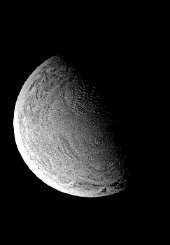
CHAMPAIGN, Ill. — What's causing all the commotion on Enceladus? Last year, when the Cassini spacecraft discovered an enormous plume erupting on Enceladus, one of Saturn's moons, scientists speculated that liquid water lay at shallow depths beneath the icy surface.
Now, as reported in the Dec. 15 issue of the journal Science, researchers have proposed an alternate model to account for this spectacular plume.
"With a diameter of only 300 miles, Enceladus is a tiny moon; it would fit easily between Los Angeles and San Francisco," said Susan Kieffer, a geology professor and planetary scientist at the University of Illinois at Urbana-Champaign, and lead author of the Science paper. "This tiny satellite should be cold and inactive, like our own moon. But it isn't."
The surface of Enceladus is composed of water ice with traces of carbon dioxide. Part of this surface does appear old and cratered like Earth's moon, Kieffer said. "The south polar region, however, is geologically active, with many surface features, indicating current activity."
Kieffer, who holds a Charles R. Walgreen Jr. Chair at the U. of I., has studied geysers and volcanoes on Earth; on Io, a satellite of Jupiter; and on Triton, a satellite of Neptune.
Instruments on the Cassini spacecraft revealed a gigantic plume of gas, water vapor and ice particles erupting from Enceladus' surface. Some of the ice escapes the moon's feeble grasp and replenishes a ring of ice particles around Saturn, called the "E ring."
Initial reports speculated that chambers of liquid water lay close to the moon's surface and erupted in a giant geyser. The water would be near freezing, so scientists dubbed the model "Cold Faithful," after the familiar, but hotter, Old Faithful geyser in Yellowstone National Park.
"A problem with this model," Kieffer said, "is that 10 percent of the plume consists of the gases carbon dioxide, nitrogen and methane. You might get a carbon dioxide-driven liquid geyser there, but you can't put this much nitrogen and methane into liquid water at the low pressures found inside Enceladus."
Nitrogen and methane are nearly insoluble in liquid water, but highly soluble in frozen water – in an ice phase called clathrate. When clathrate is exposed to a vacuum, the gas molecules burst out, ripping the ice lattice to shreds and carrying the fragments away.
Kieffer and colleagues have proposed an alternate model to explain the plume on Enceladus. The gases in the plume, they propose, are dissolved in a reservoir of clathrate under the water ice cap in the south polar region. The clathrate model allows an environment that would be 80 to 100 degrees Celsius colder than liquid water, with a "Frigid Faithful" plume emanating from clathrates, rather than from liquid water reservoirs.
"Exposed to near-vacuum conditions by fractures at the south pole, the clathrates decompose violently, spewing out nitrogen, methane and carbon dioxide gases, and ice particles; as well as leaving fracture walls coated with water ice," said Kieffer, who is also a professor in the university's Center for Advanced Study, one of the highest forms of campus recognition. "Some ice particles and ice coatings evaporate to produce the water vapor observed with the other gases," she said.
Active tectonic processes at the south pole cause continuous formation of cracks in the ice, through which many separate vents create a plume. The total discharge is comparable to that of Old Faithful, but the plume is enormously bigger because it is erupting at very low gravity into the near vacuum of space.
"We propose that cracks in Enceladus' ice cap may be opening and closing continuously, producing the spectacular plume we see reaching high above Enceladus' surface," Kieffer said. "Even if conditions are as cold as our model suggests, there is no problem launching ice particles into Saturn's E-ring."
Source: University of Illinois at Urbana-Champaign


