'Cosmic freezer' yields unique discovery
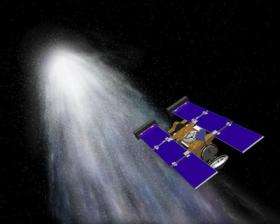
Stardust, the NASA spacecraft mission, was given that name in hopes that the seven-year journey to capture comet samples would bring back to Earth, well, stardust.
In an article coming out in the Dec. 15, 2006, issue of the journal Science, researchers at Washington University in St. Louis are the first to report that a sample they received from the mission actually does contain stardust — particles that are older than the sun.
"When the comet samples became available to analyze, one of the key scientific questions was to see whether this material also contained ‘real stardust’ particles," said Frank J. Stadermann, Ph.D., senior research scientist in physics in Arts & Sciences at Washington University and a co-author of the article.
"As it turned out, the one and only stardust particle in all of the analyzed comet samples was found right here in the St. Louis lab."
The findings appear in the Science article titled "Isotopic Compositions of Cometary Matter Returned by Stardust." Stadermann, who is a sample adviser for the Stardust mission, is also a co-author on six other reports about the mission’s initial findings that are in this special edition of Science.
Launched Feb. 7, 1999, the Stardust spacecraft sped through the tail of comet Wild 2 at 15,000 miles per hour on Jan. 2, 2004. For 15 minutes, the spacecraft extended the honeycomb-like collector, capturing cometary dust grains in 132 ice-cube-sized cells made of aerogel, a silicon-based solid that is 99.8 percent air and resembles frozen pale-blue smoke.
After the sample return capsule’s safe landing on the Utah salt flats on Jan. 15, 2006, particles — each much smaller than a grain of sand — from several of the collector's cells were extracted, sliced up and disbursed to 50 labs around the world for analysis. Of those 50 labs, which are called "preliminary examination groups," two are at Washington University.
In late February, Stadermann received his team's first cometary material — three slices of one particle. Not wasting any time, Stadermann and his Washington University team — Ernst K. Zinner, Ph.D., research professor of physics and of earth and planetary sciences; Christine Floss, Ph.D., research associate professor of physics; and Kuljeet Kaur Marhas, Ph.D., postdoctoral research associate in physics — got right to work on it, and then eventually 10 other Stardust samples.
Kevin D. McKeegan, Ph.D., professor of geochemistry at UCLA, is first author on the Science paper. McKeegan received his doctorate in physics from WUSTL in 1987, with Zinner serving as his advisor.
Using Washington University’s state-of-the-art ion probe — the NanoSIMS (SIMS is short for Secondary Ion Mass Spectrometer) — the team analyzed the particles’ elemental and isotopic composition.
The NanoSIMS, which Stadermann and Zinner helped design and test, can resolve objects as small as 50 nanometers — or one thousand times smaller than the diameter of a human hair.
The first NanoSIMS instrument in the world was purchased by WUSTL in 2000 for $2 million, with partial support from the university’s McDonnell Center for the Space Sciences, NASA and the National Science Foundation.
‘One of the most important findings’ from mission
The measurements at Washington University yielded a unique result providing a key component for our understanding of the composition and origin of comets, said Stadermann.
"When we made the discovery of the stardust grain in the comet sample we were very excited, and we immediately knew that this little particle, although it is only 1/100,000 of an inch in diameter, would be one of the most important findings of the comet dust analysis," said Stadermann.
"This discovery proves that comets comprise dust grains from outside the solar system in addition to the many other components that were formed inside the solar system," he continued.
"The fact that these very different ingredients survived side-by-side in the comet shows how well the material was preserved in this ‘cosmic freezer’ for the last 4.5 billion years.
"NASA picked the name ‘Stardust’ for this mission many years ago," Stadermann noted. "Only because of our measurement here at Washington University we now know that the comet really does contain true stardust."
Scientists hope the Stardust findings will provide answers to fundamental questions about comets, the origin of the solar system and possibly even the origin of life itself.
This discovery complements ongoing research in Washington University’s Laboratory for Space Sciences, which is part of the departments of Physics and of Earth and Planetary Sciences and the McDonnell Center for the Space Sciences, all in Arts & Sciences.
"We certainly have a lot of expertise in analyzing small grains," said Zinner about the Laboratory for Space Sciences research group. "We have worked on interplanetary dust particles since the late seventies and have been involved in the discovery of many types of presolar grains — ‘stardust’ in the literal sense — since 1987."
In 1987, Zinner and colleagues at Washington University and a group of scientists at the University of Chicago found the first stardust in a meteorite. Those presolar grains were specks of diamond and silicon carbide.
Since then, members of WUSTL's space sciences lab have played leading roles in analyzing these grains in the laboratory and interpreting the results.
"With the NanoSIMS, we have an instrument that is ideally suited to the analysis of such grains," Zinner added.
"The finding of stardust in meteorites and now comets gives us information about the early solar system," Zinner continued. "The parent bodies of primitive meteorites (asteroids) formed in different places, closer to the sun, than comets, which formed farther away. The preservation of stardust in both types of solar system bodies tells us something about their formation history. However, at present we have evidence for only one stardust grain in cometary material, making it a little early to make far-reaching conclusions."
"The preliminary examination of the comet samples is only the first step and it is clear that we will continue to study such samples for years to come," added Floss. "There are so many questions about the early solar system for which the answers are still hidden in these tiny dust particles."
Source: Washington University in St. Louis


