Researchers discover internal compass of immune cell
December 14, 2006 Researchers discover internal compass of immune cell

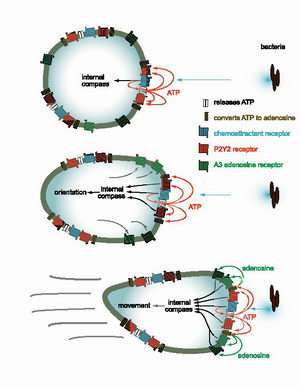
Process by which neutrophils detect and migrate towards chemoattractants. Credit: UCSD Medical Center

Researchers at the University of California, San Diego (UCSD) School of Medicine have discovered how neutrophils – specialized white blood cells that play key roles in inflammation and in the body's immune defense against bacteria – navigate to sites of infection and inflammation. These findings could potentially lead to new treatments for serious infections and inflammatory diseases in patients.

The research, reported in the December 15, 2006 issue of the journal Science, describes the elements of the "internal compass" that neutrophils use to detect and migrate towards chemoattractants, markers of infection and inflammation that are released from bacteria and inflamed tissues.

"These findings solve the long-standing puzzle of how neutrophils find their way and move toward sites of injury or infection in the body," said senior author Wolfgang Junger, Ph.D., adjunct professor of surgery at UCSD Medical Center.

His team set out to identify the key mechanisms of signal amplification that must occur in order for neutrophils to detect the low-level activating signals (chemoattractants) sent out by bacteria at injury sites. They found that neutrophils possess a built-in amplification system that is an integral part of the internal compass the cells use to locate the source of chemoattractants. At the core of the amplification system is the chemical adenosine triphosphate (ATP).

The chain of events necessary to direct the neutrophils toward its goal begins when ATP is released from the region of the cell surface closest to the source of chemoattractants. Next, ATP binds to a nucleotide receptor called P2Y2 on the cell surface, a step critical to position the cells in the direction of the source of chemoattractants.

Once this internal compass has been activated, ATP is converted by the cells to adenosine, which in turn activates A3 adenosine receptors concentrated at the front of cells, providing the signal to move toward the source of chemoattractants.

Lead authors Yu Chen, M.D., UCSD postgraduate researcher in surgery and Ross Corriden, UCSD graduate student in biomedical sciences, found that when ATP receptors were blocked, the cells became disoriented, while blocking A3 adenosine receptors slowed down the cell movement toward chemoattractants. The researchers also found that drugs which interfere with the amplification system impair cell migration to inflamed tissues.

"These findings are very important because they suggest that novel classes of anti-inflammatory drugs could be developed to prevent rheumatoid arthritis, inflammatory bowel diseases, asthma, and many other chronic inflammatory diseases," said Junger.

Conversely, drugs that boost these amplification systems and the internal compass could be used to coax neutrophils to migrate to infected wounds to improve wound healing.

Source: University of California - San Diego


print this article email this article download pdf blog this article bookmark this article     Stumble it Digg this share on Facebook retweet share on Reddit add to delicious
Rate this story - 4 /5 (1 vote)


December 14, 2006 all stories

Comments: 0

4 /5 (1 vote)
  • Stumble this up

  • Digg this

  • share this

  • hide
  • Related Stories

  • Drug shows promise for T315I-mutated chronic myeloid leukemia
    created Dec 07, 2009 | popularity not rated yet | comments 0
  • Good stress response enhances recovery from surgery, study shows
    created Dec 01, 2009 | popularity not rated yet | comments 0
  • Scientists guide immune cells with light and microparticles (w/ Video)
    created Nov 16, 2009 | popularity not rated yet | comments 0
  • Researchers have immune cells running in circles
    created Nov 02, 2009 | popularity not rated yet | comments 0
  • Researcher identifies new target to prevent fatal flu lung complication
    created Sep 29, 2009 | popularity not rated yet | comments 0


  • hide
  • Relevant PhysicsForums posts

  • Inflamed trapezius muscle
    created Dec 11, 2009
  • Nociceptors
    created Dec 05, 2009
  • Nanomaterials destroy cancer!
    created Nov 30, 2009
  • Nuclear Medicine
    created Nov 30, 2009
  • More from Physics Forums - Medical Sciences

Other News

Who gets expensive cancer drugs? A tale of 2 nations

Medicine & Health / Other

created 1hour ago | popularity not rated yet | comments 0

The well-worn notion that patients in the United States have unfettered access to the most expensive cancer drugs while the United Kingdom's nationalized health care system regularly denies access to some high-cost treatments ...


Master gene Math1 controls framework for perceiving external and internal body parts

Medicine & Health / Genetics

created 6 hours ago | popularity 5 / 5 (1) | comments 1

Waking and walking to the bathroom in the pitch black of night requires brain activity that is both conscious and unconscious and requires a single master gene known as Math1 or Atoh1, said Baylor College of Medicine researchers ...


Scientists uncover protective mechanism against liver cancer

Medicine & Health / Cancer

created 6 hours ago | popularity not rated yet | comments 0

A team of scientists from the UC San Diego School of Medicine and Osaka University in Japan have identified a protein switch that helps prevent liver damage, including inflammation, fibrosis and cancer. The findings suggest ...


Scientists suggest certain genes boost chances for distributing variety of traits, drive evolution

Medicine & Health / Genetics

created 8 hours ago | popularity not rated yet | comments 0

Genes that don't themselves directly affect the inherited characteristics of an organism but leave them increasingly open to variation may be a significant driving force of evolution, say two Johns Hopkins scientists.


Plastics component affects intestine: study

Medicine & Health / Health

created 3 hours ago | popularity 5 / 5 (3) | comments 0

The chemical Bisphenol A used in plastic containers and drinks cans has been shown for the first time to affect the functioning of the intestines, according to a French study published Monday.