Discovery sheds new light on cause of earthquakes
December 14, 2006
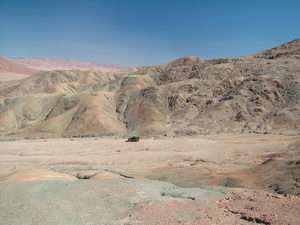
A large fault zone in the Atacama Desert in northern Chile. Credit: University of Liverpool
Research at the University of Liverpool into a large fault zone in the Atacama Desert in northern Chile has produced new insight into how fluid pressure can cause earthquakes.
Scientists have found how fluids, such as water, become sealed within the earth’s fault planes for a long period of time. This fluid pressure makes it easier for the earth’s plates to move alongside each other, eventually resulting in an earthquake.
Dr Dan Faulkner explains: “The difficulty with predicting earthquakes is that we know so little about how fault planes work. Over the years we have found that even small stresses acting on the earth’s plates can cause large earthquakes. For example the Loma Prieta earthquake in 1989 caused massive devastation, yet there was very little stress acting on the plate boundary to cause the quake in the first place.
“In theory, high stresses are needed to cause slip along a fault plane, but if something like pressurised water or gas gets inside the fault then it should act as a kind of cushion, making movement between plates easier and an earthquake more likely. Until now a problem with this theory was that as fluid pressures increased the rocks would crack and the fluids could escape through the cracks, reducing the ‘cushion’ effect. Our recent study, however, found that much smaller cracks surrounding the fault plane change the stresses acting on the rock, reducing the likelihood of significant cracks forming and allowing the fluid to escape.”
The team measured the density of ‘microcracks’ in the rock near the Chile fault line and applied varying amounts of stress to the rock to see how it responded. They found the ‘microcracks’ changed the elasticity of the rock, which meant stresses that might normally occur at almost right angles to the fault line rotated to a 45 degree angle instead.
Under normal stresses fluid would build up to such as extent that the rock would break and the fluid would escape, reducing the risk of an earthquake. When stress, however, occurs at a 45 degree angle the rock is less likely to break and the low fluid pressures inside can cause earthquakes.
Dr Faulkner added: “We now need to conduct further study into where these fluids and gases are coming from. Scientists are currently drilling of the San Andreas Fault in California, to help us understand more fully the mechanics of fault zones and how earthquakes occur.”
The San Andreas Fault Observatory at Depth (SAFOD) is a deep borehole observatory that will measure the physical conditions under which plate boundary earthquakes occur. Dr Faulkner is one of only two UK scientists who currently have access to rock drilled from the San Andreas Fault, which will be analysed in order to understand fault behaviour.
Dr Faulkner’s research is published in Nature Magazine.
Notes:
What is an earthquake?
• The Earth's lithosphere is made up of plates which are in constant motion. Plate boundaries slide past each other, creating frictional stress. When the frictional stress exceeds a certain point a failure occurs along plate boundaries, known as the fault plane. When the failure results in a displacement of the Earth's crust, seismic waves are radiated causing an earthquake.
Largest earthquakes on record:
• 1960 – Chile: 9.5 (magnitude)
• 1737 – Kamchatka: Russia: 9.3 (magnitude)
• 1964 – Alaska, US: 9.2 (magnitude)
• 2004 – Sumatra, Indonesia: 9.0-9.3 (magnitude)
• 1957 – Alaska, US: 9.1 (magnitude)
Source: University of Liverpool
-
Clam fields found at deep, low-temperature Mariana vents
12 hours ago |
4 / 5 (2) |
0
-
Project to pour water into volcano to make power
Jan 14, 2012 |
3.5 / 5 (18) |
27
-
Ohio quakes probably triggered by waste disposal well, say seismologists
Jan 09, 2012 |
5 / 5 (1) |
0
-
Earthquakes: Water as a lubricant
Nov 30, 2011 |
4.8 / 5 (4) |
1
-
Gold in them hills
Oct 28, 2011 |
1 / 5 (1) |
4
-
Engineers build first sub-10-nm carbon nanotube transistor
Feb 01, 2012 |
4.9 / 5 (31) |
30
-
Something old, something new: Evolution and the structural divergence of duplicate genes
Jan 31, 2012 |
4.6 / 5 (7) |
1
-
The hidden nanoworld of ice crystals: Revealing the dynamic behavior of quasi-liquid layers
Jan 30, 2012 |
5 / 5 (3) |
1
-
Stock market network reveals investor clustering
Jan 27, 2012 |
3.9 / 5 (23) |
8
-
Of microchemistry and molecules: Electronic microfluidic device synthesizes biocompatible probes
Jan 26, 2012 |
5 / 5 (1) |
0
-
Do some geologists actually act a lot like Randy Marsh?
21 hours ago
-
Discrepancy between oxygen and carbon-dioxide levels
Feb 09, 2012
-
where gems are found in the world
Feb 09, 2012
-
Wind Waves in Reservoir ~ Wind run-up and Wind set-up
Feb 08, 2012
-
Balance of oxygen in the atmosphere
Feb 01, 2012
-
The case for a methanol-based economy
Jan 30, 2012
- More from Physics Forums - Earth
More news stories
Latin America mining boom clashes with conservation
Latin America is experiencing a mining boom as prices rise fuelled by a hike in global demand, but the region is also being hit by a wave of violent protests, strikes and rallies by environmentalists.
5 minutes ago |
not rated yet |
0
Europe stakes billion-dollar bet on new rocket
A pencil-slim rocket is scheduled to lift into space from South America on Monday, carrying a billion-dollar bet that Europe can grab a juicy slice of the market to place satellites in low orbit.
Space & Earth / Space Exploration
19 hours ago |
3.5 / 5 (2) |
0
Political leaders play key role in how worried Americans are by climate change: study
More than extreme weather events and the work of scientists, it is national political leaders who influence how much Americans worry about the threat of climate change, new research finds.
Feb 06, 2012 |
5 / 5 (6) |
72
NASA budget will axe Mars deal with Europe: scientists
US President Barack Obama's budget proposal to be submitted next week for 2013 will cut NASA's budget by 20 percent and eliminate a major partnership with Europe on Mars exploration, scientists said Thursday.
Space & Earth / Space Exploration
Feb 10, 2012 |
5 / 5 (3) |
48
Humans may have helped the decline of African rainforests 3000 years ago
(PhysOrg.com) -- Large areas of rainforests in Central Africa mysteriously disappeared over three thousand years ago, to be replaced by savannas. The prevailing theory has been that the cause was a change ...
Love a click away in Indonesia's Twitter Republic
He was a geeky kid from Yogyakarta, she a glamorous city girl in Jakarta. In a country with one of the world's most vibrant social networking scenes they fell in love on Twitter.
Walney offshore wind farm is world's biggest (for now)
(PhysOrg.com) -- The Walney wind farm on the Irish Sea--characterized by high tides, waves and windy weather--officially opened this week. The farm is treated in the press as a very big deal as the Walney ...
GPS court ruling leaves US phone tracking unclear
A US Supreme Court decision requiring a warrant to place a GPS device on the car of a criminal suspect leaves unresolved the bigger issue of police tracking using mobile phones, legal experts say.
Europeans protest controversial Internet pact
Tens of thousands of people marched in protests in more than a dozen European cities Saturday against a controversial anti-online piracy pact that critics say could curtail Internet freedom.
Study finds that anti-diabetic medication can prevent the long-term effects of maternal obesity
In a study to be presented today at the Society for Maternal-Fetal Medicine's annual meeting, The Pregnancy Meeting, in Dallas, Texas, researchers will report findings that show that short therapy with the anti-diabetic medication ...
Netflix settlement trims 14 pct off 4Q earnings
(AP) -- Netflix pressed the rewind button on its fourth-quarter earnings after settling allegations that the video subscription service violated a consumer-privacy law.