Physicist: Stars can be strange
According to the "Strange Matter Hypothesis," which gained popularity in the paranormal 1980's, nuclear matter, too, can be strange. The hypothesis suggests that small conglomerations of quarks, the infinitesimally tiny particles that attract by a strong nuclear force to form neutrons and protons in atoms, are the true ground state of matter. The theory has captivated particle physicists worldwide, including one of Washington University's own.
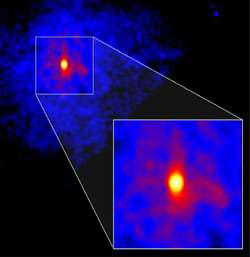
Mark Alford, Ph.D., Washington University in St. Louis assistant professor of physics in Arts & Sciences, and collaborators from MIT and the Lawrence Berkeley National Laboratory and Los Alamos National Laboratory, have used mathematical modeling to discover some properties of theoretical "strange stars," composed entirely of quark matter. Alford and his colleagues have found that under the right conditions the surface of a strange star could fragment into blobs of quark material called "strangelets," forming a rigid halo that contradicts traditional strange star models. This means that collapsed stars' nuclear leftovers, like the famously resplendent Crab Nebula, could be stranger than physicists think.
Alford and his colleagues recently published their findings in Physical Review D 73, 114016 (2006). The standard account of the dramatic death of a heavy star is that, after exploding in a supernova that rivals a whole galaxy in brightness, what is left is a "neutron star," a profoundly dense remnant, made mostly of neutrons, with a mass one and a half times that of our sun, crammed into an area with the radius of Saint Louis.
A strange star is an alternate ending of this story. If the Strange Matter Hypothesis is correct, then what is left behind is not a neutron star but an even denser strange star, made of quark matter rather than neutrons. And until recently, physicists thought that the two presented very different faces to the world.
A neutron star has a complicated multilayered surface. According to a description by M. Coleman Miller, Ph.D., of the University of Maryland, the deeper portions of the crust have voids that can be likened to Swiss cheese, overlaid by regions with sheets like lasagna, rods like spaghetti, and finally blobs like sprinklings of meatballs on the outside.
A strange star, on the other hand, was generally assumed to have a much simpler surface, consisting of a sharp interface between strange matter and the vacuum of surrounding space.
"A sharp interface between quark matter and the vacuum would have very different properties from the surface of a neutron star," noted Alford. But couldn't strange stars also have complicated surfaces? And if they did, could we even tell neutron stars and strange stars apart?
Kaleidoscopic aura of matter
Earlier this year, Alford's colleagues concocted a radical proposal. If blobs of quark matter (strangelets) have the right properties, maybe the strange star crust is something more like a kaleidoscopic aura of matter than a melon rind. "The idea was that the surface of a quark star might be as complicated as that of a neutron star, with a sort of crystalline halo or crust of strangelets," Alford explained. "If strangelets exist in reality, they will have a preferred size. If small strangelets are preferable, then big ones will split up into smaller ones. Conversely, if big strangelets are more stable, then small ones could fuse with other small ones--if they happened to bump in to each other--to make big ones."
If strangelets prefer to be big, then the strange star's surface will be the conventional simple sharp interface, with particles fused into the main body of the star. But if strangelets prefer to be small, then the surface will evaporate small strangelets to form a crystalline aura of strangelets floating in a sea of electrons.
His colleagues found that if surface tension along the interface and electrical forces within the charge distribution were neglected, then strangelets prefer to be small, and the strange star's surface indeed fragments into strangelets.
To follow, Alford joined the researchers in a more definitive investigation, addressing key parameters like surface tension and electrical forces that were neglected in the original study. Their results show that as long as the surface tension is below a low critical value, the large strangelets are indeed unstable to fragmentation and strange stars naturally come with complex strangelet crusts, analogous to those of neutron stars.
Their results will fuel the ongoing debate among astrophysicists about the nature and existence of strange stars. "A strange star believer would say: See, they showed that if the quark matter surface tension was low, then a strange star would have this strangelet crust, so perhaps some of the objects we think are neutron stars could actually be strange stars," Alford explained. "A strange star skeptic would say: Oh well, but the surface tension would have to be absurdly low for that to happen. These results basically show that for any reasonable value of the surface tension there is no crust, and strange stars are completely different."
Both conclusions are valid.
The strange star theory has its staunch defenders, but most physicists think it's merely an interesting, though improbable idea. But Alford and his colleagues are keeping its possibility afloat.
"There is still enough doubt about our understanding of these things," he said, "to leave room for speculation that there may be strange stars out there."
Source: Washington University in St. Louis


