In Granular System, Tiniest Grains Absorb Shocks 'Like a Sponge'
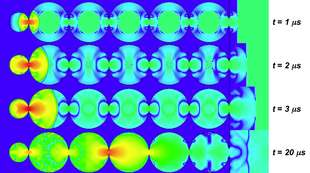
A University at Buffalo theoretical physicist who published research in 2001 demonstrating that it someday may be possible to build bridges, buildings and other structures that are nearly blast-proof, now has published results based on computer simulations showing how a shock-absorption system might be constructed to accomplish that goal.
Published in October in Physical Review Letters, the research is relevant not only to questions of shock-absorption in these structures, but also to life-saving improvements in tanks and aircraft carriers, as well as bullet-proof vests and other protective clothing for soldiers, law enforcement officers and even outdoor enthusiasts.
The simulations are of critical importance because they allow researchers and manufacturers to see how a potential system might work without having to painstakingly construct the systems and spend $40,000 to conduct a single blast in a test facility.
In earlier UB research by the same scientists, granular systems composed of individual spheres of gradually reduced size -- a "tapered" chain in a casing -- proved to be capable of efficiently absorbing well over 80 percent of input energy.
The main findings of the current research are that it is possible to retain the scalability of the system, reduce its size by a factor of five and make it far more capable of absorbing shock.
The key to achieving the results, according to Surajit Sen, Ph.D., UB professor of physics and co-author of both the current work and the 2001 publication, was the use of interstitial grains of the right sizes to control energy propagation through the chain.
"It turns out that the shock pulse is more easily managed when tiny interstitial grains are placed between the many progressively shrinking spheres or grains that make up the tapered chain," he said.
In the most recent paper, the UB physicists reported that this "decorated, tapered chain" system is capable of absorbing more than 50 percent of the shock that could not be absorbed by previous systems they had simulated.
These greater shock absorption capabilities were attributed to the use of tiny, interstitial grains or
particles of only about a millimeter that were placed in between each sphere, the "decorated" part of the chain; it turned out that the smaller these grains were, the more shock absorption they could achieve.
"These tiny grains were able to accomplish a huge trick," said Sen, co-author of the paper with Robert Doney, doctoral candidate in the Department of Physics in the UB College of Arts and Sciences. "They trap energy as it flows from the larger to the smaller grain, slowing it down. As it slows down, the smaller grain then essentially rattles back and forth between its two bigger neighbors, dissipating much of the energy as heat and sound."
Because the granular shock-absorbing system is strongly nonlinear, he said, the system allows directed energy transfer and the smaller grains undergo rapid rattling, which helps to efficiently distribute and dissipate the energy.
The simulations are significant because they have modeled shock pulses traveling at speeds approaching those encountered in combat situations, Sen said.
"These were simulations of pretty large impact shock pulses, traveling at several hundred meters per second," he explained, "and when we have such large impacts, the grains themselves now behave like sponges, absorbing the energy."
The simulations showed that in some of the larger impacts, the system would remain effective, but that significant and irreversible deformation would occur.
Sen explained that the system is proving to be very scalable, so that it could be designed to handle almost any typical shock.
According to the UB scientists, their earlier predictions about the shock-absorbing capabilities of these "tapered chain shock absorbers" were experimentally confirmed in publications in Granular Matter (2004) by independent researchers at the Colorado School of Mines in collaboration with a group at the NASA Glenn Research Center, as well as in Physical Review E (2006) by researchers at the University of Santiago in Chile and the Superior Institute of Mechanics (SUPMECA) in Paris.
Source: University at Buffalo


