Treatments for urinary infections leave bacteria bald, happy and vulnerable
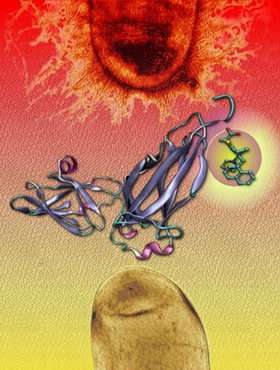
A different approach to treating urinary tract infections (UTIs) could defeat the bacteria that cause the infections without directly killing them, a strategy that could help slow the growth of antibiotic-resistant infections.
Instead of trying to wipe out bacteria, researchers in the laboratory of Scott Hultgren, Ph.D., the Helen L. Stoever Professor of Molecular Microbiology at Washington University School of Medicine in St. Louis, have been working to create pharmaceuticals that essentially "defang" the bacteria by preventing them from assembling pili, microscopic hairs that both enable the invasion of host cells and allow the bacteria to mount a cooperative defense against the host's immune system.
"We're leaving the bacteria bald but healthy and happy," says Jerome S. Pinkner, lab manager for Hultgren. "Rather than trying to kill them, we're working to make them non-pathogenic, so that they will be unable to adhere to or invade the bladder tissues and are readily eliminated from the body."
Pinkner and his colleagues think the bacteria will find it harder to evolve resistance to a treatment that does not directly impact their survival. According to an April 2006 National Institute of Allergy and Infectious Diseases fact sheet, resistance to at least one antibiotic has been detected in more than 70 percent of the bacteria that cause hospital-acquired infections.
In a recent paper in the Proceedings of the National Academy of Sciences, the Hultgren group and its collaborators reported on the successful development of a second generation of anti-pilus treatments or pilicides. A third generation is already undergoing tests now, and researchers are hoping to begin tests of their most potent pilicides in animal models in about a year.
UTIs mainly occur in women and are one of the most common infections, causing around $1.6 billion in medical expenses every year in the United States. Scientists believe 90 percent of all UTIs, which have been linked to poor hygiene, sexual behavior, and migration of intestinal flora, are caused by the bacterium Escherichia coli (E. coli).
Half of all women will experience a UTI at some point in their lives, and additional recurrent UTIs will affect 20 to 40 percent of these patients. Scientists previously thought repeat infections were primarily attributable to new infections from the intestine, where E. coli normally resides. But Hultgren's lab produced evidence showing that E. coli can enter a dormant state in the bladder where it causes no symptoms and is invisible to the immune system. Months or years later, the same bacteria can reactivate and start a new infection.
Hultgren's lab characterized in great detail the process E. coli uses to assemble its pili, which are capped by an adhesive compound that lets them attach to and invade host cells.
"E. coli is a Gram-negative bacterium, so it has an inner and an outer membrane, and many of its most important tools for interacting with the outside world are assembled in the space between the membranes," Pinkner explains.
A molecule known as the chaperone protein takes the parts of the pili from the inner membrane to their assembly site on the outer membrane. Hultgren's group determined the crystal structure of this protein and analyzed it to learn which regions of the protein needed to be blocked off by a pharmaceutical to prevent the chaperone from doing its job.
To synthesize an appropriate drug, Hultgren has been collaborating with chemists including Fredrik Almqvist, Ph.D., associate professor of bioorganic chemistry at Umeå University in Sweden.
Scientists hope that the pilicide approach will significantly diminish the bacteria's ability to find ways of evading the new treatments.
"For bacteria to develop resistance to a new antibiotic, which by definition kills bacteria, all you need is for one bacterium among trillions to acquire a genetic mutation that allows it to survive," Pinkner explains. "We think that pilicides will greatly reduce the pressure to develop resistance and have already shown in the lab that they have no effect on E. coli's growth or metabolic state."
Pinkner notes that all Gram-negative bacteria, including Yersinia pesitis (plague), Salmonella, and Klebsiella pneumoniae (pneumonia and burn and urinary tract infections) make pili and may be susceptible to the same treatments. Keeping the target of the drug specifically aimed at a virulence factor not essential for growth reduces the chances for general resistance to spread, Pinkner asserts. He also notes that such drugs will have fewer effects on bacteria that benefit the host by contributing to healthy human physiology.
"For example, there are bacteria in the intestinal tract that aid in metabolism and the normal function of the intestine, which also helps prevent this niche from being occupied by pathogenic bacteria," he explains. "Given the rise in antibiotic resistance, it is critical to design antimicrobials for the future that target the bad bacteria but leave the good ones alone."
Citation: Pinkner JS, Remaut H, Buelens F, Miller E, Åberg V, Pemberton N, Hedenström M, Larsson A, Seed P, Waksman P, Hultgren SJ, Almqvist F. Rationally designed small compounds inhibit pilus biogenesis in uropathogenic bacteria. Proceedings of the National Academy of Sciences, 2006 Nov 21;103(47):17897-17902.
Source: Washington University in St. Louis


