How Do Multiple-Star Systems Form?
December 15th, 2006 How Do Multiple-Star Systems Form?

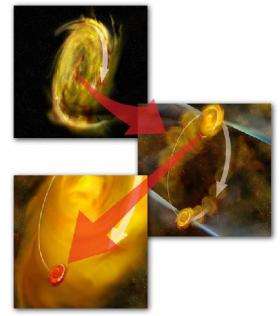
ARTIST'S CONCEPTION of proposed formation process for the multiple-star system L1551 IRS5, as revealed by observations with the Very Large Array (VLA) radio telescope. Top panel: large disk-like cloud of gas and dust rotates. Middle panel: two smaller disks of gas and dust fragment from the large disk and begin to condense into protostars, each having its own surrounding disk and shooting "jets" of material outward from the poles of its disk. Bottom panel: A third, smaller disk and protostar joins the sytem, either through the same fragmentation process or by being captured gravitationally by the larger protostars. CREDIT: Bill Saxton, NRAO/AUI/NSF

Astronomers have used the National Science Foundation's Very Large Array (VLA) radio telescope to image a young, multiple-star system with unprecedented detail, yielding important clues about how such systems are formed. Most Sun-sized or larger stars in the Universe are not single, like our Sun, but are members of multiple-star systems. Astronomers have been divided on how such systems can form, producing competing theoretical models for this process.

The new VLA study produced a "smoking gun" supporting one of the competing models, said Jeremy Lim, of the Institute of Astronomy & Astrophysics, Academia Sinica, in Taipei, Taiwan, whose study, done with Shigehisa Takakuwa of the National Astronomical Observatory of Japan, is published in the December 10 issue of the Astrophysical Journal.

Ironically, their discovery of a third, previously-unknown, young star in the system may support a second theoretical model. "There may be more than one way to make a multiple-star system," Lim explained.

The astronomers observed an object called L1551 IRS5, young, still-forming protostars enshrouded in a cloud of gas and dust, some 450 light-years from Earth in the direction of the constellation Taurus. Invisible to optical telescopes because of the gas and dust, this object was discovered in 1976 by astronomers using infrared telescopes. A VLA study in 1998 showed two young stars orbiting each other, each surrounded by a disk of dust that may, in time, congeal into a system of planets.

Lim and Takakuwa re-examined the system, using improved technical capabilities that greatly boosted the quality of their images. "In the earlier VLA study, only half of the VLA's 27 antennas had receivers that could collect the radio waves, at a frequency of 43 GigaHertz (GHz), coming from the dusty disks. When we re-observed this system, all the antennas could provide data for us. In addition, we improved the level of detail by using the Pie Town, NM, antenna of the Very Long Baseline Array, as part of an expanded system," Lim said. The implementation and improvement of the 43 GHz receiving system was a collaborative program among the German Max Planck Institute, the Mexican National Autonomous University, and the U.S. National Radio Astronomy Observatory.

Two popular theoretical models for the formation of multiple-star systems are, first, that the two protostars and their surrounding dusty disks fragment from a larger parent disk, and, second, that the protostars form independently and then one captures the other into a mutual orbit.

"Our new study shows that the disks of the two main protostars are aligned with each other, and also are aligned with the larger, surrounding disk. In addition, their orbital motion resembles the rotation of the larger disk. This is a 'smoking gun' supporting the fragmentation model," Lim said.

However, the new study also revealed a third young star with a dust disk. "The disk of this one is misaligned with those of the other two, so it may be the result of either fragmentation or capture," Takakuwa said.

The misalignment of the third disk could have come through gravitational interactions with the other two, larger, protostars, the scientists said. They plan further observations to try to resolve the question.

"We have a very firm indication that two of these protostars and their dust disks formed from the same, larger disk-like cloud, then broke out from it in a fragmentation process. That strongly supports one theoretical model for how multiple-star systems are formed. The misalignment of the third protostar and its disk leaves open the possibility that it could have formed elsewhere and been captured, and we'll continue to work on reconstructing the history of this fascinating system," Lim summarized.

The National Radio Astronomy Observatory is a facility of the National Science Foundation, operated under cooperative agreement by Associated Universities, Inc.

Source: NRAO


print this article email this article download pdf blog this article bookmark this article     Digg this Stumble it share on Facebook share on Reddit add to delicious save to Yahoo! bookmarks
4.3/5 after 20 votes


December 15th, 2006 all stories
Space & Earth / Astronomy

Comments: 0
Rank: 4.3/5 after 20 votes

  • Stumble this up

  • Digg this

  • Share it:
  • share on Facebook
  • share on MySpace
  • share on Slashdot
  • rss-newsfeed
  • share on Google
  • share on Reddit
  • add to delicious
  • save to Yahoo! bookmarks
  • share on Windows Live
  • Add to Mixx!
Rating: 4.3/5 after 20 votes

  • Related Stories

  • VLBA locates superenergetic bursts near giant black hole
    created Jul 02, 2009 | popularity not rated yet | comments 0
  • Astronomers discover pair of solar systems in the making
    created Jul 01, 2009 | popularity not rated yet | comments 0
  • NetApp claims victory in bidding for Data Domain
    created Jun 04, 2009 | popularity not rated yet | comments 0
  • Galaxy Evolution Explorer Mission Celebrates Sixth Anniversary
    created Apr 28, 2009 | popularity not rated yet | comments 0
  • Mysterious space blob discovered at cosmic dawn (w/Video)
    created Apr 22, 2009 | popularity not rated yet | comments 0

Tags


  • Transform a ball into a rock -- or make it invisible -- using transformation optics
    Transform a ball into a rock -- or make it invisible -- using transformation optics
    Physics / General Physics
    created 10 hours ago | popularity 3.7 / 5 (3) | comments 0
  • Could a quantum motor do work?
    Physics / General Physics
    created Jul 07, 2009 | popularity 4 / 5 (12) | comments 0
  • Physicists Demonstrate Quantum Memory with Matter Qubits
    Physicists Demonstrate Quantum Memory with Matter Qubits
    Physics / General Physics
    created Jul 03, 2009 | popularity 4.5 / 5 (20) | comments 1
  • 'Holey' Nanosheets for Wastewater Dye Removal
    Nanotechnology / Nanomaterials
    created Jul 01, 2009 | popularity 5 / 5 (5) | comments 1
  • Jellyfish Robot Swims Like its Biological Counterpart
    Jellyfish Robot Swims Like its Biological Counterpart
    Electronics / Robotics
    created Jun 26, 2009 | popularity 4.4 / 5 (9) | comments 1
  • Other News

    Living fossils hold record of 'supermassive' kick

    Living fossils hold record of 'supermassive' kick

    Space & Earth / Astronomy

    created 2 hours ago | popularity 4.5 / 5 (2) | comments 1

    The tight cluster of stars surrounding a supermassive black hole after it has been violently kicked out of a galaxy represents a new kind of astronomical object and a fossil record of the kick.


    Methane-eating microbes can use iron and manganese oxides to 'breathe'

    Methane-eating microbes can use iron and manganese oxides to 'breathe'

    Space & Earth / Earth Sciences

    created 6 hours ago | popularity 4.7 / 5 (3) | comments 0

    Iron and manganese compounds, in addition to sulfate, may play an important role in converting methane to carbon dioxide and eventually carbonates in the Earth's oceans, according to a team of researchers ...


    Tremors on southern San Andreas Fault may mean increased quake risk

    Tremors on southern San Andreas Fault may mean increased quake risk

    Space & Earth / Earth Sciences

    created 4 hours ago | popularity not rated yet | comments 0

    (PhysOrg.com) -- Increases in mysterious underground tremors observed in several active earthquake fault zones around the world could signal a build-up of stress at locked segments of the faults and presumably ...


    A Galaxy Collision in Action

    A Galaxy Collision in Action

    Space & Earth / Astronomy

    created 4 hours ago | popularity 4.8 / 5 (4) | comments 1

    This beautiful image gives a new look at Stephan's Quintet, a compact group of galaxies discovered about 130 years ago and located about 280 million light years from Earth. The curved, light blue ridge running ...


    NASA sails through countdown, weather outlook poor (AP)

    NASA sails through countdown, weather outlook poor

    Space & Earth / Space Exploration

    created 3 hours ago | popularity not rated yet | comments 0

    (AP) -- NASA is sailing through the countdown for Saturday's launch of space shuttle Endeavour, with weather the lone concern.