Reading Shakespeare has dramatic effect on human brain

December 18, 2006
Research at the University of Liverpool has found that Shakespearean language excites positive brain activity, adding further drama to the bard's plays and poetry.
Shakespeare uses a linguistic technique known as functional shift that involves, for example using a noun to serve as a verb. Researchers found that this technique allows the brain to understand what a word means before it understands the function of the word within a sentence. This process causes a sudden peak in brain activity and forces the brain to work backwards in order to fully understand what Shakespeare is trying to say.
Professor Philip Davis, from the University's School of English, said: "The brain reacts to reading a phrase such as he godded me' from the tragedy of Coriolanus, in a similar way to putting a jigsaw puzzle together. If it is easy to see which pieces slot together you become bored of the game, but if the pieces don't appear to fit, when we know they should, the brain becomes excited. By throwing odd words into seemingly normal sentences, Shakespeare surprises the brain and catches it off guard in a manner that produces a sudden burst of activity - a sense of drama created out of the simplest of things."
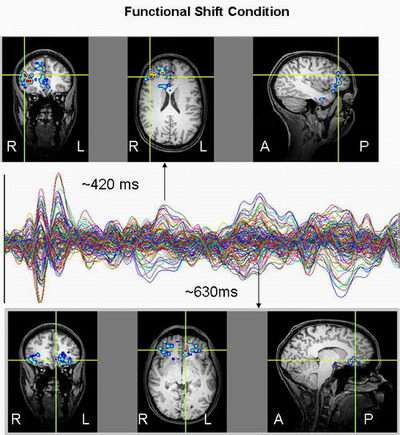
The effect of functional shift on the brain. Credit: University of Liverpool
Experts believe that this heightened brain activity may be one of the reasons why Shakespeare's plays have such a dramatic impact on their readers.
Professor Neil Roberts, from the University's Magnetic Resonance and Image Analysis Research Centre, (MARIARC), explains: "The effect on the brain is a bit like a magic trick; we know what the trick means but not how it happened. Instead of being confused by this in a negative sense, the brain is positively excited. The brain signature is relatively uneventful when we understand the meaning of a word but when the word changes the grammar of the whole sentence, brain readings suddenly peak. The brain is then forced to retrace its thinking process in order to understand what it is supposed to make of this unusual word."
Professor Roberts and Professor Davis together with Dr Guillaune Thierry, from the University of Wales, Bangor, monitored 20 participants using an electroencephalogram (EEG) as they read selected lines from Shakespeare's plays.
In this initial test electrodes were placed on the subject's scalp to measure brain responses.
Professor Roberts said: "EEG gives graph-like measurements and when the brain reads a sentence that does not make semantic sense it registers what we call a N400 effect a negative wave modulation. When the brain reads a grammatically incorrect sentence it registers a P600 effect an effect which continues to last after the word that triggered it was first read."
Researchers also found that when participants read the word producing the functional shift there was no N400 effect indicating that the meaning was accepted but a P600 effect was observed which indicates a positive re-evaluation of the word. The team is now using magnetoencephalography (MEG) and functional magnetic resonance imaging (FMI) to test which areas of the brain are most affected and the kind of impact it could have in maintaining healthy brain activity.
Professor Davis added: "This interdisciplinary work is good for brain science because it offers permanent scripts of the human mind working moment-to-moment. It is good for literature as it illustrates primary human thinking. Through the two disciplines, we may discover new insights into the very motions of the mind."
Source: University of Liverpool
-
Texas A&M center confronts antibiotic crisis with potential new bacterial treatment
Nov 03, 2011 |
4.8 / 5 (4) |
1
-
Hippocampus plays bigger memory role than previously thought
Nov 01, 2011 |
4.5 / 5 (2) |
0
-
The World-Changer: Steve Jobs knew what we wanted
Oct 06, 2011 |
not rated yet |
0
-
Young children show improved verbal IQ
Oct 04, 2011 |
5 / 5 (2) |
1
-
Study finds promising drug treatment for improving language, social function in people with autism
Sep 29, 2011 |
5 / 5 (1) |
0
-
Engineers build first sub-10-nm carbon nanotube transistor
Feb 01, 2012 |
5 / 5 (21) |
19
-
Something old, something new: Evolution and the structural divergence of duplicate genes
Jan 31, 2012 |
4.6 / 5 (7) |
1
-
The hidden nanoworld of ice crystals: Revealing the dynamic behavior of quasi-liquid layers
Jan 30, 2012 |
5 / 5 (2) |
1
-
Stock market network reveals investor clustering
Jan 27, 2012 |
4.1 / 5 (21) |
8
-
Of microchemistry and molecules: Electronic microfluidic device synthesizes biocompatible probes
Jan 26, 2012 |
not rated yet |
0
-
Nutrition label stuffs and diets
Feb 02, 2012
-
Lowe syndrom genetic test
Feb 02, 2012
-
Bill Doyle: Treating cancer with electric fields
Feb 01, 2012
-
Colonoscopy - which drugs are better?
Jan 31, 2012
-
Blunt Force Trauma
Jan 31, 2012
-
Cyberknife VSI, one touched recently, another about to be...
Jan 30, 2012
- More from Physics Forums - Medical Sciences
More news stories
Whole exome sequencing identifies cause of metabolic disease
Sequencing a patient's entire genome to discover the source of his or her disease is not routine yet. But geneticists are getting close.
5 hours ago |
5 / 5 (5) |
0
|
Hearing metaphors activates brain regions involved in sensory experience
When a friend tells you she had a rough day, do you feel sandpaper under your fingers? The brain may be replaying sensory experiences to help understand common metaphors, new research suggests.
Medicine & Health / Neuroscience
5 hours ago |
not rated yet |
1
|
Researchers weigh methods to more accurately measure genome sequencing
Lost in the euphoria of the 2003 announcement that the human genome had been sequenced was a fundamental question: how can we be sure that an individual's genome has been read correctly?
4 hours ago |
not rated yet |
0
New procedure repairs severed nerves in minutes, restoring limb use in days or weeks
American scientists believe a new procedure to repair severed nerves could result in patients recovering in days or weeks, rather than months or years. The team used a cellular mechanism similar to that used by many invertebrates ...
Medicine & Health / Neuroscience
16 hours ago |
5 / 5 (12) |
7
|
Why two new studies represent important breakthrough in Alzheimer's disease research
Two different research groups have independently made the same important discoveries on how Alzheimer's disease spreads in the brain. The groups' findings have the potential to give us a much more sophisticated understanding ...
Medicine & Health / Neuroscience
5 hours ago |
5 / 5 (2) |
0
Amazon fungi found that eat polyurethane, even without oxygen
(PhysOrg.com) -- Until now polyurethane has been considered non-biodegradable, but a group of students from Yale University in the US has found fungi that will not only eat and digest it, they will do so even in the absence ...
Scientists chart high-precision map of Milky Way's magnetic fields
(PhysOrg.com) -- Scientists at the Naval Research Laboratory (NRL) are part of an international team that has pooled their radio observations into a database, producing the highest precision map to date of ...
Renowned physicist invents microscope that can peer at living brain cells
(PhysOrg.com) -- Ever since scientists began studying the brain, theyve wanted to get a better look at what was going on. Researchers have poked and prodded and looked at dead cells under electron microscopes, ...
New kind of high-temperature photonic crystal could someday power everything from smartphones to spacecraft
A team of MIT researchers has developed a way of making a high-temperature version of a kind of materials called photonic crystals, using metals such as tungsten or tantalum. The new materials which ...
Discovery of extremely long-lived proteins may provide insight into cell aging
One of the big mysteries in biology is why cells age. Now scientists at the Salk Institute for Biological Studies report that they have discovered a weakness in a component of brain cells that may explain ...
Hackers intercept FBI, Scotland Yard call (Update)
(AP) -- Trading jokes and swapping leads, investigators from the FBI and Scotland Yard spent the conference call strategizing about how to bring down the hacking collective known as Anonymous, responsible ...
Mar 05, 2009
Rank: not rated yet