Too mellow for our predatory world
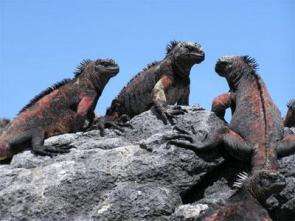
Marine iguanas on the Galapagos Islands live without predators - at least this was the case up until 150 years ago. Since then they have been confronted with cats and dogs on some islands of the Archipelago. For scientists, they are therefore a suitable model of study in order to discover if such generally tame animals are capable of adapting their behaviour and endocrine stress response to novel predation threats.
Scientists from the Max Planck Institute for Ornithology, the University of Ulm Tufts University and Princeton University were able to show that the stress response induced by corticosterone (CORT) is absent in predator-naïve animals but can be fully restored with experience. However, as the researchers found out, the flight distance of the reptiles does not sufficiently increase, which limits their ability to successfully escape from newly introduced predators.
Who of us has not dreamt of living on an island? Apparently, island life has certain advantages. This is also true for the marine iguanas. For millions of years they have lived without natural predators. In the course of evolution they have become excessively tame. Hundreds of reptiles doze, spread-eagled, on black lava rocks, soaking up the sun - behaviour that would be unthinkable in an environment with predators, where reptiles are persistently exposed to the threat of being devoured by others.
The absence of predators may lead to adaptations in the behaviour of insular animals. Over a longer evolutionary period, birds for example can lose their ability to fly. This would greatly reduce their ability to escape should new predators appear. In contrast to such "hard wired" traits, however, behavioural patterns should be significantly more flexible. In programmes introducing tame species into the wild, animals are trained to recognise and cope with predators. But in most cases it is very difficult to predict the flexibility in behaviour because little is known about the underlying physiological mechanisms that control behaviour such as flight.
The scientist around Thomas Rödl from the Max Planck Institute for Ornithology visited the Galápagos Islands for field studies from December 2003 until January 2004 and again in March 2005, using the research platform of the Max Planck Society. The islands in the Pacific Ocean continue to be a magnet for evolutionary biologists. Nowhere else is it possible to observe such a variety of different adaptation strategies in such a relatively small number of species. However, it is not only scientists who are drawn to the island; increasingly tourists have also discovered this unique archipelago. In 2005, approx. 126,000 people descended on the island, and the trend is rising. And this causes problems. Not only do tourists disturb the many animals living on the Galápagos Islands; they also introduce alien animal and plant species which are causing great damage to local flora and fauna.
Rödl and his colleagues Silke Berger as well as Michael Romero and Martin Wikelski wanted to find out to what extent marine iguanas from various populations and with different predator-experiences would differ in terms of stress response and behaviour. To this end the researchers conducted so-called "harassment experiments". At first, they recorded the original flight initiation distance of "naïve" animals. The researchers then experimentally chased the animals for 15 minutes, always approaching up to the point where the reptiles moved away and fled a short distance. At the end of the experiment, the scientists captured the animals and collected blood samples in order to determine CORT levels. When animals interpreted the situation as threatening, the concentration of corticosteroid hormones in the blood plasma increased within just a few minutes.
There were significant differences in the various island populations examined by the scientists: marine iguanas with no experience of predator-pressure tolerated a human approach up to one or two metres and failed to mount a stress response even during sustained chasing. Darwin had already described the remarkable tameness of these animals, also termed "low wariness", during his voyage on the Beagle in 1835. In marine iguanas living with an intermediate predation risk, it was only the act of being captured that led to increased concentrations of corticosterone, and the flight distance only increased in those animals that had already been once caught. In contrast, the reptiles living with acute predation pressure responded to the harassment experiment with an immediate increase in CORT levels.
"Our experiments have shown that the animals increase their flight initiation distance and are able to mount a corticosteroid stress response", explains Thomas Rödl. It seems that the function of the stress axis can be retained even through long evolutionary periods with no predation pressure and that it can quickly regain its activity once predation resumes. "But changes in flight distance are too slight and insufficient", says Rödl. "We were able to capture the same animals up to six times in four weeks." It is therefore not very surprising that the introduction of cats and dogs has dramatically reduced the population of marine iguanas on some islands - on San Cristobal the local population is virtually extinct. Wardens of the National Park keep finding animals with bite marks from dogs. Although these wounds are not fatal in themselves, they often lead to secondary infections which eventually kill the animals.
It appears that while marine iguanas are capable of learning to recognise predators they are unable to efficiently increase their flight initiation distance. This means that the ability to adapt to new predators is not limited by constraints in the physiological system but by narrow behaviour. "Long-lasting escape flights entail a loss of strength for the animals. In the absence of predators, selection may have privileged especially those animals that did not engage in such costly behaviour, providing them with an advantage in terms of fitness", speculates Rödl. The scientists’ findings are a first indication why tame animals have become extinct in many continents but also provide fresh arguments for conservation biologists.
For in the meantime, the government of Ecuador has opened the UNESCO world heritage site of the Galápagos Islands to the cruise ship market. With growing mass tourism, the situation is getting more difficult. The National Park Management is considering raising the entry fee from the currently charged $100 to $500 in order to reduce the number of visitors - possibly the only possibility to create sustainable tourism, thereby ensuring the necessary protection of the unique animal and plant world of the Galápagos.
Citation: Thomas Rödl, Silke Berger, L. Michael Romero and Martin Wikelski, Tameness and stress physiology in a predator-naive island species confronted with novel predation threat, Proceedings of the Royal Society B, FirstCite Early Online Publishing December 2006
Source: Max-Planck-Gesellschaft


