Run amok enzyme causes same problems in both humans and fruit flies
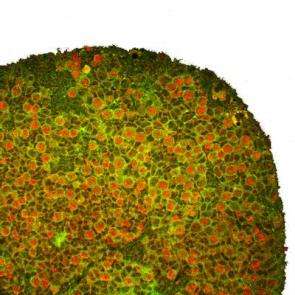
An enzyme found at elevated levels in several human cancers has been linked to abnormal tumor growth in fruit flies, a discovery that provides a new model for understanding the link between stem cell biology and cancer, according to researchers at the University of Oregon.
Using fluorescent staining and laser-scanning microscopy, the eight-member research team studied various mutations in a gene called aurora-A to observe how changes in protein expression affected the ability of Drosophila neuroblasts, a type of neural stem cell, to maintain their stem cell character without forming tumors.
Reporting in the Dec. 20 issue of the journal Genes & Development, Chris Doe and colleagues detail how an overproduction of renewed neuroblasts in the flies can be traced to misregulation by the aurora-A kinase. This enzyme under normal conditions appears to be critical as a traffic cop for various proteins during mitosis in neuroblasts, they concluded.
"In humans, there has been a lot of thought that maybe stem cell populations are at the heart of many cancers," said Ryan O. Andersen, a doctoral student in Doe's lab. "The numbers are off drastically. Instead of properly dividing, they are overproducing more stem cells rather than maintaining a steady population. This loss of regulation leads to tumors populated with these overproduced cells."
Andersen and Cheng-Yu Lee, a postdoctoral fellow, were lead authors on the paper. Doe, a Howard Hughes Medical Institute investigator, is a professor of biology in the UO Institute of Neuroscience and Institute of Molecular Biology.
In Drosophila, Doe's team found that a mutation in aurora-A, an evolutionary conserved gene in fruit flies and humans, results in two distinguishing problems: Proteins (Numb) involved in the differentiation into neurons and neuroblast self-renewal (aPKC) are not sorted to their proper sides of the cell, and the mitotic spindle that provides cortical polarity becomes misaligned. The subsequent splitting leads to new cells with improper proteins mixes, including an overproduction -- in this case 10 times more than normal -- of new neuroblasts that lead to tumors in the brain.
"We conclude that the aurora-A kinase is required to coordinate the position of proteins within the neuroblasts," Doe said. "When it is absent, too little neuron-promoting proteins are delivered into the young neurons and they never lose their stem-cell nature. This leads to a stem-cell tumor in the fly brain."
The team's findings appear to reverse traditional thinking that too much activation of aurora-A leads to tumors, including those in more than half of colorectal cancers. Instead, Doe and colleagues argue that aurora-A and numb are tumor suppressants under normal conditions, and that a loss of aurora-A is what prompts overproduction of new neuroblasts and, thus, tumor development.
Source: University of Oregon


