Fossil Discovery Turns Scientific Theory on Its Head
December 18th, 2006 Fossil Discovery Turns Scientific Theory on Its Head

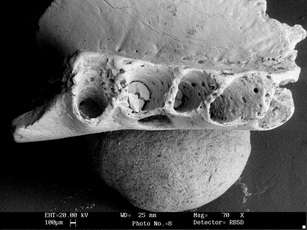
Part of the jawbone of the fossilised mouse-like creature believed to have lived at least 16 million years ago. Credit: University of Adelaide

An international team led by University of Adelaide palaeontologist Trevor Worthy has discovered a unique, primitive type of land mammal that lived at least 16 million years ago on New Zealand.

The discovery of tiny fossilised bones of a mouselike creature in the Central Otago region is the first hard evidence that New Zealand once had its own indigenous land mammals. The finding could prompt a major rewrite of prehistory textbooks, say scientists.

Mr Worthy, a University of Adelaide PhD student in the School of Earth & Environmental Sciences, and fellow team members from New Zealand and the University of NSW, discovered fossilised parts of a jaw and a leg from the mammal, unearthed in sediment from the St Bathans lake bed in the South Island. It represents an evolutionary stage that pre-dates the split between pouched marsupials and placental mammals.

The find adds a whole new insight into the evolution of mammals in New Zealand, putting paid to the theory that the country’s diverse prehistoric groundbird fauna evolved there because they had no competition from land mammals.

“Scientists have long held the view that New Zealand has this weird and wonderful avian biota that lived on the ground because there were no mammals to impede or compete with birds. It appears that this little mouselike animal was part of the fauna on the ancient Gondwana supercontinent and it got stuck on New Zealand when the latter separated more than 80 million years ago,” Mr Worthy says.

The discovery also challenges geological claims that New Zealand was entirely submerged beneath the sea from 25 to 30 million years ago and re-colonised by plant and animal species from nearby land masses like Australia once it re-emerged.

“While a lot of the land disappeared temporarily, there is evidence that some of it was emergent because there are floral pollen records that indicate there were living plants throughout the period. The Tuatara reptiles, also found in New Zealand, have no living relatives in the fossil record until 65 million years ago – and there is no evidence of them in Australia, so we can only assume they have been in New Zealand all the time.”

Mr Worthy and his team expect to unearth more mammal fossils from the St Bathans site, perhaps even other species that pre-date the split between pouched marsupials and placental mammals, surviving for millions of years in isolation in New Zealand.

“The deposition site was a big lake – 5600km2 – and the three mammal bones from the mouse were discovered in a 36m2 area, so it’s reasonable to believe we will find more. We have already found bats of three families at this site, of which two are new in the world. We have also unearthed 24 kinds of extinct birds from this sediment that were previously unknown.”

The findings were published in the Proceedings of the National Academy of Sciences journal this week.

The Australian Research Council recently awarded the team a $513,902 grant over three years to further explore the St Bathans site. Mr Worthy is organising the next field trip in early January.

Source: University of Adelaide


print this article email this article download pdf blog this article bookmark this article     Digg this Stumble it share on Facebook share on Reddit add to delicious save to Yahoo! bookmarks
4.1/5 after 35 votes


December 18th, 2006 all stories
Other Sciences / Archaeology & Fossils

Comments: 0
Rank: 4.1/5 after 35 votes

  • Stumble this up

  • Digg this

  • Share it:
  • share on Facebook
  • share on MySpace
  • share on Slashdot
  • rss-newsfeed
  • share on Google
  • share on Reddit
  • add to delicious
  • save to Yahoo! bookmarks
  • share on Windows Live
  • Add to Mixx!
Rating: 4.1/5 after 35 votes

  • Related Stories

  • Tiny bones rewrite textbooks
    created Dec 13, 2006 | popularity not rated yet | comments 0
  • Jatropha Helps Air New Zealand Cut Its CO2 Emissions by More Than 60%
    created Jun 17, 2009 | popularity not rated yet | comments 0
  • Aviation biofuel proves itself in tests, but is there enough?
    created May 28, 2009 | popularity not rated yet | comments 0
  • Marine scientists find massive volcanic cone, new deep-sea animal species
    created May 05, 2009 | popularity not rated yet | comments 0
  • WHO raises its pandemic alert level on swine flu
    created Apr 27, 2009 | popularity not rated yet | comments 0

Tags


  • Physicists Demonstrate Quantum Memory with Matter Qubits
    Physicists Demonstrate Quantum Memory with Matter Qubits
    Physics / General Physics
    created Jul 03, 2009 | popularity 4.4 / 5 (17) | comments 1
  • 'Holey' Nanosheets for Wastewater Dye Removal
    Nanotechnology / Nanomaterials
    created Jul 01, 2009 | popularity 5 / 5 (5) | comments 1
  • Jellyfish Robot Swims Like its Biological Counterpart
    Jellyfish Robot Swims Like its Biological Counterpart
    Electronics / Robotics
    created Jun 26, 2009 | popularity 4.4 / 5 (8) | comments 1
  • Could Maxwell's Demon Exist in Nanoscale Systems?
    Could Maxwell's Demon Exist in Nanoscale Systems?
    Physics / General Physics
    created Jun 24, 2009 | popularity 4.4 / 5 (18) | comments 29
  • Living Safely with Robots, Beyond Asimov's Laws
    Living Safely with Robots, Beyond Asimov's Laws
    Electronics / Robotics
    created Jun 22, 2009 | popularity 4.6 / 5 (52) | comments 40
  • Other News

    Creation Museum president Ken A. Ham

    Paleontologists brought to tears, laughter by Creation Museum

    Other Sciences / Other

    created Jun 30, 2009 | popularity 4.2 / 5 (42) | comments 121

    For a group of paleontologists, a tour of the Creation Museum seemed like a great tongue-in-cheek way to cap off a serious conference.


    Mummified dinosaur skin yields up new secrets

    Mummified dinosaur skin yields up new secrets

    Other Sciences / Archaeology & Fossils

    created Jul 01, 2009 | popularity 4.7 / 5 (15) | comments 10

    (PhysOrg.com) -- Scientists from The University of Manchester have identified preserved organic molecules in the skin of a dinosaur that died around 66-million years ago.


    Liberal? Conservative? Stanford study says mental nudge can make voters flip-flop

    Liberal? Conservative? Stanford study says mental nudge can make voters flip-flop

    Other Sciences / Social Sciences

    created Jul 02, 2009 | popularity 3.8 / 5 (5) | comments 4

    (PhysOrg.com) -- No doubt you’ve worked hard for your success. But chances are you’ve also had some help and lucky breaks along the way.


    Probing Question: How do Ponzi Schemes work?

    Other Sciences / Economics

    created Jul 02, 2009 | popularity 5 / 5 (2) | comments 2

    Imagine the shock, the horror, and the sheer panic that would come with learning that the financial plan you’d sunk your life savings into was a sham, the financial experts you trusted were crooks, and all your money was ...


    Tourists enjoy a "Pineapple Tour" in Costa Rica

    Costa Rica tops happiness, 'green living' poll

    Other Sciences / Social Sciences

    created Jul 04, 2009 | popularity 3 / 5 (3) | comments 0

    Costa Rica is the happiest place on earth, and one of the most environmentally friendly, according to a new survey by a British non-governmental group.