New magnetic polymers may advance spintronics technologies
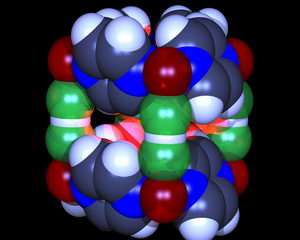
Researchers at the U.S. Department of Energy's Argonne National Laboratory have pioneered a new approach for making magnetic polymers that are held together with very strong hydrogen bonds. These polymers contain an innovative bifluoride, HF2–, building block that allows a magnetically ordered state to be obtained. The development may help lead to new techniques for faster and more versatile computer chips, among other applications.
The research is reported in the December 21 issue of Chemical Communications and is featured on the cover of the journal.
The research examines the role of hydrogen bonds in designing the structure of molecular materials. “Nature uses hydrogen bonds to do all kinds of things, including holding the DNA double helix together, and is important in a wide range of biological processes,” said John Schlueter, Argonne chemist and an author of the research paper. “When making molecular materials, strong bonds are needed to fabricate the molecular building blocks. Weaker bonds, including hydrogen bonds, act as the glue to hold the blocks together.” It's this phenomenon that allowed the creation of the first fully organic superconductor, discovered at Argonne a decade ago.
The magnetic polymer, which forms as beautiful deep blue crystals, is produced when copper ions bind to pyrazine molecules, creating a sheet-like structure. Like a Tinkertoy® building block, the bifluoride ion acts as a bridge to hold the planes together. The product is a three-dimensional coordination polymer, which forms through very mild synthetic conditions.
The exceptionally simple structure is held together by one of the strongest hydrogen bonds known, making this a very thermally stable material. Each copper ion, which sits at the corner of a molecular cube, contains one unpaired electron. These spins are disordered at normal temperatures, a state known as paramagnetism; however, the spins begin to align in opposite directions as the temperature drops, creating a magnetic state called antiferromagnetism.
The researchers studied the magnetic properties of the material by a technique that uses muons as mini-magnetometers. Muons are subatomic particles that are heavier than electrons but have the same charge and magnetic spin. The researchers hope that the magnetic studies will help them understand to what extent bifluoride units and their hydrogen bonds influence the spin arrangement on neighboring magnetic centers.
This work has demonstrated for the first time that this innovative molecular building block can be rationally incorporated into molecular frameworks under mild synthetic conditions and that magnetic superexchange can indeed be mediated through hydrogen bonding. The ingenious synthesis of the novel 3-D coordination polymers opens up a route to a range of new solid state coordination compounds that will provide a way to study the how the unique properties of hydrogen bonds can be used to modify the spin arrangement of neighboring magnetic centers. One next step, Schlueter said, is to change the spacing between the layers of the compound to see what impact that has on the nature of the bond and how that affects the magnetic properties of the material.
In the past, this group has pioneered a new process for the synthesis of molecular superconductors, discovering the most highly tunable family known and the first completely organic superconductor. They have shown that hydrogen bonding is important for superconductivity in these materials because it intimately links the conducting sheets to the anionic layers. Schlueter is now interested in making hybrid materials by inserting magnetic layers between the conducing sheets to form a simple spintronic device. To accomplish this, it is critical to understand how the conducting and magnetic layers communicate through hydrogen bonds.
Spintronics, also known as spin electronics, is an emerging technology that looks to develop devices that exploit the quirky world of quantum physics, or physics at the incredibly small atomic level, particularly the up-or-down spin property of electrons. While conventional electronics use the charge of the electron, spintronic devices would use both the spin and charge, achieving vastly superior performance. Scientists across the globe are racing to develop the spintronics field. It could revolutionize the computing industry with chips that are more versatile and exponentially more powerful than today's most cutting-edge technology.
Schlueter did the research in collaboration with a former Argonne postdoctoral researcher, Jamie Manson, who is now at Eastern Washington University, and with colleagues at Oxford University, the High Field Magnet Laboratory in Dresden, Germany, and North Carolina State University.
Source: Argonne National Laboratory


