Shadows of Venus
The planet Venus is growing so bright, it's actually casting shadows.
It's often said (by astronomers) that Venus is bright enough to cast shadows. So where are they? Few people have ever seen a Venus shadow. But they're there, elusive and delicate--and, if you appreciate rare things, a thrill to witness. Attention, thrill-seekers: Venus is reaching its peak brightness for 2005 and casting its very best shadows right now.
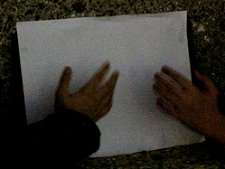
Image: Richard and Douglas Lawrence make hand shadows using the light of Venus. Photo details: 60 sec, ISO 1600.
Amateur astronomer Pete Lawrence of Selsey, UK, photographed the elusive shadow of Venus just two weeks ago. It was a quest that began in the 1960s:
"When I was a young boy," recalls Lawrence, "I read a book written by Sir Patrick Moore in which he mentioned the fact that there were only three bodies in the sky capable of casting a shadow on Earth. The sun and moon are pretty obvious, but it was the third that fascinated me -- Venus."
Forty years passed.
Then, "quite by chance a couple of months ago," he continues, "I found myself in Sir Patrick's home. The conversation turned to things that had never been photographed. He told me that there were few, if any, decent photographs of a shadow caused by the light from Venus. So the challenge was set."
On Nov. 18, Lawrence took his own young boys, Richard (age 14) and Douglas (age 12), to a beach near their home. "There was no ambient lighting, no moon, no manmade lights, only Venus and the stars. It was the perfect venue to make my attempt." On that night, and again two nights later, they photographed shadows of their camera's tripod, shadows of patterns cut from cardboard, and shadows of the boy's hands--all by the light of Venus.
The shadows were very delicate, "the slightest movement destroyed their distinct sharpness. It is difficult," he adds, "for a cold human being to stand still long enough for the amount of time needed to catch the faint Venusian shadow."
Difficult, yes, but worth the effort, he says. After all, how many people have seen themselves silhouetted by the light of another planet?
If you'd like to try, this is the week. Your attempt must come before Dec. 3. After that, the crescent moon will join Venus in the evening sky, and any shadows you see then will be moon shadows.
Instructions: Find a dark site (very dark) with clear skies and no manmade lights. Be there at sunset. You'll see Venus glaring in the southern sky. When the sky fades to black, turn your back on Venus (otherwise it will spoil your night vision). Hold your hand in front of a white screen--e.g., a piece of paper, a portable white board, a white T-shirt stretched over a rock--and let the shadow materialize.
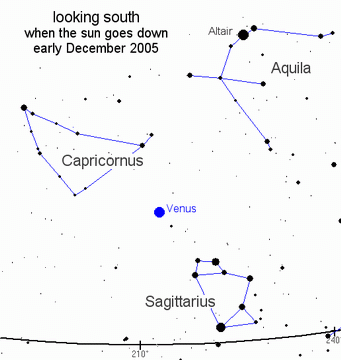
Can't see it? Venus shadows are elusive. "Young eyes help," notes Lawrence, whose teenage sons saw the shadows more easily than he did.
Shadows or not, before you go home, be sure to look at Venus directly through binoculars or a small telescope. Like the moon, Venus has phases, and this week it is a lovely crescent. Aside: If Venus is at peak brightness, shouldn't it be full? No. Venus is full when it is on the opposite side of the sun, fully illuminated yet far from Earth. Venus is much brighter now, as a crescent, because Earth and Venus are on the same side of the sun. Venus is nearby, big and bright.
Look at Venus or look away from it. Either way, it's a great view.
Source: Science@NASA (by Dr. Tony Phillips)


